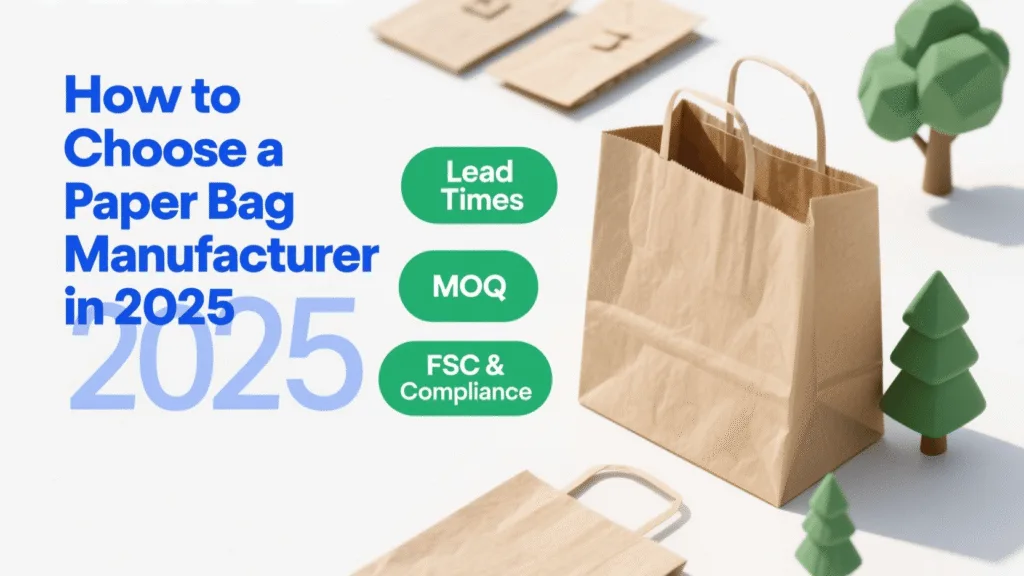
How to Choose the Right Paper Bag Manufacturer: 4 Key Factors to Evaluate
Struggling to find a reliable paper bag manufacturer? You’re juggling confusing quotes, uncertain timelines, and complex certifications, risking your product launch and brand reputation with every decision.
Finding the right paper bag manufacturer involves evaluating four key areas: production lead times, Minimum Order Quantity (MOQ), sustainability and social compliance certifications, and global compliance. A great partner will be transparent about their timelines, offer flexible MOQs, provide verifiable certifications, and ensure your packaging meets international standards.
Choosing a manufacturer feels like a high-stakes decision because it is. One wrong move can lead to delayed shipments, wasted inventory, unethical sourcing, or even legal trouble. Over my ten years in the packaging industry, from the factory floor to leading Yiwu Omet Packaging, I’ve seen firsthand how these four pillars can make or break a brand’s success. This isn’t just about getting a bag; it’s about building a supply chain you can trust. Let’s break down exactly what you need to look for.
How Do You Evaluate a Manufacturer’s Production Lead Times?
Worried your packaging won’t arrive in time for a critical product launch? Miscalculating lead times can create stressful delays, missed retail deadlines, and lost sales opportunities for your business.
To evaluate lead times, request a detailed production schedule that breaks down each stage: design approval, material sourcing, printing, finishing, quality control, and shipping. A reliable manufacturer will provide clear timelines and proactively communicate potential delays, offering solutions to keep your project on track.
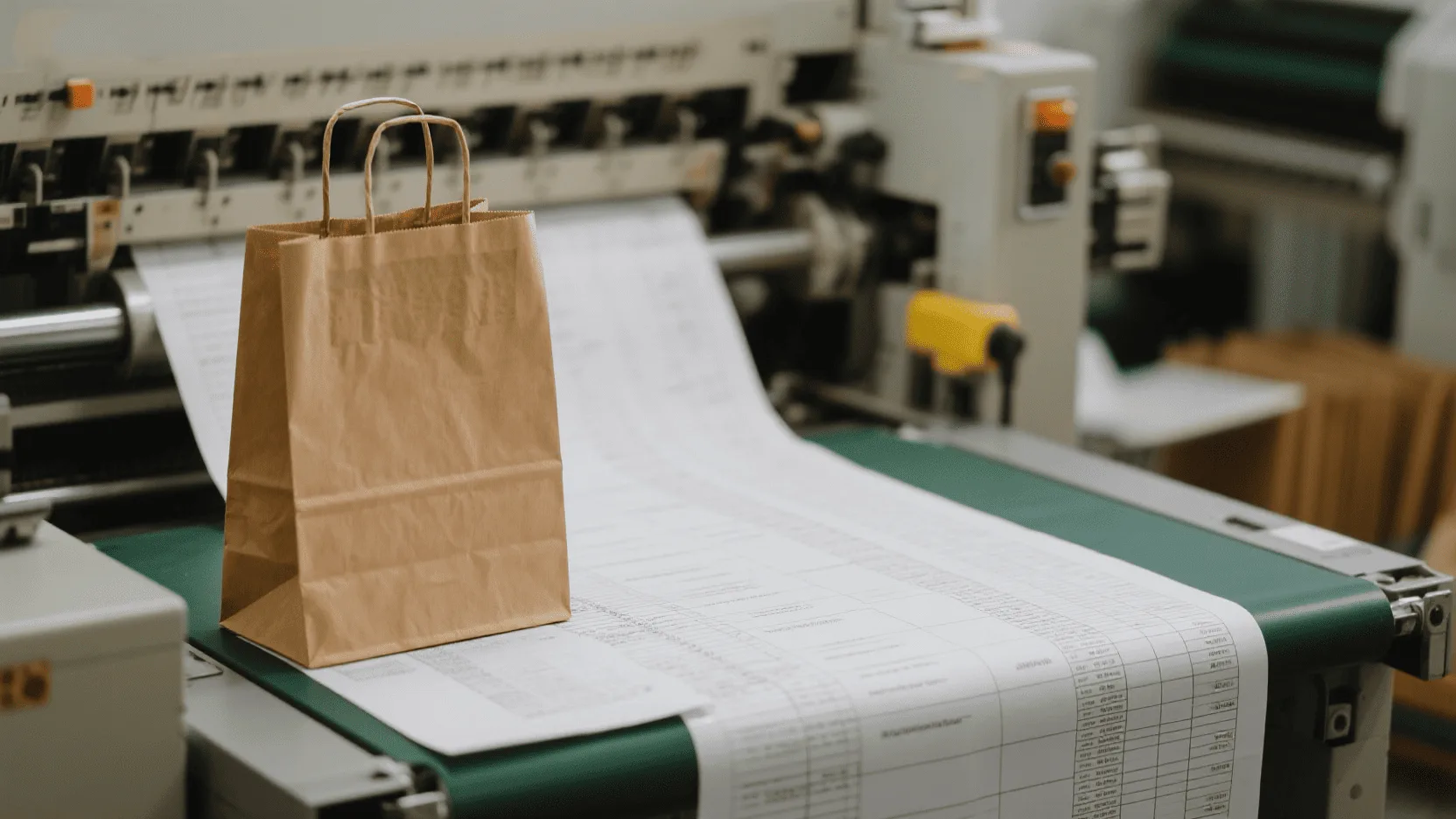
A few years ago, a new client came to us in a panic. They were launching a new cosmetic line, and their previous supplier had promised a four-week turnaround for their custom paper bags. Six weeks later, the bags hadn’t even entered production. The supplier blamed material shortages, but the real issue was a lack of transparency. This experience taught me the value of a detailed, honest production timeline. It’s not just about the final delivery date; it’s about understanding the entire process.
At Omet Packaging, we map out every step for our clients. This includes pre-production sampling, which can take 7-10 days, and mass production, which typically ranges from 15-30 days depending on complexity. We also factor in shipping, which can vary widely. By being upfront about each phase, we build trust and eliminate those last-minute surprises that can derail a launch. A good partner doesn’t just give you a date; they give you a roadmap.
Understanding the Components of a Lead Time
A complete lead time is more than just manufacturing. It’s a multi-stage process where each part has its own timeline. Ask potential manufacturers to break down their quotes with estimated times for each of these stages:
- Design & Prototyping1: This initial phase involves finalizing your artwork and creating a physical sample for approval. It’s your chance to check colors, materials, and construction.
- Material Sourcing2: The manufacturer needs to procure the right paper, inks, and handles. The availability of specialized materials can impact this stage.
- Mass Production: This is the core manufacturing phase, including printing, die-cutting, gluing, and assembly. Complex finishes like hot stamping or embossing add time.
- Quality Control3: A dedicated team inspects the finished products to ensure they meet your specifications. This is a critical step that shouldn’t be rushed.
- Logistics & Shipping4: This includes packing the order, handling customs documentation, and the actual transit time, whether by sea or air.
Here’s a look at how different factors can influence your overall timeline:
| Factor | Standard Timeline Impact | High-Complexity Impact (e.g., custom die-cut, multiple finishes) |
|---|---|---|
| Prototyping | 5-7 business days | 10-15 business days |
| Mass Production | 15-20 business days | 25-35 business days |
| Sea Freight | 30-40 days | 30-40 days |
| Air Freight | 7-10 days | 7-10 days |
| Total (Sea) | ~50-67 days | ~65-90 days |
| Total (Air) | ~27-37 days | ~42-60 days |
What Is a Reasonable MOQ for Custom Paper Bags?
Feel stuck between ordering too few bags at a high price or too many that will gather dust? Finding a manufacturer whose Minimum Order Quantity (MOQ) fits your budget and inventory needs is a common challenge.
A reasonable MOQ for custom paper bags typically starts at 1,000 units, but this can vary based on bag complexity, materials, and the manufacturer’s scale. The key is finding a partner whose MOQ aligns with your sales forecasts and allows for cost-effective production without excessive overstock.
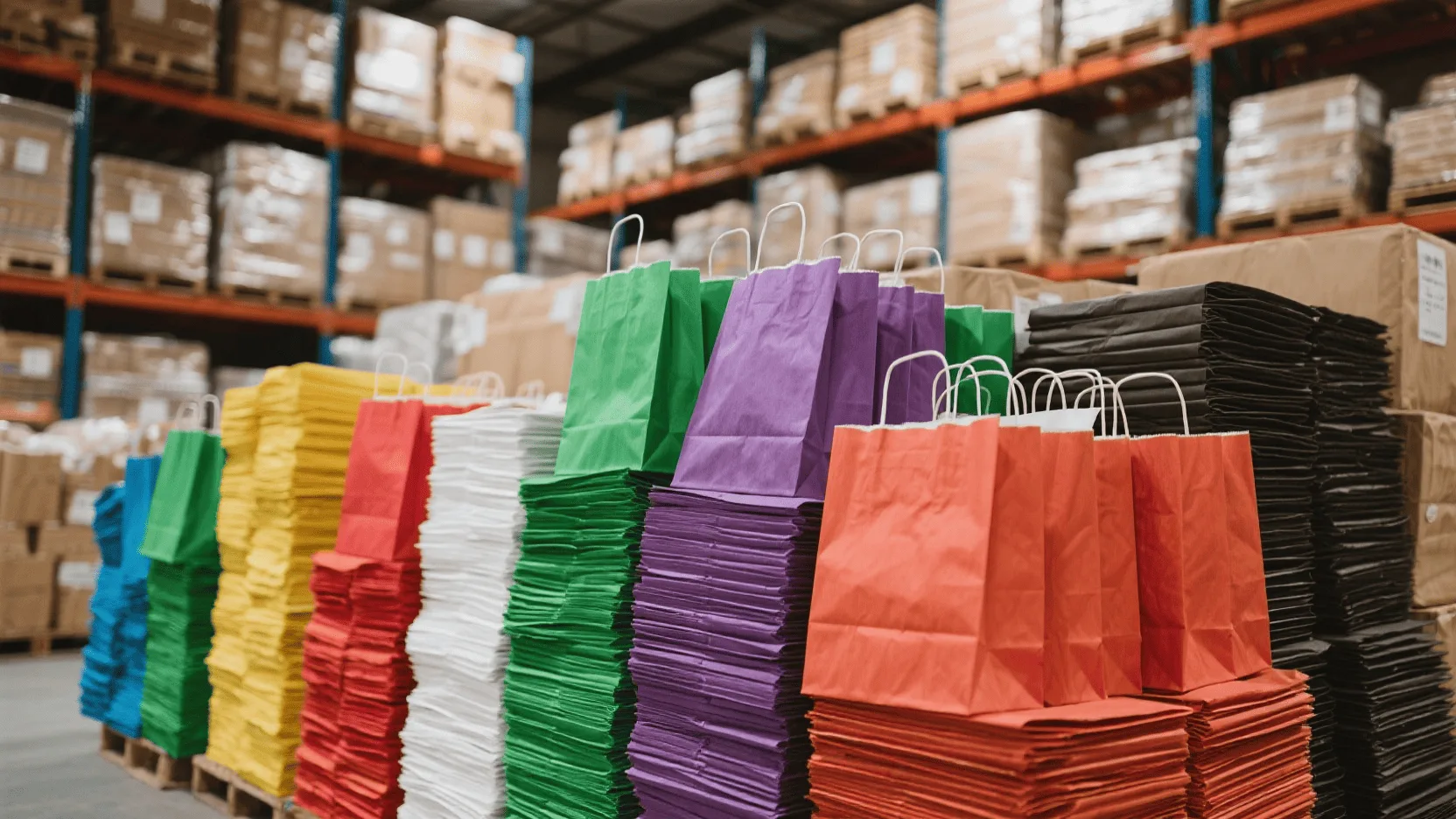
I remember working with a small e-commerce startup that sold handmade jewelry. They needed beautiful, branded jewelry packaging but couldn’t commit to the 5,000-unit MOQ their previous supplier demanded. It would have tied up too much of their capital. We worked with them to find a solution, starting with a 1,000-piece run using a slightly more standardized (but still premium) material that we already had in stock. This allowed them to get professional packaging without the crippling upfront cost.
As their business grew, so did their order sizes. The right MOQ isn’t just a number; it’s a reflection of a manufacturer’s willingness to support businesses at different stages of growth. A supplier who is rigid on this point might not be the right long-term partner for a growing brand.
How to Negotiate a Better MOQ
If a manufacturer’s standard MOQ is too high, don’t walk away immediately. There are often ways to negotiate. The goal is to reduce the setup costs and risks for the manufacturer, making a smaller run more feasible for them. Here are some strategies that have worked for my clients:
- Simplify the Design1: Reduce the number of colors in your print or choose a standard bag size. Complex setups are expensive, so simplification can lower the production cost floor.
- Use Stock Materials: Ask if the manufacturer has high-quality stock paper or handles they can use. This eliminates their need to place a special order for raw materials, which often comes with its own MOQ.
- Offer a Deposit: Committing to a larger portion of the payment upfront can show you’re a serious partner and reduce the financial risk for the supplier.
- Stagger the Order: Propose a blanket order. For example, commit to purchasing 5,000 bags over six months but ask to receive them in shipments of 1,000. This gives the manufacturer a larger total order while helping your cash flow and storage.
Understanding the balance between cost and quantity is crucial. While a higher quantity almost always yields a lower per-unit price, it’s a false economy if half the bags end up unused.
Why Are Sustainability and Social Compliance Certifications Important?
Are you concerned that your packaging choices might be harming the environment or that your supplier’s sustainability claims cannot be verified? In a market filled with vague terms like "eco-friendly" and "green," simply trusting a manufacturer’s claims can expose your brand to greenwashing risks, reputational damage, and supply chain problems.
Look for verifiable certifications and documentation, especially FSC® for responsible forestry, recycled-content documentation for paper containing recycled material, and social compliance audits such as BSCI. A strong manufacturer should be able to show current certificates or audit reports rather than relying on unsupported sustainability claims.
When I founded Yiwu Omet Packaging, one of my first major goals was to achieve FSC certification. It wasn’t just a business decision; it was a personal one. I’ve seen the industry from the ground up, and I know the impact it can have. For me, it was essential to build a company that not only delivered quality but also upheld its responsibility to the planet.
Today, when we show our FSC certificate to clients, it’s more than a piece of paper. It’s a promise that their gift packaging or shipping boxes can be sourced through a verified responsible-forestry supply chain. More importantly, responsible sourcing requires more than simply displaying an FSC logo. You need to verify that the manufacturer itself is certified and that its certification is valid.
What Exactly Is FSC Certification and Why Should You Demand It?
FSC (Forest Stewardship Council) certification verifies that forest-based materials come through a supply chain meeting FSC’s responsible forestry requirements. For packaging manufacturers, FSC Chain of Custody (CoC) certification is particularly important because it tracks certified material through the supply chain.
The Chain of Custody system means that companies handling FSC-certified materials—from the forest and paper mill to distributors and packaging manufacturers—must maintain the required controls to support an FSC claim. This is why you should never rely solely on a supplier saying, "We use FSC paper."
When evaluating a manufacturer, ask for its FSC Chain of Custody certification code and verify it through the FSC Public Search database. This simple check can help distinguish a genuinely certified supplier from one making unsupported claims.
There are three main FSC labels you may encounter on paper packaging:
| FSC Label Type | Meaning | Best For |
|---|---|---|
| FSC 100% | All materials used are from FSC-certified forests. | Brands wanting the highest level of assurance. |
| FSC Mix | A mixture of material from FSC-certified forests, recycled material, and/or FSC controlled wood. | A balance of sustainability and availability; common in packaging. |
| FSC Recycled | All materials are from recycled content. | Brands prioritizing circularity and reducing virgin material use. |
How Can You Verify a Manufacturer’s Claims About Recycled Content?
A supplier may tell you their paper bags are "made with recycled content," but that statement alone doesn’t tell you whether the paper contains 10%, 40%, or 100% recycled material.
For recycled paper, ask for official documentation from the paper mill specifying the recycled-content percentage, particularly the percentage of Post-Consumer Waste (PCW).
This distinction matters because "recycled" can refer to different types of recovered material:
- Pre-consumer waste: Scrap or unused material recovered during manufacturing, such as paper trimmings.
- Post-consumer waste (PCW): Paper that has already been used by consumers, collected through a recycling system, and reprocessed into new paper.
PCW is especially relevant for brands trying to support a more circular economy. If a manufacturer cannot provide a clear percentage or supporting documentation, treat vague recycled-content claims cautiously.
There are also practical trade-offs. Higher PCW content can sometimes affect brightness, smoothness, print appearance, or tensile strength. For a premium cosmetic packaging project, a lower PCW percentage may provide a more refined appearance, while a grocery or retail bag may be better suited to a higher recycled-content specification. A knowledgeable manufacturer should help you balance sustainability goals with the performance and appearance your packaging requires.
Beyond Environmental Proof, What Other Certifications Ensure a Reliable Supplier?
Sustainability is only one part of responsible sourcing. An environmentally responsible bag is still a poor choice if it is produced under unacceptable labor conditions or without a consistent quality management system.
Look for social compliance and quality management credentials such as BSCI, ISO 9001, and SMETA. These provide additional evidence that a manufacturer takes ethical labor practices, workplace safety, quality control, and supply chain transparency seriously.
When our company, Yiwu Omet Packaging, went through the BSCI audit, it required detailed inspection of our operation, including employment practices, working hours, health and safety, and other workplace conditions. For buyers, this type of independent assessment provides additional confidence that the supplier is operating responsibly.
When vetting a new supplier, don’t just ask whether they have a certification. Ask to see the latest certificate or audit report and verify that it applies to the actual manufacturing facility you are considering.
Here are the key certifications and assessments to look for:
| Certification | What It Proves | Why It Matters to You |
|---|---|---|
| FSC CoC | Tracks FSC-certified material through the supply chain. | Helps verify responsible paper sourcing and supports legitimate FSC claims. |
| BSCI | Assesses social compliance, including labor practices and working conditions. | Helps protect your brand from association with unethical labor practices. |
| ISO 9001 | Establishes a formal quality management system. | Reduces the risk of inconsistent quality, defects, and production errors. |
| Sedex/SMETA | Assesses labor standards, health and safety, environmental practices, and business ethics. | Provides additional visibility into a supplier’s ethical performance. |
How Can You Ensure Your Packaging Meets Global Compliance Standards?
Are you worried a simple packaging oversight could get your products stuck at customs? Navigating the maze of international regulations is complex, and non-compliance can lead to fines, delays, and a damaged reputation.
To ensure compliance, partner with a manufacturer experienced in global exports who can provide documentation for standards such as REACH, RoHS, food-contact requirements, and California Proposition 65 where applicable. They should understand the requirements of your target markets and conduct the necessary testing to help ensure your packaging is safe and compliant.
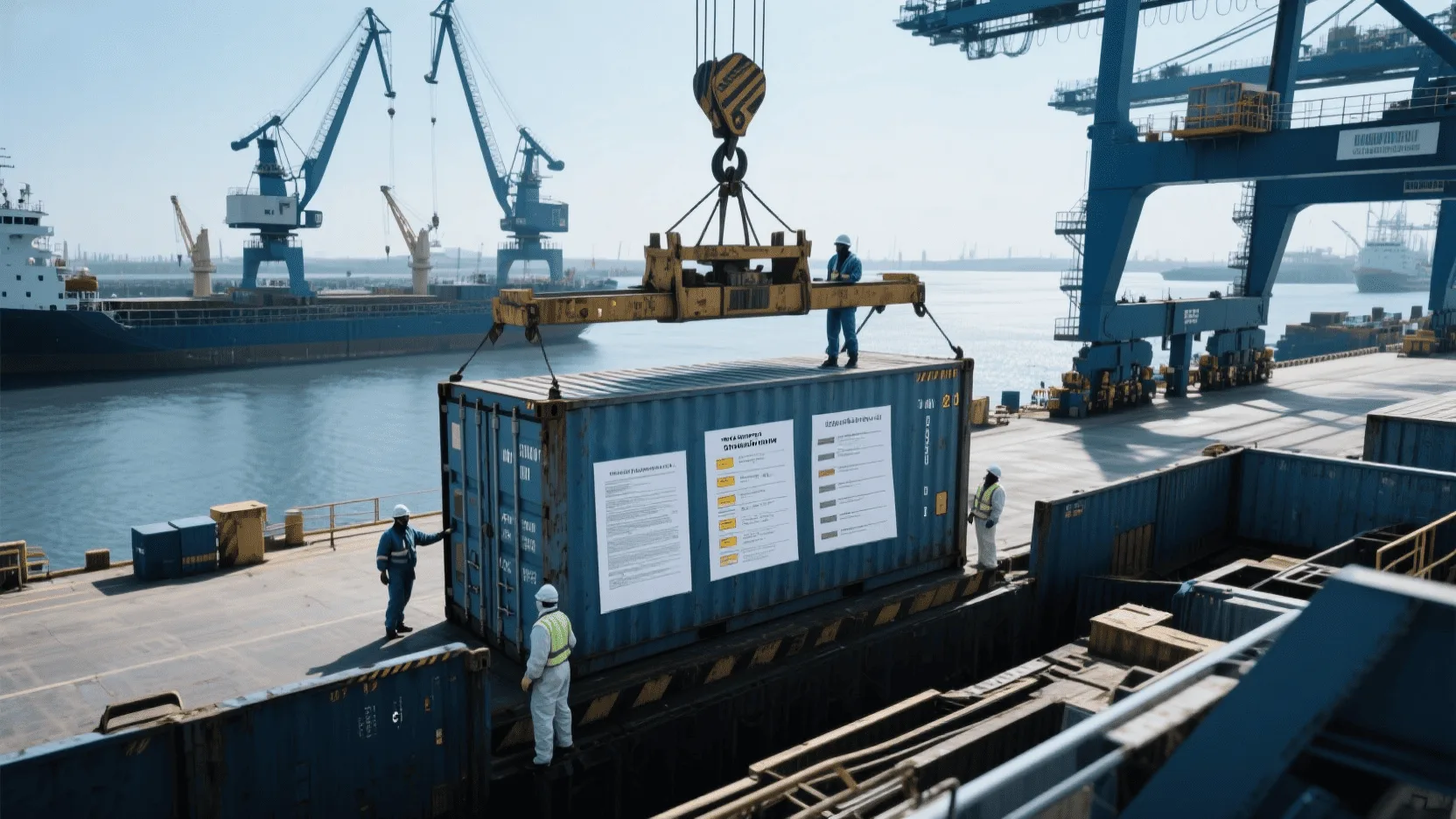
I’ll never forget an incident early in my career where a large shipment of food packaging for a European client was held up for weeks. The issue wasn’t the food product itself, but the ink used on the paper boxes. It contained a chemical restricted under the EU’s REACH regulation. It was a costly lesson in the importance of deep compliance knowledge.
The manufacturer had simply used their standard ink, unaware of the specific rules for that market. This is why at Omet Packaging, our process includes a compliance review for every export order. We ask clients where their products will be sold and check the relevant regulations. Whether it’s ensuring our cosmetic packaging meets applicable chemical restrictions or using food-safe adhesives for a bakery in Australia, we manage the details so our clients don’t have to.
A good manufacturing partner isn’t just a producer; they are your compliance partner in a complex global market.
Key Compliance Standards to Discuss with Your Manufacturer
The exact requirements depend on your product, materials, and destination market. Your manufacturer should be able to explain which standards apply to your project and provide relevant test reports or declarations of compliance.
| Standard | Region | What It Regulates | Why It Matters for Paper Bags |
|---|---|---|---|
| REACH1 | European Union | Registration, Evaluation, Authorisation and Restriction of Chemicals. It covers substances of very high concern (SVHCs). | Helps ensure inks, glues, coatings, and other materials used on your bags comply with applicable EU chemical restrictions. |
| RoHS2 | European Union | Restriction of Hazardous Substances, primarily for electrical and electronic equipment. | Relevant when packaging is associated with electrical products or includes applicable electronic components. |
| FDA3 | United States | Regulations governing applicable food-contact materials. | Critical for packaging intended for direct food contact, where paper, inks, adhesives, and coatings must meet applicable requirements. |
| Prop 654 | California, USA | Warning requirements for significant exposures to listed chemicals. | Important for products sold in California where packaging materials may fall within applicable Proposition 65 requirements. |
Before you sign a contract, ask for the manufacturer’s compliance track record. Request redacted examples of documentation for shipments to your target countries. An experienced, transparent manufacturer will have this information readily available and will see your questions as a sign of a diligent and professional buyer.
Conclusion
Choosing the right paper bag manufacturer is a strategic decision that impacts your brand’s finances, reputation, sustainability, and operational efficiency. By carefully evaluating lead times, MOQ, verifiable sustainability and social compliance certifications, recycled-content claims, and global compliance, you can build a resilient and reliable supply chain that supports your growth for years to come.
Don’t settle for vague promises. Ask for documentation, verify certifications, request samples, and evaluate the manufacturer’s ability to communicate clearly throughout the production process.
Ready to find a packaging partner who checks all the boxes? Contact us at Yiwu Omet Packaging to discuss your project.
Explore our blog for more insights on elevating your brand with premium packaging solutions.
FAQ
1. What is the biggest mistake brands make when choosing a paper bag manufacturer?
The most common mistake is focusing solely on the lowest per-unit price. This often leads to overlooking critical factors like material quality, sustainability claims, compliance failures, communication issues, and unreliable lead times, which can cost far more in the long run through delays, rejected products, and damage to brand reputation.
2. What certifications should I look for in a paper bag manufacturer?
At a minimum, look for relevant certifications and documentation such as FSC Chain of Custody (CoC) for responsible paper sourcing and BSCI or SMETA for social compliance. ISO 9001 can provide additional assurance of a structured quality management system. If the paper contains recycled material, also ask for documentation specifying the recycled-content and PCW percentage.
3. How can I verify that a manufacturer really uses FSC-certified paper?
Ask the manufacturer for its FSC Chain of Custody certification code and verify it through the FSC Public Search database. Don’t rely solely on an FSC logo or a supplier’s verbal claim.
4. How can I verify recycled content in paper bags?
Ask for an official paper mill specification or certificate showing the recycled-content percentage and, when relevant to your sustainability requirements, the percentage of Post-Consumer Waste (PCW). This gives you a more reliable basis for evaluating recycled-content claims.
5. Is FSC-certified paper more expensive?
FSC-certified paper can sometimes carry a premium depending on the paper type, availability, and market conditions. However, the actual difference varies by project, so it’s better to request a quotation for both certified and non-certified material rather than assuming a fixed percentage.
6. What is a reasonable MOQ for custom paper bags?
A reasonable MOQ for custom paper bags typically starts at around 1,000 units, but this varies according to bag size, materials, printing, finishing, and the manufacturer’s production capabilities. If the standard MOQ is too high, you can ask about stock materials, simplified designs, staggered deliveries, or a larger blanket order with multiple shipments.
7. Does using recycled paper affect the print quality of my bags?
Paper with a high percentage of Post-Consumer Waste (PCW) can be less bright and may have more visible fibers, which can slightly affect print appearance. Modern recycled papers can still provide excellent print quality, but for very bright or highly detailed designs, a lower PCW content or suitable coated recycled paper may be preferable. Always request a sample before mass production.
8. Can I get a physical sample before placing a full order?
Yes, and you absolutely should. A reputable manufacturer will provide a pre-production sample or prototype for approval. This allows you to verify colors, dimensions, material feel, handle construction, printing, and overall quality before committing to thousands of units. This step is crucial for avoiding costly mistakes.
-
Understanding REACH is crucial for ensuring your packaging complies with applicable chemical restrictions and protects consumers and the environment. ↩ ↩ ↩
-
RoHS is primarily an electrical and electronic equipment regulation, but may be relevant to packaging associated with products containing applicable electronic components. ↩ ↩
-
Familiarizing yourself with applicable FDA food-contact requirements is essential when packaging is intended for direct food contact. ↩ ↩
-
Understanding Proposition 65 helps businesses evaluate applicable chemical warning requirements for products sold in California. ↩ ↩