
Fresh flowers travel at 0–2°C and 90%+ humidity. Ordinary gift wrap tears within minutes. Learn how to pick paper that survives.
Choose fresh flower wrapping by moisture exposure, not by looks. Specify wet-strength virgin kraft or aqueous-coated paper, match GSM to each layer, seal prints against ink bleed, verify EU and US rules, and lock holiday production dates 90–120 days ahead.
Key Takeaways / TL;DR
- Specify wet-strength virgin kraft or PFAS-free aqueous-coated paper for 90%–95% humidity conditions: untreated paper retains under 10% of its dry strength when wet, and wet-strength paper holds 15–30%.
- Match GSM to layer function — 17–28 gsm wet-strength tissue for petals, 45–60 gsm for standard sleeves, 70–100 gsm kraft for heavy hand-tied bouquets, plus pre-creased die-cut cones above 100 gsm.
- Seal custom prints with water-resistant flexo or offset inks plus an inline aqueous overprint varnish, then require a ten-stroke wet-cloth rub test on the cured print before bulk approval.
- For EU sales, qualify the SKU under PPWR 2030 recyclability rules and check EUDR scope with customs or compliance advisers; for US sales, confirm FDA food-contact review only for edible bouquets.
- Verify valid FSC Chain of Custody and BSCI credentials for the exact factory and SKU, then freeze artwork, paper grade, and size 90–120 days before peak floral holidays.
Last February, three wholesale buyers walked into our Yiwu office — Ometpack, founded in 2013 — wanting the same thing: matte luxury printing at the price of plastic film. None asked what happens to paper inside a cold room. By the third morning of misting tests, all three samples had collapsed within twenty minutes, and the dark logo had smudged onto white petals. That afternoon, I told our team how to write this guide.
Why Does Regular Gift Wrapping Paper Fail on Fresh Cut Flowers?
Gift paper fails in humidity.
Fresh cut flowers travel at 0°C–2°C with 90%–95% humidity. Dry gift wrap absorbs that moisture, loses over 90% of its strength, and tears within minutes. Choose wet-strength sizing and test finished samples under real misting conditions.
What happens when dry paper meets a cold room
Dry wrapping paper is cellulose: a web of long fibers held together by hydrogen bonds. That web is strong in dry air and weak the moment water arrives. Stem water wicks through folds by capillary action, cooler condensation drips onto the sheet, and short recycled fibers separate even faster. The visible result — tears, wrinkles, and ink smearing onto petals and hands — matches the lab numbers. Under ISO 3781, untreated paper retains less than 10% of its dry tensile strength after immersion in water, while properly wet-strength paper holds 15–30%.
Commercial floral coolers run at 0°C–2°C and 90%–95% relative humidity, per the USDA Agricultural Handbook No. 66. Standard gift wrap does not survive that environment, and neither does clay-coated art paper. Specify wet-strength sizing in the purchase order and require a finished-sample test before bulk approval.
| Sample | Dry strength | After 30-minute immersion | Misting behaviour |
|---|---|---|---|
| Standard coated gift wrap | High | ~5–10% retained | Tears and wrinkles; ink rubs onto petals |
| Short-fiber recycled tissue | Low to begin | Below 5% retained | Folds lift, water leaks through |
| Wet-strength virgin kraft | Medium | 15–30% retained | Holds folds, resists wet rubbing |
| Aqueous-coated kraft + OPV | High | 70%+ retained | Minimal transfer, stays foldable |
[CEO Insight]: Every February, new floral importers bring us standard 80 gsm coated gift wrap and ask whether we can quote it for wet bouquets. In our lab cooler simulation, that wrap collapses within twenty minutes of misting. We never quote it for florists. We quote wet-strength virgin kraft and run the buyer’s artwork through it first.
Which Paper Types Work Best for Fresh Flowers: Kraft, Tissue, Coated, or Wet-Strength?
Kraft, tissue, coating, wet?
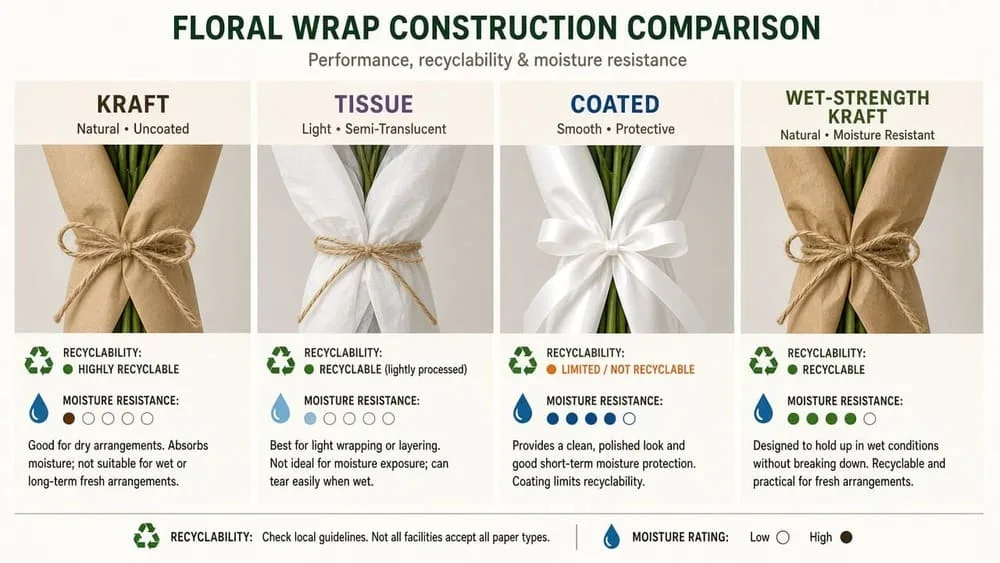
No single paper fits every bouquet. Virgin kraft adds structure; tissue cushions petals; coated paper improves print and adds a barrier; wet-strength paper tolerates damp handling. Confirm the exact construction, because coatings change both performance and recycling rules.
Four constructions, four different realities
Virgin kraft gives a natural brown look and real body. Tissue is light and soft, best as an inner cushion around hydrangeas and peonies. Coating improves print clarity and adds a modest water barrier. Wet-strength sizing keeps the sheet intact on damp stems. One warning stands above all: treatments change disposal. In 2024, paper and cardboard packaging recycled at 83.2% in the EU, against 40.7% for plastic packaging (Eurostat, 2024). That gap is why recyclable paper construction deserves design time instead of hope.
| Construction | Moisture mechanism | EU curbside recyclability | Print quality | Best use |
|---|---|---|---|---|
| Virgin kraft | Long fiber network | Yes | Good, matte | Supermarket sleeves, structural wraps |
| Aqueous-coated kraft | Water-based dispersion | Yes, repulpable | Excellent, vibrant | Branded luxury wraps |
| Dry-waxed tissue | Paraffin or vegetable wax | Usually no | Soft, natural | Inner cushion around wet stems |
| "Korean waterproof" film | BOPP plastic sheet | No | Good gloss | Dry retail display only |
For gift-ready presentation at retail, see our custom gift wrapping solutions and the broader Wrapping Paper Hub.
[CEO Insight]: Most wholesale products sold as Korean waterproof floral paper are BOPP plastic films, not cellulose. European supermarket tenders now check recyclability, and plastic film triggers plastic EPR fees. At Ometpack, side-by-side trials on FSC-certified wet-strength kraft and aqueous-varnished kraft deliver a luxury matte finish on a recyclable base.
What GSM Paper Weight Should Buyers Specify for Different Floral Bouquets?
Light inside, strong outside.
Paper weight should follow the layer, not a single number. Use 17–28 gsm wet-strength tissue as a petal cushion, 45–60 gsm for everyday retail sleeves, and 70–100 gsm virgin kraft for heavy hand-tied bouquets. Above 120 gsm, pre-crease or add structure; stiff stock snaps at the tie-point around wet stems.
Match GSM to the layer, not the bouquet
Many buyers pick one sheet weight and apply it everywhere. Bouquets are layered products: a cushion around the petals, a sleeve at the neck, and a structural collar that stands the bouquet upright in a water bucket. Each layer has a different job, so each layer needs a different GSM.
| Bouquet type | Layer function | Recommended construction | GSM range | Typical format |
|---|---|---|---|---|
| Delicate roses, peonies, hydrangeas | Inner petal cushion | Wet-strength tissue | 17–28 gsm | Pre-cut 50×70 cm sheet |
| Standard supermarket bouquets | Neck sleeve, clean fold | Machine-glazed or kraft | 45–60 gsm | Pre-cut 58×58 cm sheet |
| Long-stem hand-tied bouquets | Stand-up collar | Virgin long-fiber kraft | 70–100 gsm | Flat sheet or die-cut cone |
| Architectural luxury stems | Outer structural shell | Virgin kraft | 105–120 gsm max | Pre-creased die-cut cone |
Thirty minutes of testing at Ometpack settled a common mistake: a 120 gsm kraft sheet often tears at the tie-point, because stiff short fibers snap when twisted around wet stems. For heavy bouquets, we trial 60–80 gsm long-fiber virgin kraft wrapped on real wet stems, then quote the grade that survives. Buyers pay for fiber toughness, not paper weight.
Should Floral Businesses Order Pre-Cut Sheets, Counter Rolls, or Pre-Formed Sleeves?
Sheets, rolls, or sleeves?
Format follows volume. Pre-formed conical sleeves speed central packing lines and suit supermarket chains; pre-cut flat sheets control waste, sizing errors, and pallet loading; counter rolls suit studio florists with fixed dispensers. Match format to daily bouquet volume, labor time, and container density.
Match format to volume and labor
Three formats serve three different operations. Pre-formed conical sleeves are die-cut and side-glued, with an open bottom for water buckets. They turn bouquet packing into a drop-in motion and are the standard answer on supermarket assembly lines. Pre-cut flat sheets eliminate manual cutting errors, keep consumption per bouquet consistent, and pack flat for export — the default for multi-store retail chains. Counter rolls serve wholesale florist supply: the buyer orders a core diameter (typically 38–76 mm) and roll weight, and florist wall dispensers do the rest.
Cost hides in the format. Waste depends on how cleanly your sheet width aligns with the factory’s jumbo-roll width. Freight depends on pallet density — how much air space the format leaves inside a 40HQ container.
| Format | Best for | Labor impact | Watch for |
|---|---|---|---|
| Pre-formed conical sleeves | High-volume supermarket lines | Fastest drop-in packing | Die-set cost; glue bond after water contact |
| Pre-cut flat sheets | Multi-store retail chains | No cutting errors | Trim waste; standard 50×70 or 58×58 cm |
| Counter rolls | Wholesale florist supply | Flexible cut length | Core 38–76 mm; dispenser compatibility |
[CEO Insight]: When we load European containers at Ometpack, switching high-volume seasonal SKUs from bulky small rolls to flat 58×58 cm sheets or nested die-cut sleeves cuts dead air space inside a 40HQ container. Freight per wrapped bouquet drops with the same paper grade.
How Can Buyers Stop Custom Printed Floral Paper from Bleeding Ink?
Ink bleeds? Print sealed.
Seal the print. Use water-resistant flexographic or offset inks, then apply an inline aqueous overprint varnish. Keep dark Pantone shades off the wet-contact face. Before any bulk order, require a ten-stroke wet-cloth rub test on the cured print.
Seal the print: inks plus overprint varnish
Unsealed print fails predictably. Dark Pantone ink — black, navy, deep burgundy — sits on the sheet surface rather than inside the fiber. Wet petals and rain water dissolve the binder, and pigment transfers onto hands, petals, and coats. The fix is a barrier over the ink, not a different paper.
For continuous patterns at high volume, water-resistant flexographic inks with resin binders give the best value. For fine botanical halftones, sheet-fed offset printing with a clear aqueous overprint varnish delivers sharper detail. The varnish goes on inline, immediately after curing, so every sheet receives the same seal. At Ometpack, our automated printing and coating lines run flexo, offset, and in-line aqueous varnish in one pass.
| Test | Method | Pass criterion |
|---|---|---|
| Wet rub | Ten strokes of water-soaked white cotton cloth under firm pressure | Zero pigment transfer |
| Water dwell | Thirty minutes of standing droplets on the print | No bleeding, softening, or wrinkling |
| Fold integrity | Fold flat, hold under slight tension | No cracks along the fold line |
[CEO Insight]: Dark logo ink bleeding onto a customer’s white coat in the rain ends a premium floral brand. On Ometpack’s automated lines, every custom batch gets a 24-hour curing hold, a lab wet-cloth rub test, and a 30-minute water-droplet dwell check before master cartons close.
What Sustainability and Compliance Rules Apply to Floral Wrapping Paper in the EU and US?
Recyclable claims need proof.
EU buyers need recyclable, deforestation-free construction and valid producer responsibility registration; US buyers need FDA food-contact review only when wrapping edible bouquets, plus honest Prop 65 and FTC claim language. Verify scope with the importer and the exact regulation. No universal GSM threshold exists; test the real SKU.
EU: recyclability by 2030, EUDR by SKU
Recyclable paper wins a shelf, but rules decide the market. In the EU, Regulation (EU) 2025/40 requires all packaging placed on the market to be recyclable with at least a 70% recyclability performance score by 2030, with per-capita waste-reduction targets of 5% by 2030, 10% by 2035, and 15% by 2040 against 2018. Heavy PE or OPP-laminated wraps that fail mill repulping will be phased out; mono-material wet-strength kraft and aqueous-coated kraft qualify.
EUDR, Regulation (EU) 2023/1115, needs care. Its scope is product-code specific, and Annex I carries a packaging-use note for packaging that supports, protects, or carries another product. Standalone paper rolls and sheets imported under CN Chapter 48 are not automatically exempt — importers need pulp geolocation records proving zero deforestation after 31 December 2020. In the US, FDA food-contact rules under 21 CFR Part 176 apply only to edible bouquets. California Proposition 65 is a chemical exposure question, not a blanket certification, and FTC Green Guides require proof behind every recyclability claim.
| Requirement | EU | US | Buyer check |
|---|---|---|---|
| Recyclability by 2030 | ≥70% score; all packaging (Regulation (EU) 2025/40) | Varies by state and MRF | Confirm local acceptance before claiming "curbside recyclable" |
| Deforestation-free | EUDR Regulation (EU) 2023/1115 | Not applicable | Ask for pulp geolocation records for standalone paper imports |
| Food contact | Not applicable | FDA 21 CFR Part 176 — edible bouquets only | Confirm intended use with the importer |
| Chemical claims | PFAS restrictions on barriers | Prop 65 exposure | Request PFAS-free statement and heavy-metal limits |
[CEO Insight]: Many EU wholesalers assume all packaging is EUDR-exempt until customs brokers flag standalone CN 48 paper shipments. Ometpack holds active FSC Chain of Custody, BSCI, and EUDR/EPR traceability documentation — verify scope on the certifications page — so buyers pass supermarket sustainability audits with documents in hand.
How Do MOQ, Cost, and Seasonal Lead Time Work for Custom Floral Paper?
Custom runs cost more.
Unit price depends on paper grade, sheet size, print coverage, coating, tooling, and finishing. Realistic MOQ bands: 3,000–5,000 pre-cut sheets per design for offset; 1–2 metric tons or 10,000–30,000 pieces for flexo rolls and die-cut sleeves. Lock artwork and capacity 90–120 days before Valentine’s Day and Mother’s Day.
Cost drivers and a 120-day calendar
Unit price rises in four predictable places: paper grade, sheet size, ink coverage, coating, tooling, and finishing. A heavy coated sheet with five Pantone colors costs several times a 45 gsm white kraft sheet. Buyers who understand the quote breakdown negotiate in the right places. Treat published MOQ figures as starting points — the real number depends on your factory, artwork complexity, and run length.
For custom floral paper shops, realistic bands are 3,000–5,000 pre-cut sheets per design for sheet-fed offset, and 1–2 metric tons or 10,000–30,000 pieces for flexo rolls and die-cut sleeves. The second rule is calendar discipline. Peak floral demand collides with pre-Chinese-New-Year factory capacity crunches, so schedules are built backward, not forward.
| Milestone | Timing before holiday | Action |
|---|---|---|
| Artwork freeze | 120 days | Final proofs; approved reference sample |
| Paper allocation | 90 days | Reserve wet-strength rolls for peak SKUs |
| Sample approval | 75–60 days | Wet-immersion and ink-rub tests pass |
| Production slot | 45–30 days | Lock machine time and QC window |
| Ocean booking | 60–30 days | Book LCL/FCL before Q4 capacity crunches |
| Arrival check | 50–35 days in transit | Inspect at destination before replenishment |
[CEO Insight]: The most expensive mistake I see is approving Valentine’s Day artwork in late December, leaving air freight as the only option. At Ometpack, we reserve wet-strength base paper in Q3 and print the wrap, waterproof stickers, greeting cards, and carrier bags together in Yiwu — cutting sampling and consolidation time by weeks.
How Should Procurement Teams Vet a Custom Floral Wrapping Paper Manufacturer?
Photo approval is not QC.
Ask for the full construction and a signed reference sample. Check material traceability, automated printing and converting capacity, moisture-test method, written inspection checklist, export packing, and current FSC and BSCI credentials. Agree on pass criteria for tearing, ink transfer, folds, and appearance before any bulk run.
The supplier audit checklist
A photo email is not supplier approval. Quality control has to travel with the order: material specification, sample approval, in-line printing and converting checks, final inspection, export packing, and a defect report before shipment. Walk the buyer through the full loop, then ask the five questions below.
| Audit question | What to ask | Red flag |
|---|---|---|
| Wet performance | Will you run 30-minute cold immersion and wet-rub tests? | No test method offered |
| Construction | Exact paper, coating, ink, and finish? | "Waterproof" without construction details |
| Traceability | FSC license code, pulp origin, BSCI scope? | Generic certificate, no license code |
| Converting | Automated slitting, die-cutting, coating lines? | Hand packing, single press |
| Shipment | Inner poly liners, desiccant, corner protectors? | Unlined cartons for humid sea transit |
[CEO Insight]: Even perfect wet-strength paper arrives warped if packed carelessly for a 35-day humid voyage. Every pallet at Ometpack leaves shrink-wrapped with corner protectors, inner poly moisture liners, and signed QC inspection reports — ready to distribute straight off the container.
Conclusion
The right flower wrap protects the bouquet in the cold chain, keeps the logo clean in rain, and survives the buyer’s sustainability audit. Match grade, GSM, format, and compliance to the route, then approve a finished sample before committing.
Send Ometpack your bouquet dimensions, moisture exposure, artwork, target market, and quantity. We respond with a specification review and a free wet-test sample kit — wrapping paper plus waterproof stickers and care cards. Request samples via our contact form or explore custom printed wrapping paper today. Next in the Tags & Stickers cluster: How to Choose Waterproof Floral Stickers for Fresh Bouquets — read here.
FAQs
What is the best paper for wrapping fresh flowers in cold rooms?
Use wet-strength virgin kraft or aqueous barrier-coated kraft, with 17–28 gsm wet-strength tissue for inner petal layers and 45–60 gsm construction for standard retail sleeves. Specify wet strength in writing, and approve a sample soaked for 30 minutes plus a ten-stroke ink rub test before bulk production.
Is "Korean waterproof paper" actually recyclable paper?
Most products sold under that name are BOPP plastic film, not cellulose. Plastic film cannot enter curbside paper recycling in the EU and can trigger plastic EPR fees. Require the material specification, coating details, and test results before buying any SKU labeled Korean waterproof.
What GSM should fresh flower wrapping paper use?
Match GSM to the layer, not the bouquet. Choose 17–28 gsm wet-strength tissue for delicate petals, 45–60 gsm for everyday retail sleeves, and 70–100 gsm virgin kraft for heavy hand-tied bouquets. Keep sheets at or below 120 gsm unless pre-creased, because stiff stock snaps around wet stems.
How can custom printed floral wrap be kept from bleeding ink?
Use water-resistant flexographic or offset inks and seal them with an inline aqueous overprint varnish. Keep dark Pantone shades off the wet-contact face, cure fully, and require a ten-stroke wet cotton-cloth rub test on the finished print before approving bulk production.
Which compliance documents should a floral wrap supplier provide?
Ask for the SKU construction, the FSC Chain of Custody license code, BSCI scope, and pulp geolocation records for EU imports. Request FDA food-contact review only for edible bouquets. Verify every certificate on the official registry before printing any environmental claim.
Note: Please ensure FAQPage Schema markup is applied to the FAQs section above. If the article contains step-by-step instructions, consider adding HowTo Schema.