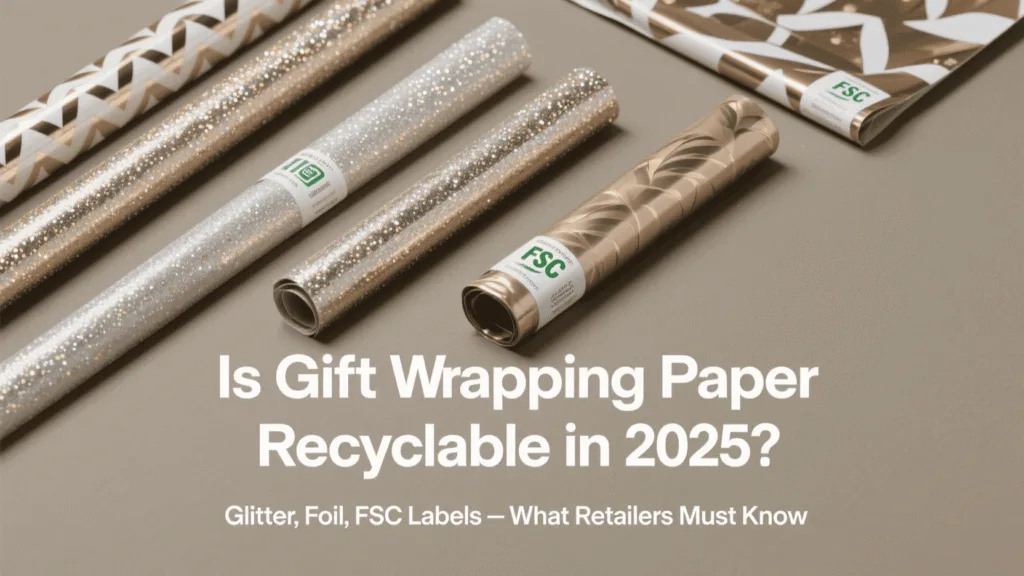
Is Gift Wrapping Paper Recyclable? A Complete Guide for Sustainable Retailers in 2026
Struggling with sustainable choices for your gift wrap? The wrong selection can damage your eco-friendly reputation and alienate customers, turning a festive touch into a landfill liability.
Most plain, uncoated wrapping paper is recyclable, but many popular styles containing glitter, foil, plastic films, or certain coatings are not. For 2026, retailers must understand not only which materials are recyclable, but also how paper coatings, inks, FSC certification, and decorative finishes affect the end-of-life of their packaging. This guide clarifies what to choose and how to verify it.

I still remember the scene after a big family holiday celebration years ago. Piles of beautiful, shimmering gift wrap were being stuffed into trash bags, destined for the landfill. It looked festive for a moment, but its final destination felt incredibly wasteful. As someone who has built a career in paper packaging, it struck me how a simple choice by a retailer—the choice of which wrap to stock—could make such a massive difference.
That moment solidified my mission to help brands make smarter packaging choices, starting with something as universal as gift wrap. Today, sustainability requires looking beyond whether something simply looks like paper. You need to consider its coatings, printing inks, decorative finishes, sourcing certifications, and whether your supplier can substantiate the claims being made.
Why Does Most Festive Gift Wrap End Up in Landfills?
You believe you’re making a green choice by stocking paper products. But the hidden plastics, foils, and glitters in festive gift wrap can contaminate recycling streams and prevent otherwise useful paper fibers from being recovered.
Traditional gift wrap is often a composite material, not just paper. It may be laminated with plastic, embedded with metallic foil, covered with glitter, or treated with other non-paper finishes. These materials can interfere with the pulping and screening processes used in paper recycling, causing the product to be rejected by some recycling facilities and sent to landfill.

When I first toured a materials recovery facility (MRF), the manager pointed to a bale of contaminated paper. It was speckled with shiny, glittery fragments. He explained how decorative contaminants can create serious problems during recycling. The paper is mixed with water to create a pulp slurry, but plastic films do not break down like paper fibers, while foil and glitter can be screened out as contaminants.
As a business owner, you need to understand this downstream impact. The wrap you choose directly affects the viability of the recycling process available in your market. That’s why at Omet Packaging, we guide our clients toward materials that are clean and simple by design.
The Contamination Conundrum
The most common culprits are the decorative elements and surface treatments that make gift wrap look special.
- Glitter1: Conventional glitter can contain tiny plastic particles that are difficult to remove from paper recycling streams and wastewater.
- Foil and Metallic Finishes2: Foil is a separate material bonded to the paper and can interfere with conventional paper recycling.
- Plastic Coatings and Lamination: Gloss, matte, velvet, and other finishes may use plastic films. These films prevent the material from behaving like ordinary paper during pulping.
- Ribbons and Bows: These are separate non-paper components that should be removed before recycling and should not be considered part of a recyclable paper substrate.
- Excessive Plastic Tape: Small amounts may be tolerated by some recycling systems, but large amounts of tape can create processing problems.
| Feature | Recyclable Status | Why? |
|---|---|---|
| Plain Uncoated Paper | Generally Yes | Paper fibers can be processed through conventional pulping systems. |
| Uncoated Kraft Paper | Generally Yes | Strong paper fibers and no plastic coating make it a strong sustainable choice. |
| Clay-Coated Paper | Often Yes | Mineral-based coatings can be compatible with paper recycling, depending on the specific product and local facility. |
| Glitter-Coated | No / Generally Not Accepted | Glitter can introduce non-paper particles into the recycling stream. |
| Foil/Metallic | Generally No | Separate metallic or plastic layers can be difficult to remove. |
| Plastic Laminated | No | The plastic film prevents the product from being processed as ordinary paper. |
| Heavy Ink/Dye | Depends | Recyclability depends on the formulation, quantity, and capabilities of the local recycling system. |
Is That Shiny Finish Making Your Paper Unrecyclable?
You love the premium, luxurious look of a glossy finish on your gift wrap. It makes your branding pop. But that beautiful sheen can sometimes be the very thing that prevents the paper from being accepted for recycling.
Many glossy, matte, and velvet finishes are created using plastic lamination. To maximize recyclability, choose uncoated paper or verify that any coating is compatible with your intended recycling system rather than assuming that every "paper" coating is recyclable.
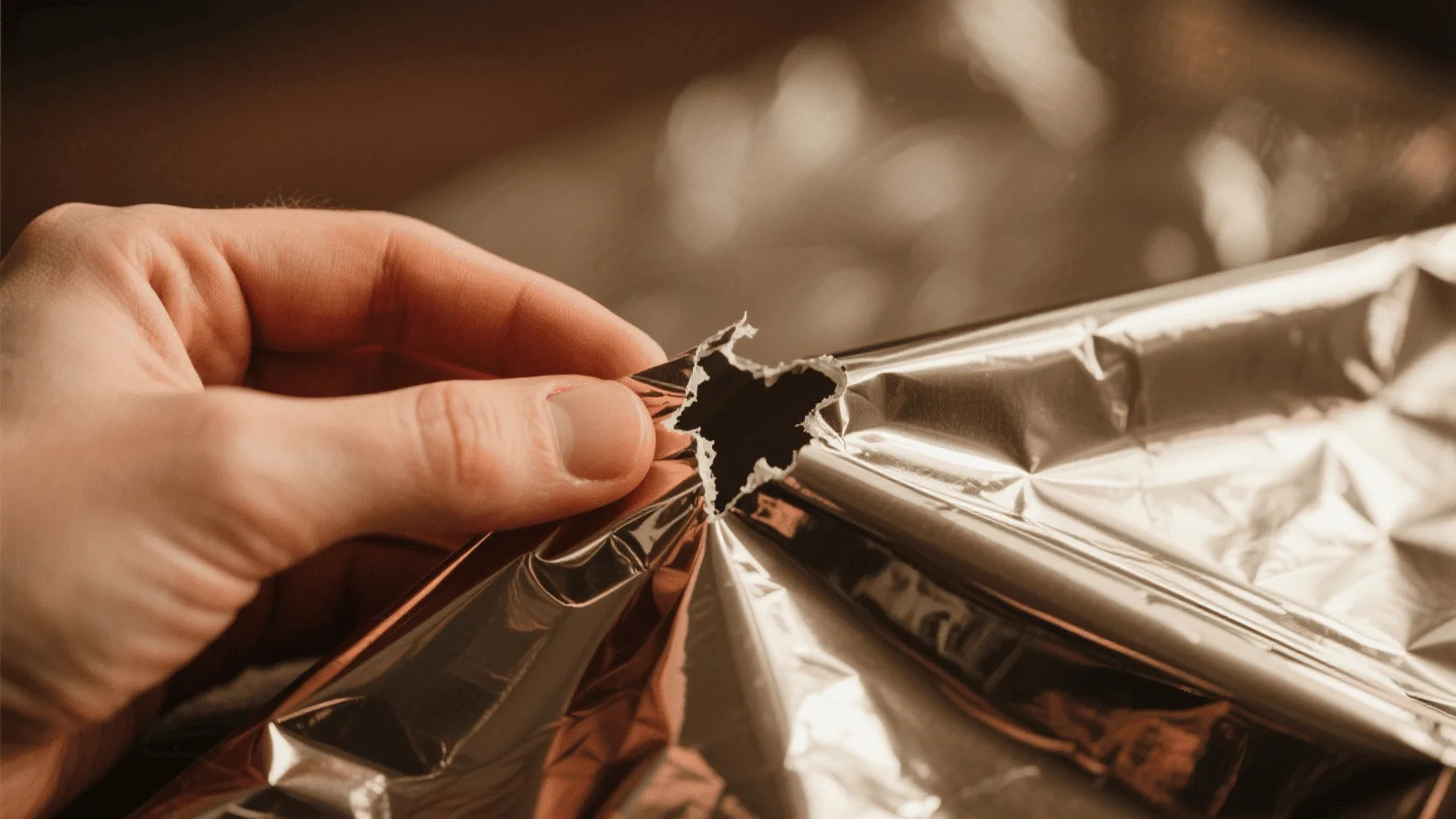
The easiest preliminary check is the "rip test." Try to tear the paper. If it tears cleanly with a fibrous edge, it is more likely to be paper-based. If it stretches, feels unusually tough, or you can see a thin film separating from the paper, it may contain plastic lamination.
This is only a practical screening method, not a substitute for technical documentation. A few years ago, we worked with a high-end jewelry brand that wanted a "velvet touch" finish for its jewelry packaging solution. The finish felt incredibly luxurious, but it relied on a plastic film. We ultimately helped them choose a heavyweight paper solution that created a premium tactile effect without compromising their sustainability objectives.
Understanding Coatings and Finishes
Not all coatings are created equal. The distinction is critical for any brand that cares about what happens to its packaging after unboxing.
| Coating Type | Description | Recyclability |
|---|---|---|
| Plastic Lamination (Gloss, Matte, Velvet)1 | A thin film of plastic bonded to the paper surface. | Generally No |
| UV Coating | A polymer coating cured with ultraviolet light to create a high-gloss finish. | Check with the recycling system/supplier |
| Aqueous Coating2 | A water-based coating used for sheen and scuff resistance. | Often compatible with paper recycling |
| Clay Coating | A mineral-based coating used to create a smooth, printable surface. | Generally compatible, depending on the product and facility |
| Uncoated Paper | Paper with no additional surface coating. | Best option for straightforward recyclability |
Could Your Choice of Ink Send Your Paper to the Landfill?
Your brand colors are specific and vibrant, and you need them to be reproduced perfectly. But you’ve heard that some inks can be difficult to recycle, and you don’t want your printing choices to undermine your sustainability goals.
Most modern printed paper can still enter recycling systems, but choosing soy- or vegetable-based or suitable water-based inks can support a more environmentally responsible printing strategy. The key is to evaluate the complete printing system rather than assuming that any particular ink automatically makes paper recyclable.
Paper recycling commonly includes a de-inking stage in which ink is separated from the recovered paper fibers. Ink formulation can affect this process and the resulting pulp quality.
For brands focused on sustainable packaging, specifying appropriate inks is therefore another useful step. When requesting custom wrapping paper, ask your supplier what ink system they use and whether the finished printed paper has been evaluated for recyclability.
The Impact of Different Ink Types
| Ink Type | Environmental Consideration | Recyclability | Performance |
|---|---|---|---|
| Petroleum-Based | Can have higher VOC considerations depending on formulation. | Generally Recyclable | Standard, wide color range. |
| Soy/Vegetable-Based | Lower-VOC formulations can support a more environmentally responsible printing process. | Generally Recyclable | Excellent color reproduction. |
| Water-Based | Uses water as a primary carrier and can be a suitable choice for sustainable paper printing. | Generally Recyclable | Good for many paper applications. |
| Metallic Inks | May contain metallic pigments and require additional evaluation. | Check with Supplier | Creates a metallic appearance without necessarily using foil. |
The important distinction is that ink choice alone does not determine whether wrapping paper is recyclable. A paper printed with a suitable ink can still become difficult to recycle if it is subsequently laminated with plastic, covered with glitter, or combined with other non-paper materials.
Are "Extras" Like Glitter and Foil Ruining Your Sustainability Efforts?
A touch of gold foil or a sparkle of glitter makes your Christmas gift wrap feel festive and special. But these attractive additions can be among the biggest obstacles to recyclability.
Yes, glitter, foil, and other non-paper decorative elements can compromise the recyclability of wrapping paper. If sustainability is the priority, the safest approach is to create visual impact through paper, color, typography, and design rather than adding materials that cannot be readily separated from the paper.

I’ve seen firsthand how difficult decorative contaminants can be for recycling operations. Glitter particles can become embedded in recovered pulp, while metallic foils and plastic films may be screened out during processing.
If you want a premium metallic appearance, discuss alternatives with your printer rather than automatically choosing hot foil stamping. A suitable metallic ink may provide a similar visual direction with less additional material, although its compatibility with your local recycling system should still be verified.
The safest approach is simple: make the paper itself the star of the design. Use strong typography, sophisticated patterns, high-quality paper, and thoughtful color combinations to create visual excitement without adding unnecessary non-paper components.
The Contaminant Hall of Shame
To maximize the likelihood that your paper can be recycled, avoid or carefully evaluate these common additions:
- Glitter1: Conventional glitter can introduce microplastic particles into recycling streams.
- Foil Stamping2: Adds a separate metallic layer that can complicate paper recycling.
- Ribbons & Bows: These should be removed before recycling and are not part of the recyclable paper substrate.
- Plastic Laminations: Gloss, matte, and soft-touch films can turn otherwise recyclable paper into a composite material.
- Excessive Tape: Encourage customers to remove as much tape as practical before recycling.
How Can You Reliably Identify Recyclable Wrapping Paper?
Choosing eco-friendly gift wrap can feel like a guessing game. How can you be sure the "recyclable" claim from a supplier is legitimate and won’t mislead your environmentally-conscious customers?
Start with the physical paper, then verify the specifications with your supplier. Use the scrunch or rip test as a preliminary check, look for information about coatings and inks, ask for the exact material composition, and confirm that the finished product is appropriate for the recycling system where it will be sold.
A few years ago, a potential client came to us frustrated. They had been sourcing what they thought was "eco-friendly" wrap, only to face backlash from customers who pointed out it was clearly laminated. They felt deceived.
This is a common procurement risk. In my experience, the most reliable brands and suppliers are transparent. We encourage our partners to test the physical material themselves, but more importantly, to look beyond marketing terms and request documentation.
An FSC® logo can demonstrate responsible sourcing of the paper fiber, but FSC certification does not automatically mean that the finished wrapping paper is recyclable. A paper can come from FSC-certified sources and later be laminated with plastic or decorated with non-paper materials.
Deeper Dive into Verification
To ensure you are stocking genuinely sustainable wrapping paper, use a multi-step verification process.
- The Scrunch and Rip Tests: These are useful first-line checks. Paper that stays crumpled and tears with a fibrous edge is more likely to be uncoated paper. However, treat these tests as preliminary indicators rather than certification of recyclability.
- Request Material Specifications: Ask for the exact paper type, GSM, coating, lamination, ink system, and decorative finishes. If the supplier cannot clearly explain what is in the product, that is a procurement red flag.
- Verify Recyclability Claims: Ask whether the finished product—not simply the base paper—has been assessed for recyclability. Also consider the requirements of the recycling systems in your target market.
- Check FSC Certification Separately: FSC can verify responsible sourcing and chain-of-custody requirements, but it should not be presented as proof that the finished product is recyclable.
- Supplier Dialogue: A trustworthy custom paper packaging supplier should be able to explain the material composition and provide relevant certification or technical documentation. At Omet Packaging, we make our commitment to responsible sourcing and manufacturing transparent through certifications including BSCI and FSC.
What Is FSC Chain of Custody and Why Does It Matter for Your Gift Wrap?
You want to show customers your commitment to sustainability by using the FSC logo on your Christmas gift wrap. But the rules can seem confusing, and using the mark incorrectly can create compliance and greenwashing risks.
FSC Chain of Custody (CoC) is a verified tracking system that follows eligible forest-based material through the supply chain. If you want to place an FSC label on the finished gift wrap, the relevant manufacturing and supply-chain requirements must be met, including the certified printer or converter applying the approved label. Simply buying FSC-certified paper is not enough.

Think of the Chain of Custody like the provenance of a valuable piece of art. To establish authenticity, you need a documented history from the original source through the relevant stages of the supply chain.
FSC works on a similar principle. The material moves from a responsibly managed forest or other eligible source through the supply chain, eventually reaching the printer or converter that produces the final packaging.
This is why you cannot simply buy FSC-certified paper and ask an uncertified printer to add an FSC logo. The finished product’s claim must be supported by the applicable FSC certification and labeling requirements.
Why You Can’t Just Buy FSC Paper
This is one of the most important points for brand managers and buyers.
The FSC label is not simply a graphic representing "eco-friendly." It is a protected trademark associated with a specific certified supply chain. A certified supplier must manage FSC materials appropriately, maintain the required records, and follow FSC labeling and trademark rules.
When you work with a qualified certified supplier like Omet Packaging, the supplier can manage the FSC material sourcing and applicable label process for your custom gift wrap. The logo therefore represents a verified system rather than an unsupported marketing claim.
What Do the Different FSC Labels (100%, Mix, Recycled) Actually Mean?
You see "FSC Mix," "FSC 100%," and "FSC Recycled" labels. They all sound good, but they represent different material claims and cannot be used interchangeably.
FSC 100% means the forest-based material comes from FSC-certified forests, FSC Recycled refers to recycled material, and FSC Mix represents a combination of eligible FSC-certified, recycled, and/or controlled sources according to FSC requirements. The correct label depends on the certified material used in your product.
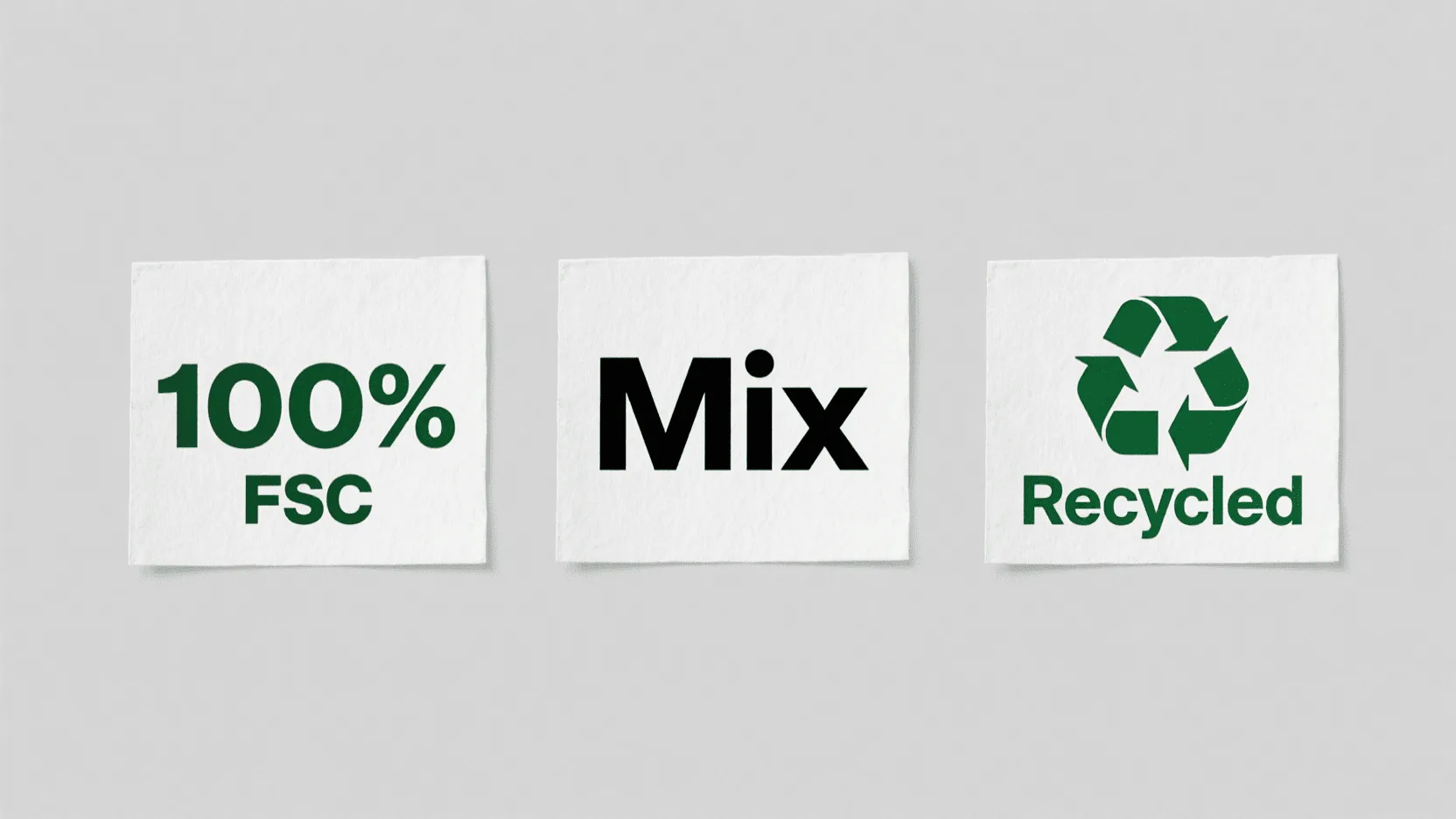
When you order wholesale Christmas gift wrap, the paper supplied for your project will have a specific FSC designation. You cannot simply choose whichever FSC label sounds most attractive. The label must correspond to the certified material and applicable FSC requirements.
Comparing the Three FSC Labels
| Label Type | Composition | What It Communicates | Best For |
|---|---|---|---|
| FSC 100% | Forest-based material from FSC-certified forests. | Material comes entirely from FSC-certified forest sources. | Products where maximum certified virgin fiber sourcing is required. |
| FSC Mix | A combination of FSC-certified, recycled, and/or controlled sources under the FSC system. | Supports responsible sourcing while allowing a practical combination of fiber sources. | Many commercial paper and printing applications. |
| FSC Recycled | Recycled material meeting FSC requirements. | Maximizes the use of reclaimed fiber. | Recycled gift wrap, tissue paper, and paperboard products. |
The key point is that FSC certification and recyclability address different questions. FSC primarily concerns the responsible sourcing and chain of custody of forest-based material. Recyclability concerns what happens to the finished product after use.
A genuinely sustainable packaging strategy should consider both.
How Can I Use the FSC Logo in My Marketing and On My Product?
You’ve done everything right and have a legitimately certified product. Now you want to communicate that achievement, but you’re afraid of breaking strict rules around the FSC trademark.
For on-pack use, work with your certified supplier to use the correct FSC label and follow the applicable trademark requirements. Do not download an FSC logo from the internet and add it to your artwork yourself. For promotional communications, use accurate claims that reflect exactly what has been certified.
The FSC trademark is protected, and certified suppliers must follow the relevant requirements for its use. For an FSC-labeled product, the supplier should provide or manage the appropriate label artwork, including the applicable license information, and ensure the artwork meets certification requirements before production.
This is another reason to choose a supplier experienced with FSC-certified packaging. It reduces the risk of a beautiful design being printed with an incorrect or unauthorized FSC mark.
On-Pack vs. Promotional Claims
There is an important distinction between putting the FSC mark on the product and talking about FSC certification in your marketing.
-
On-Pack Claims: This refers to the FSC label physically appearing on the gift wrap.
- Do: Work with your certified supplier to obtain and use the correct approved FSC label.
- Don’t: Download an FSC logo from Google Images and place it yourself.
- Don’t: Alter, recreate, or use an incomplete FSC trademark.
-
Promotional Claims: This includes your website, social media, emails, catalogs, and advertising.
- Do: Make factual claims that accurately describe the certified product.
- Do: Specify what the FSC claim applies to, such as a particular range of gift wrap.
- Don’t: Present FSC certification as a general "eco-friendly" badge covering products that are not certified.
- Don’t: Claim that your entire retail company is FSC-certified unless your business actually holds the relevant certification or license.
The safest rule is simple: never use the FSC mark to imply more than your certification actually proves.
What Are the Best Eco-Friendly Gift Wrap Alternatives?
Your customers are actively seeking sustainable options. Are you offering innovative, eco-friendly wrapping that sets your brand apart, or are you stuck with the same unrecyclable, glittery rolls?
Excellent alternatives include unbleached kraft paper, responsibly sourced uncoated paper, custom-printed tissue paper, and reusable fabric wraps like Furoshiki. These options can reduce reliance on non-paper decorations while creating a premium, thoughtful unboxing experience.

I’ve seen a significant shift in the market toward what I call "functional beauty." Brands are moving away from disposable flair and toward packaging that is both beautiful and responsible.
One of our most successful projects involved creating a line of custom gift bags from thick, high-quality kraft paper. The design was so elegant that customers were encouraged on the tag to reuse the bag for storage or re-gifting.
Another client in the cosmetics industry switched from traditional boxes to custom-printed tissue paper secured with a branded sticker. It reduced their shipping weight, cut costs, and gave their products a delicate, boutique feel that customers loved.
These solutions prove that sustainability doesn’t mean sacrificing aesthetics. It’s an opportunity for creativity: use premium paper, sophisticated printing, thoughtful patterns, and reusable formats to transform packaging from disposable waste into something customers value.
Comparing Sustainable Alternatives
Each alternative offers a unique combination of benefits for your brand, from cost to customer experience. Making the right choice depends on your product, brand identity, sustainability goals, and local recycling infrastructure.
- Kraft Paper1: A strong, affordable, and widely recyclable choice when it is uncoated. Its natural appearance works particularly well for brands emphasizing authenticity and sustainability.
- Custom Tissue Paper: Lightweight and delicate, tissue paper can be printed with brand logos or patterns. It adds a premium unboxing experience and is generally recyclable when free from plastic coatings and non-paper decorations.
- Reusable Options2: Fabric wraps, drawstring bags, and reusable containers can extend the useful life of packaging and reduce single-use waste.
- Uncoated Custom Wrapping Paper: For retailers who need traditional gift wrap, high-quality uncoated paper offers a straightforward way to combine branding with recyclability.
| Alternative | Recyclability/Reusability | Brand Perception | Best For |
|---|---|---|---|
| Kraft Paper | Generally Recyclable | Earthy, authentic, minimalist | All-purpose, e-commerce shipping |
| Uncoated Printed Paper | Generally Recyclable | Premium, versatile, branded | Retail, seasonal gifting |
| Printed Tissue Paper | Generally Recyclable | Delicate, premium, boutique | Apparel, cosmetics, subscription boxes |
| Fabric Wraps (Furoshiki) | Fully Reusable | High-end, thoughtful, zero-waste | Luxury goods, special occasion gifts |
| Reusable Gift Bags | Fully Reusable | Practical, convenient, lasting value | Retail stores, corporate gifting |
How Does Choosing Recyclable Wrap Impact Your Brand and Bottom Line?
You worry that sustainable packaging is an added expense you can’t afford. But what is the hidden cost of ignoring powerful consumer trends and risking your brand’s reputation?
Adopting genuinely recyclable or reusable gift wrap is a strategic investment. It can help meet consumer expectations, reduce the risk of unsupported environmental claims, strengthen brand consistency, and create a more credible sustainability story. The goal is not simply to spend more on "green" packaging, but to choose materials whose environmental claims can actually be supported.

The return on investment in sustainability isn’t always measured in immediate dollars and cents; it’s also measured in brand equity and future-proofing your business.
I’ve worked with business owners who initially hesitated at the slightly higher cost of FSC-certified paper or custom-designed, recyclable shipping packaging. However, brands that make credible sustainability improvements can benefit from stronger customer trust and positive word-of-mouth.
In today’s transparent market, a claim of "eco-friendly packaging" that does not survive scrutiny can damage credibility. Conversely, a clear commitment demonstrated through tangible choices—such as uncoated paper, appropriate inks, verified sourcing, and honest recycling instructions—creates a stronger and more defensible brand story.
The Business Case for Green Gifting
The benefits of adopting sustainable gift wrap1 extend far beyond environmental responsibility. It’s a practical business decision that can strengthen your brand’s position in the modern market.
- Meeting Consumer Demand: Consumers increasingly pay attention to the environmental impact of packaging. Offering verifiably responsible gift wrap can differentiate your brand in a crowded retail environment.
- Avoiding ‘Greenwashing’ Backlash: Vague "eco-friendly" claims are risky. Use specific, supportable statements and keep FSC claims separate from broader recyclability claims.
- Building a Cohesive Brand Story: Your packaging is a physical manifestation of your brand. If your marketing speaks of quality and sustainability while your gift wrap is plastic-laminated and glitter-covered, the contradiction is obvious. Sustainable gift wrapping paper makes your brand story more consistent.
- Future-Proofing Procurement: Selecting simpler, recyclable materials and working with transparent suppliers can make it easier to adapt as recycling requirements and sustainability expectations evolve.
Conclusion
Ultimately, choosing recyclable gift wrap for 2026 is a critical decision for any retailer. It’s no longer just about aesthetics; it’s about understanding the complete lifecycle of your packaging and making claims you can prove.
The simplest strategy is to start with the material itself: choose uncoated or appropriately recyclable paper, avoid plastic lamination, glitter, and unnecessary foil, specify suitable inks, and verify the finished product with your supplier. If you want to use an FSC label, make sure the applicable Chain of Custody requirements are met and that the correct FSC trademark is used.
Sustainability does not require boring packaging. It requires smarter design. You can create beautiful gift wrap through premium paper, strong typography, sophisticated patterns, color, and thoughtful printing rather than relying on materials that create recycling problems.
Ready to align your packaging with your brand values? Contact us at Omet Pack to explore custom, sustainable gift wrap solutions.
For more insights, check out our guides on creating stunning Gift Boxes or choosing the right Tags & Stickers.
FAQ
Is all paper-based gift wrap recyclable?
No. Paper-based gift wrap may become difficult or impossible to recycle when it contains plastic lamination, glitter, foil, or other non-paper components. Plain, uncoated paper is generally the safest choice, but local recycling requirements should always be checked.
How can I tell if wrapping paper has a plastic coating?
Try the rip test as a preliminary check. If the paper tears cleanly with a fibrous edge, it is more likely to be uncoated paper. If it stretches, strongly resists tearing, or a transparent film separates from the surface, it may contain plastic lamination. For commercial procurement, always confirm the material composition with your supplier.
Does an FSC® certification mean the paper is recyclable?
No. FSC certification primarily addresses responsible sourcing and Chain of Custody. It does not automatically guarantee that the finished wrapping paper is recyclable. FSC-certified paper can still become difficult to recycle if it is subsequently laminated with plastic or combined with non-paper decorations.
Do I need my own FSC certification to sell FSC-labeled gift wrap?
Generally, a retailer or brand owner does not need to hold the same Chain of Custody certification simply to sell a finished FSC-labeled product. However, the product must be supplied through the appropriate certified chain, and FSC trademark and promotional rules still apply. Work with a certified supplier to ensure the claim is valid.
Can I just download the FSC logo and put it on my packaging?
No. The FSC trademark is protected. For an FSC-labeled product, obtain the correct label through your certified supplier and follow the applicable FSC trademark requirements. Never use an unofficial logo downloaded from the internet.
What is the difference between FSC 100%, FSC Mix, and FSC Recycled?
FSC 100% refers to forest-based material from FSC-certified forests. FSC Recycled refers to recycled material meeting FSC requirements. FSC Mix combines eligible FSC-certified, recycled, and/or controlled sources under the FSC system. The correct label depends on the certified material used.
Is brown kraft paper always recyclable?
Not necessarily. Standard uncoated kraft paper is generally an excellent recyclable choice, but kraft paper with plastic lamination, glitter, foil, or other non-paper finishes may not be accepted in recycling systems.
Are soy-based or water-based inks better for recyclable gift wrap?
They can be a good choice for a more environmentally responsible printing strategy, but ink type alone does not determine recyclability. The paper substrate, coatings, decorative finishes, and local recycling process all matter.
What about hot foil stamping? Can it be recycled?
Hot foil adds a separate metallic layer to the paper and can complicate recycling. If maximum recyclability is the priority, avoid foil and create metallic effects through graphic design or discuss suitable ink-based alternatives with your printer.
Can I recycle wrapping paper that still has tape on it?
A small amount of tape may be tolerated by some recycling systems, but practices vary. The best approach is to remove as much tape, ribbon, and other non-paper material as possible before recycling.
How can my business order custom, eco-friendly wrapping paper?
You can work with a specialized packaging supplier like Yiwu Omet Packaging. We offer design consultation and can produce custom gift wrapping paper using appropriate paper stocks, FSC-certified materials where applicable, and suitable printing options to match your brand’s aesthetic and sustainability goals.