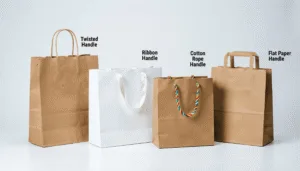
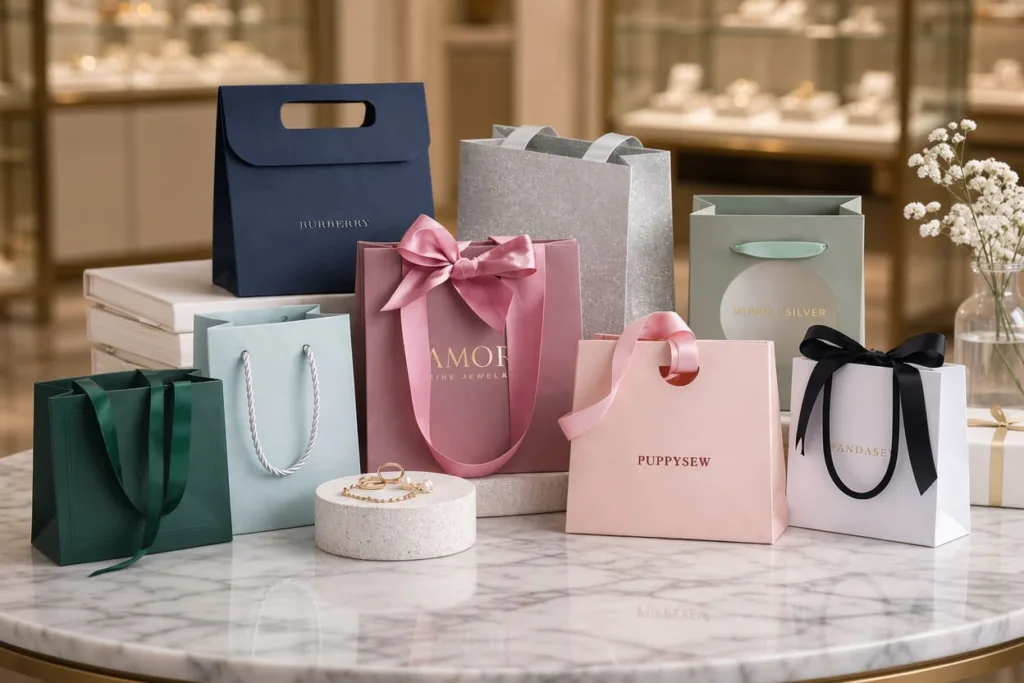
Are you a jewelry brand getting beautiful paper bag samples, only for the mass production order to arrive with scuffs, torn handles, and inconsistent colors? A single bad batch can delay a product launch, damage your brand’s premium perception at the point of sale, and lead to costly rework. This guide provides a factory-direct checklist to help you specify, vet, and order custom jewelry paper bags that perform flawlessly.
Luxury jewelry bags are defined by their material choice (like Kraft or Art Paper), precise paper weight (gsm), reinforced handle structures, and flawless surface finishes. Sourcing these bags successfully requires clear specifications and a thoroughly vetted supplier to prevent common and costly quality control failures during production and shipping.
Key Takeaways / TL;DR:
- Jewelry paper bag dimensions should be based on the jewelry box size, not the jewelry piece itself, ensuring a snug and secure fit.
- The perception of luxury comes from structural integrity, including reinforced handle areas and scuff-resistant surfaces, not just from using thick paper.
- For European Union and North American markets, verifying a supplier’s compliance documentation, such as FSC Chain of Custody and BSCI audit reports, is a critical step.
- Realistic procurement timelines for custom orders from China require planning for 8–12 weeks, which includes sampling, mass production, and sea freight.
- A reliable supplier should be evaluated on their documented quality control process, sampling speed, and transparent communication, not just on their final price.
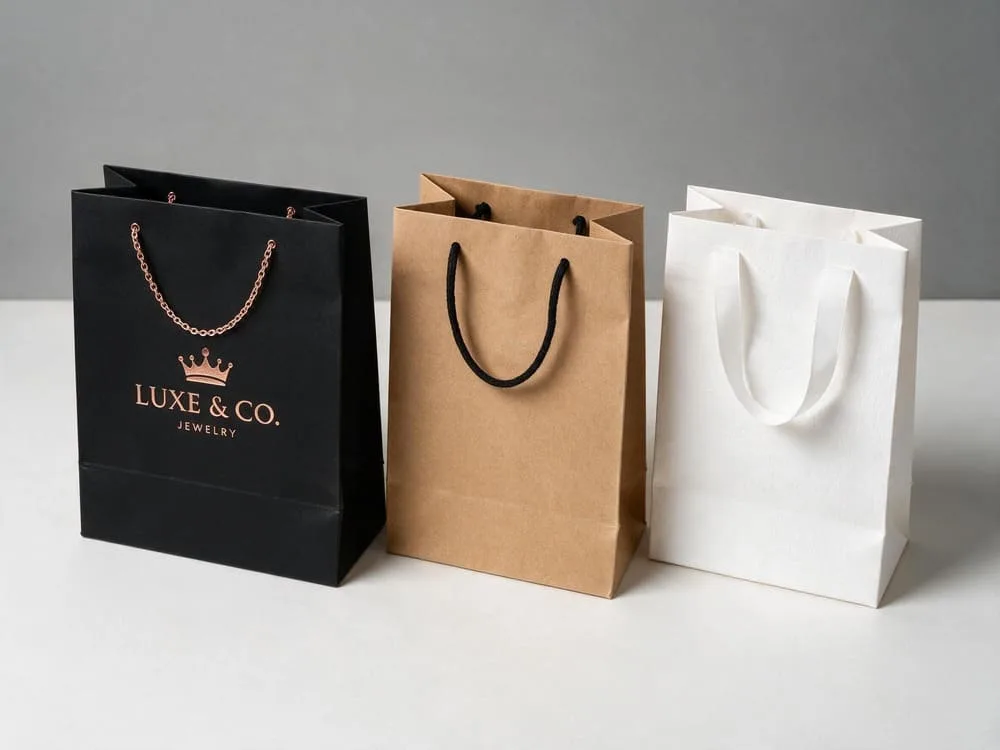
As the founder of a packaging factory in Yiwu, I’ve seen firsthand how easily a jewelry paper bag order can go wrong. I remember a client from Germany who was thrilled with our initial sample—a beautiful, small black bag with a gold foil logo. But they had approved the design based on a low-resolution digital mockup. When the first 500 units came off the line, the foil on their ultra-thin logo font was breaking in places. It was a classic case of the design being unsuited for the chosen finishing process. We had to remake the tooling and adjust the artwork, which added a week to their timeline. This experience taught me that educating my clients on the manufacturing realities is as important as the production itself. Let’s walk through the key decisions you need to make to avoid such surprises.
What makes jewelry paper bags “luxury” instead of just “small”?
Concerned that your small paper bag might look cheap? A torn handle, a scuffed surface, or a weak structure at the checkout counter can instantly undermine your brand’s premium image. Here is what truly defines high-end quality.
Luxury jewelry paper bags are defined by their structure, surface, and production consistency. A premium build uses heavier, stiffer paper, features clean and precise fold lines, includes reinforced handle areas, and is protected by finishes that resist scuffing during retail handling.
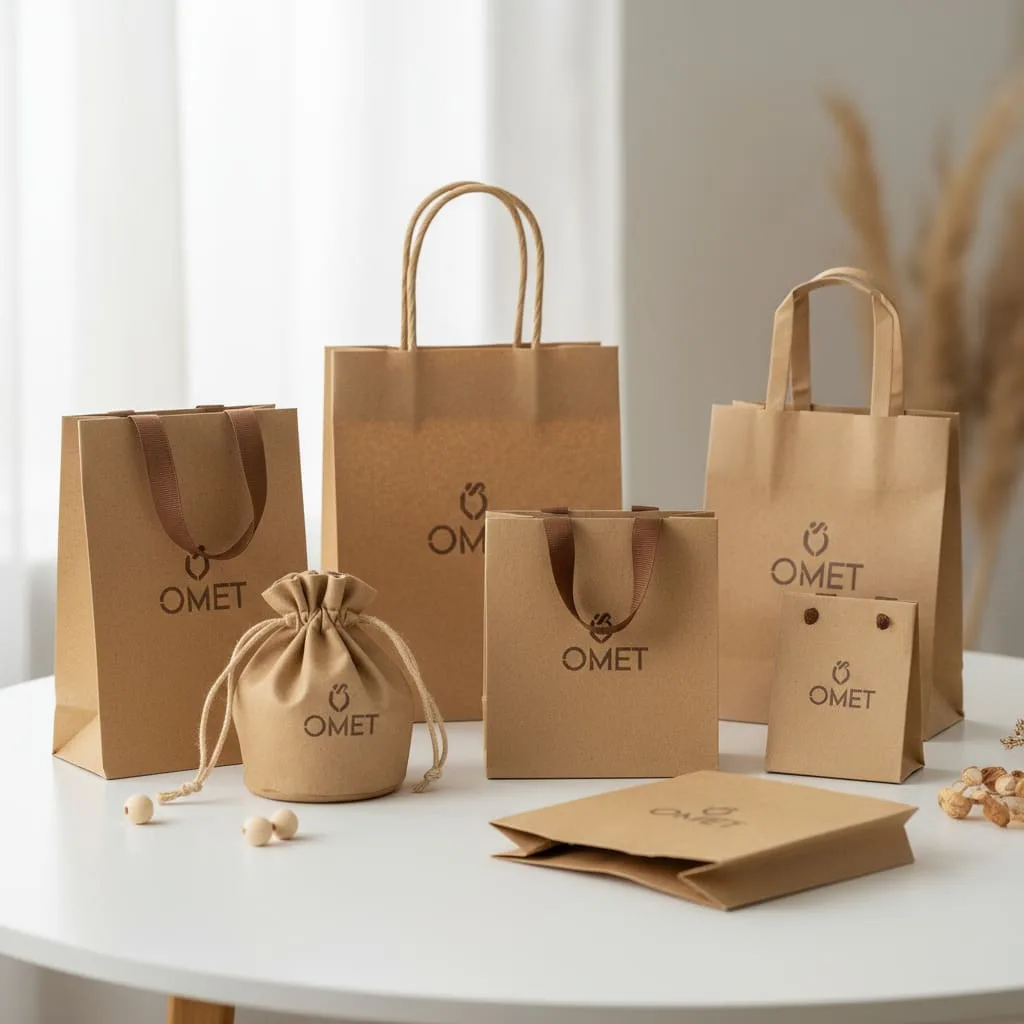
From my experience on the factory floor, what separates a standard bag from a luxury one isn’t just the price; it’s the attention to engineering details that prevent common failures. Small bags amplify every minor flaw—a slightly off-center logo, a weak glue line, or a crooked handle becomes immediately obvious.
H3: Beyond Thickness: The Role of Structural Integrity
A luxury bag feels substantial. This is achieved not just by choosing a high gsm paper but by ensuring the structure is sound. Key elements include:
- Reinforced Top Folds: The area where the handles attach is the highest stress point. We always add a reinforced cardboard patch or a full top-turnover to distribute the load and prevent the handles from tearing through the paper.
- Clean Crease Lines: Automated die-cutting and creasing machines ensure that every fold is sharp and exact. This prevents the "puffy" or misaligned look you see on lower-quality bags and ensures they fold flat for shipping and open easily in-store.
- Solid Base: A reinforced bottom card insert helps the bag stand upright and hold its shape, even with a heavier jewelry box inside.
H3: Surface Finish: The First Impression and Lasting Protection
The surface of the bag is the first thing a customer touches. A premium finish must look and feel high-quality while also protecting the bag from damage.
- Scuff-Resistant Lamination: For matte finishes, which are very popular in the luxury segment, we recommend an anti-scuff matte lamination. Standard matte films can scratch easily during transit, but this specialized film maintains a clean look from our factory to your customer’s hands.
- Flawless Finishes: Whether it’s hot foil stamping, embossing, or spot UV, the application must be perfect. This requires precise registration (alignment) and quality control to ensure there are no breaks in the foil, no misaligned embossing, and no dust specks in the UV coating.
As the CEO of Ometpack, I’ve learned that most "luxury" failures happen after the bag is made. They occur during packing, shipping, or in-store handling. That’s why our quality control extends to specifying how bags are interleaved with protective sheets and packed into cartons to prevent scratches and abrasions.
What size jewelry paper bag should a brand choose for rings, earrings, necklaces, and watches?
Choosing the wrong size bag can make a beautiful piece of jewelry feel insignificant. An oversized bag looks wasteful and allows the product to slide around, while an undersized one is difficult for staff to pack at a busy checkout counter.
A good jewelry paper bag size is driven by the dimensions of the jewelry box, not the jewelry itself. The bag should fit the box with minimal empty space to avoid a "cheap oversized" look and to reduce the risk of the box being crushed during transport.

The goal is to create a secure and elegant presentation. When we receive a request for quote (RFQ), one of the first questions we ask is for the outer dimensions of the jewelry box or boxes the bag needs to hold. From there, we can recommend a size that provides just enough clearance for a sheet of tissue paper and allows for easy insertion.
Here is a general guide to help you start the process. Remember to always measure your specific boxes and request a physical sample to test the fit.
| Jewelry Item | Typical Box Size (cm, L×W×H) | Recommended Bag Size (cm, W×G×H) |
|---|---|---|
| Rings / Earrings | 5 x 5 x 4 | 10W x 8G x 12H |
| Pendant / Bracelet | 9 x 9 x 3 | 14W x 8G x 16H |
| Necklace | 16 x 16 x 4 | 20W x 10G x 25H |
| Watch / Bangle | 10 x 10 x 8 | 15W x 12G x 18H |
Note: W=Width, G=Gusset (Depth), H=Height. These are starting points; always test with your actual packaging.
H3: The Importance of a "Tight, Upright Fit"
From a structural standpoint, I always advocate for a "tight, upright fit." When a bag is too wide for its contents, the top edges tend to crease and the handles can twist, making the entire package look sloppy. A snug fit helps the bag maintain its intended shape, presenting a much cleaner and more professional appearance under boutique retail lighting.
H3: Standardizing Sizes for Efficiency
For brands with a wide range of products, I recommend standardizing on 2-3 bag sizes rather than creating a unique size for every box. This strategy significantly reduces your total MOQ requirements, lowers tooling costs, and simplifies inventory management for your retail stores. It’s a simple way to control costs without compromising the customer experience. You can explore our standard ranges in the Premium Paper Packaging Catalog.
Kraft paper vs. coated art paper vs. textured paper: which material is best for your brand?
The material you choose is the foundation of your bag’s look, feel, and performance. Are you aiming for an earthy, sustainable vibe or a sleek, modern luxury feel? The paper itself tells a story before a single word is printed on it.
Kraft paper is ideal for an eco-minimalist brand with a strong sustainability narrative. Coated art paper delivers the best results for sharp logo edges, rich colors, and consistent luxury retail presentation. Textured specialty paper is perfect when a unique tactile feel is the priority.
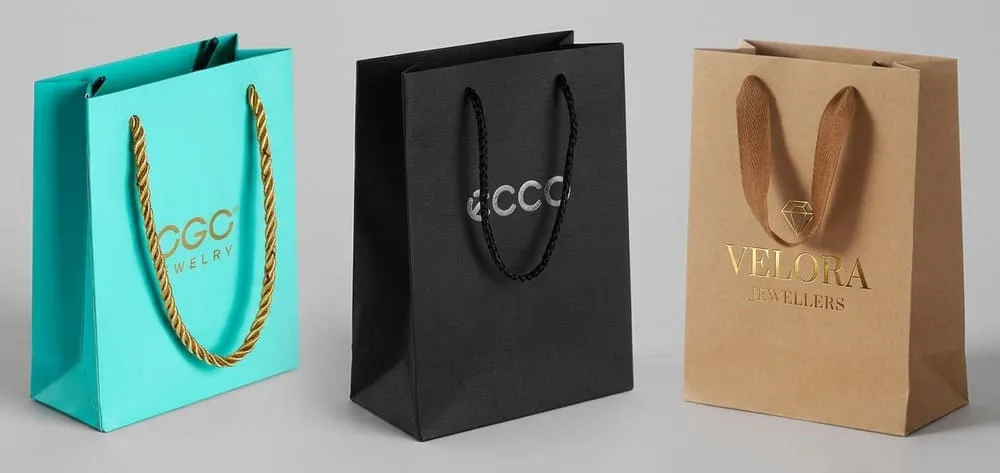
Each material has its own set of strengths and manufacturing considerations. Choosing the right one depends on your brand identity, print requirements, and budget. If you are targeting European markets, using materials with clear sustainability credentials, like those from our FSC certified supply chain, is becoming a baseline expectation.
Here’s a breakdown to help you decide:
| Feature | Kraft Paper (120-170 gsm) | Coated Art Paper (150-250 gsm) | Specialty Textured Paper (180-300 gsm) |
|---|---|---|---|
| Look & Feel | Natural, rustic, earthy | Smooth, clean, modern, consistent | Tactile, unique, sophisticated |
| Best For | Eco-conscious brands, minimalist designs | Full-color printing, sharp logos, photographic images | High-end luxury, brands focused on tactile experience |
| Printing | Good for simple, bold prints (e.g., black ink) | Excellent for CMYK, Pantone, and fine details | Variable; texture can affect fine lines and foil adhesion |
| Finishing | Best with simple finishes like debossing or one-color foil | Supports all finishes: lamination, foil, UV, embossing | Requires careful testing; foil may not adhere well to deep textures |
| Sustainability | Strong eco-narrative, often available as recycled and FSC certified | Recyclable, but lamination can complicate the process; FSC options are standard | Varies widely; must verify composition and recyclability |
| Cost | $ | $$ | $$$ |
H3: A Factory CEO’s Material Recommendation
If a client wants a deep, consistent black bag with a crisp gold foil logo, I almost always recommend coated art paper with a matte lamination. While foil on kraft paper can look stunning, the natural fiber variations in the paper can cause slight inconsistencies in the black ink density from batch to batch. Coated paper provides a perfectly uniform surface, ensuring that every single bag looks identical—a key requirement for luxury brands. At Ometpack, we can run samples on different substrates to show you the real-world difference before you commit to a full production run.
How does FSC certification and EPR compliance affect your jewelry paper bag sourcing?
Navigating international regulations can be a major headache for buyers. Are your bags compliant for sale in Germany? What about France? A mistake here can lead to fines or your products being held at customs.
FSC (Forest Stewardship Council) certification and EU EPR (Extended Producer Responsibility) are two distinct but linked compliance requirements for sourcing jewelry paper bags. FSC ensures the paper comes from responsibly managed forests, supporting EUDR traceability. EPR requires importers to register and report packaging volumes in EU member states.
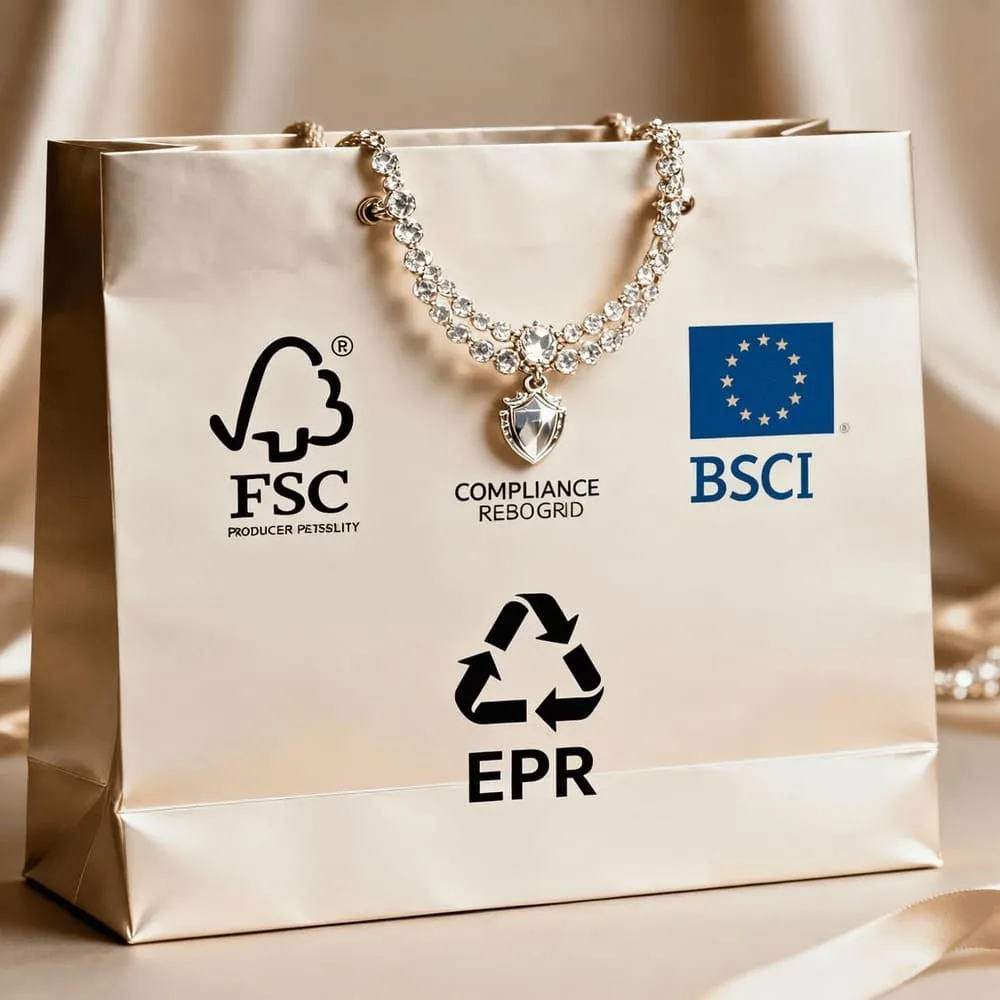
These are not just buzzwords; they are now standard sourcing requirements for most major European and North American retailers. As a manufacturer, it’s my job to provide you with the documentation you need to meet your obligations.
H3: FSC and EUDR: Proving Your Paper’s Origin
The EU Deforestation Regulation (EUDR) requires companies to prove that products derived from wood, including some paper goods, do not come from deforested land. The most widely accepted way to demonstrate this is through FSC Chain of Custody (CoC) certification.
- What to ask your supplier: "Can you provide your active FSC CoC certificate number?" You can and should verify this number on the official FSC database. An expired certificate offers no protection. At Ometpack, our certifications are always current, and we provide this documentation with every relevant order.
H3: EPR: Your Responsibility as an Importer
Extended Producer Responsibility (EPR) regulations in the EU (such as Germany’s LUCID registry and France’s Triman logo requirements) make the company that first places the packaging on the market—that’s you, the importer or brand—responsible for financing its collection and recycling.
- What to ask your supplier: "Can you provide a detailed breakdown of the materials and weights for each packaging component?" You will need this data to accurately complete your EPR registration and reporting. A professional factory should be able to provide this information easily.
H3: My CEO Insight on Compliance
I’ve seen a dramatic shift in client inquiries over the past two years. Previously, compliance was an afterthought. Now, it’s often the first question. When a European buyer asks, "Are your bags compliant?", what they are really asking is, "Can you provide the paperwork I need to operate legally?" We win long-term partners by proactively providing a clean compliance file with every shipment—FSC documents, material declarations, and consistent weight data. This turns a complex headache for our clients into a simple box-ticking exercise. It’s a core part of our one-stop service, which you can learn more about by taking our Factory Tour.
How to vet a custom jewelry paper bag supplier: A 7-point checklist?
Choosing the right supplier is the single most important decision you will make. A great partner acts as an extension of your team, anticipating problems and ensuring quality, while a poor one can become a source of constant delays and defects.
Vetting a supplier requires evaluating seven key areas: factory ownership, active compliance certifications, production equipment, sampling process, QC documentation, export record, and communication responsiveness. Skipping any of these exposes you to significant risk.

Before placing an order for thousands of units, you need to be confident in your supplier’s ability to deliver. I always tell potential clients: judge us on the quality of our questions, not just our price. A supplier who only asks "How many?" and "What’s your target price?" is not equipped for B2B-grade production.
Here is the checklist I recommend every buyer use:
- Factory Direct vs. Trading Company: Ask for a factory address, photos of their actual production lines, and ideally, a live video tour. A true manufacturer will be proud to show you their equipment.
- Active Certifications: Request their current FSC and BSCI certificates and verify the certificate numbers and expiry dates online.
- Sampling Capability & Speed: Can they produce a paid pre-production sample using the exact materials and finishes within 5-7 business days? A fast, accurate sampling process is a strong indicator of genuine manufacturing capability.
- Documented QC Process: Ask for their internal QC checklist and the AQL (Acceptable Quality Level) standard they use. For packaging, AQL 2.5 is a rigorous standard. A supplier who can’t provide this documentation likely doesn’t have a formal process.
- Export Track Record: Ask for non-confidential examples of their work for clients in your market (e.g., Europe or North America). This demonstrates their experience with your region’s quality expectations and customs requirements.
- Technical Communication: Send them a technical specification with paper gsm, Pantone colors, and a dieline. Is their response quick, clear, and accurate? Their ability to understand technical details in writing is a proxy for their ability to execute them in production.
- Transparent Quoting and Terms: Does their quote clearly break down costs? Are the payment terms standard (e.g., 30% deposit, 70% before shipment)? A professional partner provides a formal Proforma Invoice and contract.
Ultimately, trust is built on transparency. A supplier who is open about their processes, welcomes inspections, and communicates clearly is one you can build a long-term relationship with. It’s why we put so much information on our website, from our full paper bag product range to our operational details.
Conclusion
Sourcing premium jewelry paper bags is about proactively controlling details, not just reacting to problems. It requires precise specifications for materials and finishes, a partnership with a vetted manufacturer who understands compliance, and a clear quality control plan that is enforced from day one. By using this checklist, you can move beyond generic quotes and build a packaging solution that protects your product, elevates your brand, and performs flawlessly at retail.
Ready to build a bag that reflects the quality of your jewelry? Contact our team at Ometpack today for a custom quote based on your design. For more guides and insights on paper packaging, explore our comprehensive Paper Bags Hub.
FAQs (Frequently Asked Questions)
What is the best paper for luxury jewelry bags?
Coated art paper of 190-250 gsm generally provides the best surface for sharp printing, vibrant colors, and premium finishes like foil stamping, making it a top choice for luxury brands. Kraft paper offers a strong sustainability narrative, while textured papers add a unique tactile element.
What is a typical MOQ for custom jewelry paper bags from China?
The Minimum Order Quantity (MOQ) for custom jewelry paper bags from a direct Chinese factory like Ometpack typically starts at 500 to 1,000 units per design. This quantity is often required to make offset printing and automated finishing processes cost-effective.
How do you prevent ribbon handles from tearing out of small paper bags?
Handle tear-out is prevented by structural reinforcement. Reliable manufacturers add a concealed cardboard patch or use a folded-top construction at the handle attachment points. This distributes the weight and stress, ensuring the handles remain secure even with repeated use.
Do jewelry paper bags need to be FSC certified for the EU market?
While not a universal legal mandate for all bags, FSC certification is a standard requirement for most major European retailers. It demonstrates a commitment to responsible sourcing and is the most widely accepted method for showing compliance with regulations like the EUDR.
How long does it take to produce custom jewelry paper bags?
A typical timeline from order confirmation to delivery is 8-12 weeks. This includes 5-7 days for pre-production sampling, 15-25 days for mass production, and 25-40 days for sea freight to Europe or North America. Air freight is faster but significantly more expensive.