When you contact a packaging supplier and ask for “custom paper bags,” the supplier will usually need more information before preparing a quotation. What size do you need? What type of paper should you use? Do you prefer twisted paper handles, ribbon handles, or die-cut handles? Will the bags carry clothing, gifts, food, or other products?
Choosing the right paper bag involves more than selecting a color or printing a logo. The bag’s construction, paper material, handle style, size, and intended use all influence its appearance, functionality, production cost, and suitability for your product.
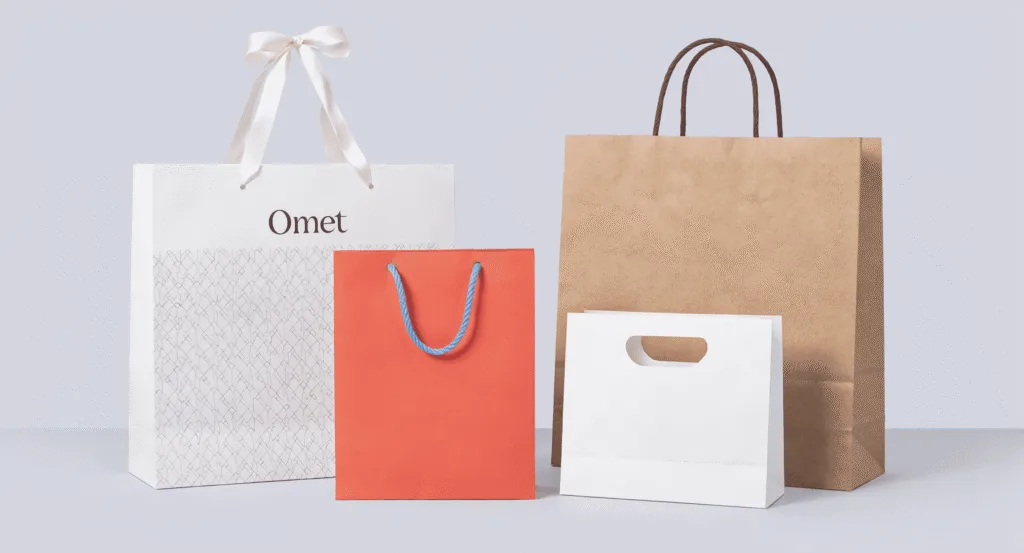
The main types of custom paper bags include twisted handle bags, flat handle bags, Euro tote bags, die-cut handle bags, and SOS bags. Each type is designed for different applications, budgets, and branding requirements.
In this guide, I will explain the main paper bag styles, compare their features, and share practical advice to help you choose the right packaging for your business.
Key Takeaways
- Twisted handle bags: A practical choice for retail, gifting, takeout, and promotional packaging. They are commonly produced using automated machinery and can be suitable for larger-volume orders.
- Flat handle bags: An economical option for lightweight products, takeaway packaging, pharmacies, and promotional use.
- Euro tote bags: A premium paper bag style often made with coated art paper, reinforced construction, and rope or ribbon handles. They are popular with boutiques, luxury brands, and gift retailers.
- Die-cut handle bags: Paper bags with handles cut directly into the bag structure. They offer a clean appearance and are suitable for many lightweight retail applications.
- SOS bags: Self-Opening Sacks with a flat bottom and a self-standing construction. They are commonly used for groceries, bakeries, takeaway food, and other practical packaging applications.
- The right bag depends on more than appearance: Product weight, bag dimensions, paper material, printing, handle construction, order quantity, and budget all matter.
Quick Comparison: Which Custom Paper Bag Is Right for Your Business?
Before looking at each style in detail, the following table provides a quick overview.
| Paper Bag Type | Common Applications | Main Advantages | Important Considerations |
|---|---|---|---|
| Twisted Handle Bag | Retail, gifting, takeout, promotional packaging | Practical, cost-effective, and suitable for many applications | Handle attachment and paper specifications affect durability |
| Flat Handle Bag | Lightweight retail, takeaway, pharmacies, events | Economical and simple construction | Best suited to products compatible with its construction and load capacity |
| Euro Tote Bag | Luxury retail, boutiques, premium gifting | Premium appearance and flexible branding options | Often involves additional finishing or assembly costs |
| Die-Cut Handle Bag | Lightweight retail, events, promotional packaging | Clean, modern appearance with an integrated handle | Handle strength depends on paper, cutout design, and reinforcement |
| SOS Bag | Groceries, bakeries, takeaway food, lunch packaging | Flat bottom and self-standing construction | Usually prioritizes function over premium presentation |
The table is a starting point. A packaging supplier should review your product weight, dimensions, design, and intended use before recommending the final construction.
1. What Are Twisted Handle and Flat Handle Paper Bags?
Twisted handle and flat handle paper bags are among the most widely used styles for everyday retail and takeaway packaging. They are often manufactured on automated paper bag production lines, making them practical options for businesses that need consistent quantities and straightforward construction.
At Omet Pack, we work with different paper bag constructions and printing requirements. The most suitable production method depends on the bag’s dimensions, paper material, handle design, and order quantity.
Twisted Handle Paper Bags
Twisted handle bags use paper cords that are twisted to form the handles. The handles are commonly attached to the inside of the bag, although the exact construction can vary according to the design.
They are widely used for:
- Retail stores and boutiques
- Gift shops
- General shopping
- Promotional packaging
- Some takeaway and food-service applications
- Seasonal and event packaging
Twisted paper handles can provide a comfortable carrying experience, but the actual strength of the finished bag depends on the paper, handle material, attachment method, reinforcement, and product weight.
Flat Handle Paper Bags
Flat handle bags use flat paper handles rather than twisted paper cords. Their simple construction can make them an economical option for businesses that need functional packaging at a competitive price.
They are commonly used for:
- Takeaway food
- Pharmacies
- Lightweight retail products
- Promotional events
- Small gifts
- Everyday shopping
A flat handle bag may be suitable for lightweight products, but it should not automatically be considered unsuitable for heavier items. The correct choice depends on the complete bag construction and its tested load capacity.
Twisted Handle vs. Flat Handle Bags
| Feature | Twisted Handle Bag | Flat Handle Bag |
|---|---|---|
| Handle construction | Twisted paper cord | Flat paper handle |
| Appearance | Practical, with a slightly textured handle | Simple and functional |
| Cost | Depends on materials, design, and production method | Often economical |
| Comfort | Can provide a comfortable grip | Depends on handle width, paper, and load |
| Typical applications | Retail, gifting, shopping, and promotional packaging | Takeaway, lightweight retail, and promotional packaging |
| Main purchasing consideration | Handle attachment, paper specification, and product weight | Handle construction, paper specification, and product weight |
My advice: If you need economical paper bags for everyday retail or promotional use, twisted and flat handle bags are good styles to compare. Ask your supplier to recommend the paper specification and handle construction according to the products you intend to carry.
2. What Is a Luxury Euro Tote Paper Bag?
A Euro tote bag is a premium-style paper shopping bag often associated with boutiques, luxury retail, beauty products, gifting, and high-end packaging.
Compared with a basic paper shopping bag, a Euro tote often features heavier paper, a reinforced top, a reinforced bottom, and premium handles such as cotton rope, polyester rope, grosgrain ribbon, or satin ribbon.
The exact construction varies by supplier and design. Some Euro tote bags are hand-finished, while others use semi-automated or other production methods.
Main Features of Euro Tote Bags
1. Premium paper materials
Euro totes are often made from coated art paper or specialty paper. Common specifications may include approximately 190–300 GSM, but the appropriate paper weight depends on the bag size, structure, and product requirements.
2. High-quality printing
Brands can choose from different printing and finishing options, including CMYK printing, Pantone colors, and selected specialty finishes. The best printing method depends on the artwork, paper material, color requirements, and order quantity.
3. Matte or gloss finishing
Matte or gloss lamination can change the appearance and surface feel of the bag. It may also provide additional protection, but the final environmental and recycling characteristics depend on the complete construction.
4. Reinforced construction
A Euro tote may include a reinforced top fold, a bottom insert, or other structural reinforcement. These features can improve the bag’s rigidity and carrying performance when properly designed.
5. Premium handles
Rope and ribbon handles are popular choices for luxury packaging. Options may include cotton rope, polyester rope, grosgrain ribbon, or satin ribbon. Handle color, attachment method, and reinforcement should be confirmed during the quotation and sampling process.
When Should You Choose a Euro Tote?
A Euro tote may be a good choice when your packaging needs to communicate a premium brand image.
Typical applications include:
- Fashion and apparel brands
- Jewelry and accessories
- Beauty and cosmetics
- Luxury gifts
- Boutique retail
- Premium promotional packaging
However, a Euro tote is not automatically the strongest paper bag available. Its performance depends on the paper, dimensions, reinforcement, handle attachment, and product weight. For heavier products, I recommend confirming the required load capacity and evaluating a physical sample before placing a bulk order.
3. What Are Die-Cut Handle Paper Bags?
A die-cut handle paper bag has a handle opening cut directly into the upper section of the bag. Unlike a bag with separate rope or paper handles, the handle is integrated into the bag’s paper structure.
This construction gives the bag a clean and modern appearance. It is often used when a brand wants a simple design without additional handles.
Advantages of Die-Cut Handle Bags
- Clean and minimalist appearance
- Integrated handle design
- Suitable for many lightweight retail products
- Useful for events and promotional packaging
- Can be customized in different sizes and printed designs
What Should You Consider?
The handle opening can create a stress point in the paper. The bag’s performance depends on the paper material, dimensions, cutout design, reinforcement, and the weight of the product.
For heavier products, the handle area may require reinforcement or a different construction. Always discuss the expected load with your supplier.
4. What Are SOS Paper Bags?
SOS stands for Self-Opening Sack. An SOS bag is designed to open easily and stand upright, typically because of its flat-bottom construction.
These bags are commonly used in grocery stores, bakeries, food-service businesses, takeaway packaging, and other applications where practical handling is important.
Main Features of SOS Bags
- Flat-bottom construction
- Self-standing design
- Easy opening and filling
- Efficient construction for many everyday applications
- Suitable for a range of food-service and retail uses
Many SOS bags are handle-less, but the exact design depends on the product and supplier.
Common Applications
- Grocery packaging
- Bakery bags
- Sandwich and takeaway food packaging
- Lunch bags
- Food-service packaging
- Small retail products
If the bag will be used for food packaging, you should confirm the paper grade, coatings, inks, adhesives, and any applicable food-contact requirements with your supplier. Food-contact suitability must be evaluated for the complete packaging construction and intended use.
5. How Do You Choose the Right Custom Paper Bag?
Choosing the right paper bag starts with understanding the product and the requirements of your business. I recommend reviewing the following factors before requesting a quotation.
1. Product Size and Bag Dimensions
The bag should provide enough space for the product without being unnecessarily large. You should confirm:
- Bag width
- Bag height
- Bag gusset or depth
- Product dimensions
- Required internal space
- Whether the product needs protective wrapping or inserts
A suitable bag size improves presentation and can help avoid unnecessary material costs.
2. Product Weight and Carrying Requirements
Product weight is one of the most important factors when selecting a bag.
A supplier should consider:
- Product weight
- Number of items per bag
- Handle construction
- Handle attachment
- Bottom reinforcement
- Paper material
- Bag dimensions
Do not select a paper bag based only on its GSM or handle style. A physical sample and suitable load testing can help confirm whether the construction meets your needs.
3. Paper Material and GSM
GSM means grams per square meter. It describes the weight of the paper, but it does not independently determine the strength of a finished paper bag.
A higher GSM may provide a thicker or more substantial paper, but bag performance also depends on the paper grade, fiber characteristics, construction, size, reinforcement, and handle attachment.
Common material choices may include:
- White kraft paper
- Brown kraft paper
- Coated art paper
- Recycled paper
- Specialty paper
- Other paper grades suitable for the intended application
Your supplier can recommend a suitable paper specification based on the product, appearance, budget, and construction.
4. Printing and Finishing
Custom paper bags can be printed and finished in different ways, depending on the paper and production method.
Common options include:
- CMYK printing
- Pantone spot-color printing
- Matte lamination
- Gloss lamination
- Hot foil stamping
- Embossing or debossing
- Special paper or decorative finishes
For accurate color matching, provide your artwork and, when necessary, a Pantone reference or approved physical color sample.
5. Handle Style
The handle is both a functional and visual part of the bag.
Depending on the construction, you may choose:
- Twisted paper handles
- Flat paper handles
- Cotton rope handles
- Polyester rope handles
- Grosgrain ribbon handles
- Satin ribbon handles
- Die-cut handles
- Other compatible handle options
The right choice depends on the bag’s intended use, product weight, brand positioning, and budget.
6. Order Quantity and MOQ
Minimum order quantity, or MOQ, varies according to the bag type, size, paper material, printing method, handle design, and supplier’s production process.
Some machine-made bags may be more economical at larger quantities, while premium or hand-finished constructions may have different production requirements.
At Omet Pack, we review the bag specifications and order quantity before preparing a quotation. Rather than choosing a bag based only on a general MOQ, I recommend asking for pricing at several quantities to understand the cost difference.
7. Budget and Delivery Requirements
Your budget should include more than the unit price. Consider:
- Sample costs
- Printing and finishing costs
- Tooling or plate costs, where applicable
- Packaging for shipment
- Freight and delivery charges
- Production lead time
- Required delivery date
If you are comparing suppliers, make sure the quotations use the same specifications and delivery terms.
6. Custom Paper Bags for Different Industries
Different industries may have different packaging priorities.
Retail and Fashion
Retail brands often need a balance of appearance, durability, and cost. Twisted handle bags, flat handle bags, and premium Euro totes can all be considered depending on the product and brand positioning.
Gift Packaging
Gift shops and seasonal brands may prioritize attractive printing, premium handles, and a high-quality surface finish. Euro totes and other custom gift bags are common options.
Food and Takeaway
Food-service businesses often prioritize practical construction, suitable paper materials, easy handling, and efficient production. SOS bags, flat handle bags, and other food-service constructions may be appropriate depending on the application.
For direct food contact, the complete packaging must meet the applicable food-contact requirements.
Beauty and Cosmetics
Cosmetic brands often want packaging that matches their visual identity. Premium paper, specialty finishes, foil stamping, and carefully selected handles can help create a distinctive presentation.
Events and Promotional Packaging
For events, exhibitions, and promotional campaigns, the main priorities may be budget, printing, quantity, and delivery time. Economical machine-made paper bags are often worth considering.
7. Why Work with a Custom Paper Bag Manufacturer?
When you buy custom paper bags, working directly with a manufacturer can help you discuss the construction, materials, printing, and production requirements in more detail.
At Yiwu Omet Packaging Co., Ltd., we manufacture and supply custom paper packaging for international brands, retailers, and distributors.
Our paper packaging capabilities include:
- Custom paper bags
- Custom paper boxes
- Wrapping paper
- Greeting cards
- Paper labels and stickers
For paper bags, we can discuss different sizes, paper materials, printing methods, and handle options according to your requirements. Our production capabilities include automated paper bag and paper packaging lines, as well as finishing processes such as die-cutting, lamination, and hot stamping.
We understand that every project has different requirements. A practical paper bag for a high-volume retail order may need a completely different construction from a premium bag for a luxury gift or fashion brand.
Our goal is to help buyers choose a suitable construction, confirm the specifications, and develop packaging that matches their product, brand, and budget.
8. What Information Should You Send When Requesting a Quote?
To receive a more accurate quotation, I recommend sending your supplier the following information:
- Bag dimensions: Width × height × gusset or depth.
- Paper material: White kraft, brown kraft, coated art paper, or another preferred material.
- Paper GSM: If you already have a required specification.
- Printing: CMYK, Pantone, or another printing requirement.
- Handle style: Twisted, flat, rope, ribbon, die-cut, or another option.
- Finishing: Matte lamination, gloss lamination, foil stamping, or other finishes.
- Product application: Retail, gifting, food service, cosmetics, apparel, or another use.
- Product weight: Approximate weight per bag and the number of items inside.
- Order quantity: Your expected quantity per size and design.
- Delivery destination: Country, city, or full delivery address when requesting a delivered quotation.
- Artwork: A PDF, AI, or other suitable design file, if available.
- Required delivery date: When you need the bags to arrive.
If you are unsure about the best paper material or handle style, send your product details and a reference image. An experienced supplier can help recommend a suitable construction.
Conclusion: Choose the Right Paper Bag for Your Brand
From economical twisted handle bags to premium Euro totes, custom paper bags come in many different styles and constructions. The best option depends on your product, packaging goals, brand image, budget, and order quantity.
A practical shopping bag may prioritize efficient production and cost-effectiveness. A luxury Euro tote may focus on premium materials, reinforced construction, and sophisticated finishing. A die-cut bag may be ideal for a minimalist design, while an SOS bag may be better suited to self-standing food or grocery packaging.
The right paper bag is not simply the most expensive or the thickest option. It is the one whose construction, materials, handles, and dimensions are suitable for your actual application.
At Omet Pack, we help international buyers develop custom paper bags and other paper packaging according to their specifications. If you have a design, product sample, or packaging requirement, you can contact us for a quotation and production consultation.
Explore our custom paper bag options or contact Omet Pack to discuss your project.
For more information about ordering custom packaging, read our guide: Custom Packaging MOQ Explained.
Frequently Asked Questions About Custom Paper Bags
1. What are the main types of custom paper bags?
The main types include twisted handle bags, flat handle bags, Euro tote bags, die-cut handle bags, and SOS bags. They differ in their handle design, construction, materials, appearance, and typical applications.
2. Which type of paper bag is best for retail packaging?
The best type depends on the product, weight, brand image, budget, and order quantity. Twisted handle and flat handle bags are practical choices for many retail applications, while Euro totes may be suitable for premium brands. Your supplier should review the product weight and bag construction before recommending a final option.
3. What is the difference between a Euro tote and a regular kraft paper bag?
A Euro tote is generally associated with premium construction, reinforced components, and rope or ribbon handles. A regular kraft paper bag may use a simpler construction and paper handle system. However, the actual differences depend on the materials, design, and manufacturing process of each bag.
4. Are Euro tote bags stronger than other paper bags?
Not necessarily. A well-designed Euro tote can offer excellent carrying performance, but strength depends on the paper, bag dimensions, reinforcement, handle attachment, and product weight. The final construction should be evaluated against the intended load requirements.
5. What does GSM mean for paper bags?
GSM stands for grams per square meter. It describes the weight of the paper. A higher GSM may indicate a heavier paper, but it does not independently determine the strength of a finished bag. Paper grade, construction, size, reinforcement, and handle attachment also affect performance.
6. What is the most environmentally responsible paper bag option?
Paper bags made with suitable recycled or responsibly sourced paper may be a lower-impact packaging option. However, the environmental performance of the finished bag depends on its paper, inks, coatings, laminations, handles, and disposal system.
Recyclability or compostability should not be assumed without checking the complete construction and applicable local requirements.
7. Can custom paper bags be made with different handle colors?
In many cases, yes. Rope, ribbon, and other handles may be available in different colors, depending on the material, supplier capabilities, design, and order quantity. If you need a specific color, provide a Pantone reference or physical color sample for confirmation.
8. Can paper bags be customized with a window?
Some paper bag constructions can include a window, depending on the bag design, paper material, and production process. For food packaging, the window material and complete bag construction must be evaluated for the intended use and applicable food-contact requirements.
9. What is the MOQ for custom paper bags?
MOQ depends on the bag type, size, paper material, printing, handle design, finishing, and production method. Some projects may require higher quantities to achieve economical pricing, while other constructions may have different minimum order requirements. Ask your supplier to confirm the MOQ for your exact specifications.
10. What information do I need to request a custom paper bag quotation?
You should provide the bag dimensions, paper material or GSM, printing requirements, handle style, quantity, product application, approximate product weight, artwork, and delivery destination. If you are unsure about the specifications, a reference photo or product sample can help your supplier recommend a suitable construction.