What Is the Real MOQ for Custom Packaging? A Manufacturer’s Guide to Bags, Boxes & More
You’ve perfected your product and brand vision, but when you request quotes for your dream packaging, you hit a wall: the Minimum Order Quantity (MOQ). Suddenly, your plan for 500 beautiful boxes is rejected because the factory requires 5,000. This is frustrating and can make you feel like your small or new business is being ignored.
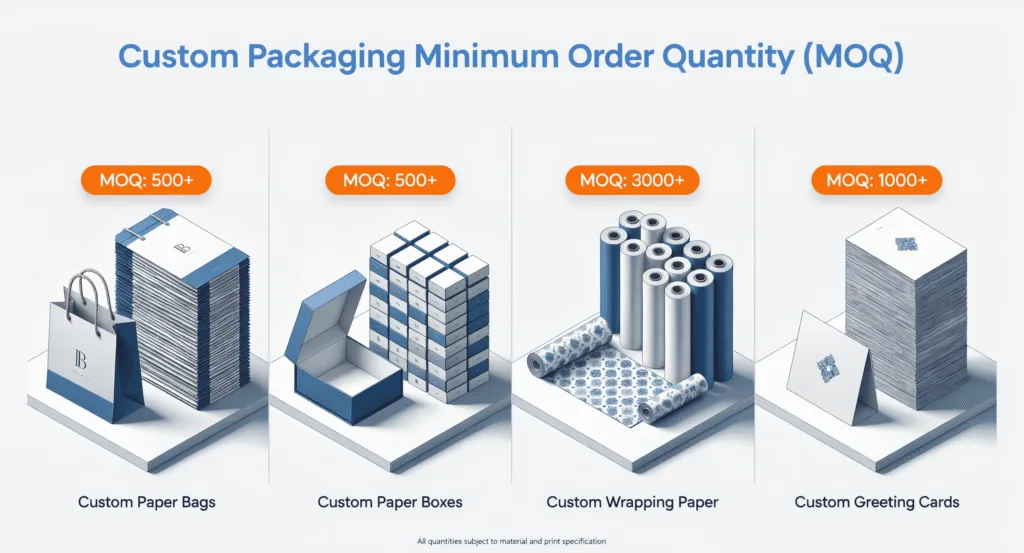
So, what is a typical MOQ for custom packaging? For most custom paper packaging, a typical MOQ is around 500–2,000 units, but there is no universal MOQ. The actual minimum depends on the packaging type, material, printing method, size, finishing, tooling, and production setup. Paper bags commonly start around 1,000 units, while luxury rigid boxes may be available from 500 units at a higher unit cost.
Key Takeaways / TL;DR
- MOQ is not an arbitrary number. It is an economic threshold that helps manufacturers cover fixed costs such as printing plates, die-cut molds, machine setup, calibration, material purchasing, and production waste.
- Custom paper bags and greeting cards commonly have MOQs around 1,000 units, although the actual minimum varies by manufacturer and specifications.
- Folding paper boxes often start around 1,000 units, while luxury rigid gift boxes may sometimes be available from 500 units because their higher manual labor content can justify a smaller production run at a higher unit cost.
- Custom wrapping paper can require a higher minimum, especially for large-volume flexographic or rotogravure production. A typical starting point may be 3,000+ sheets or an equivalent roll-based quantity, depending on the printing method, size, and material.
- You can often reduce your custom packaging MOQ by simplifying the design, using an existing die-cut size, choosing digital printing for very small runs, or accepting a higher per-unit price.
- Unit prices are typically highest at lower quantities because fixed setup costs are spread across fewer pieces. As order quantities increase, the setup cost per piece generally decreases.
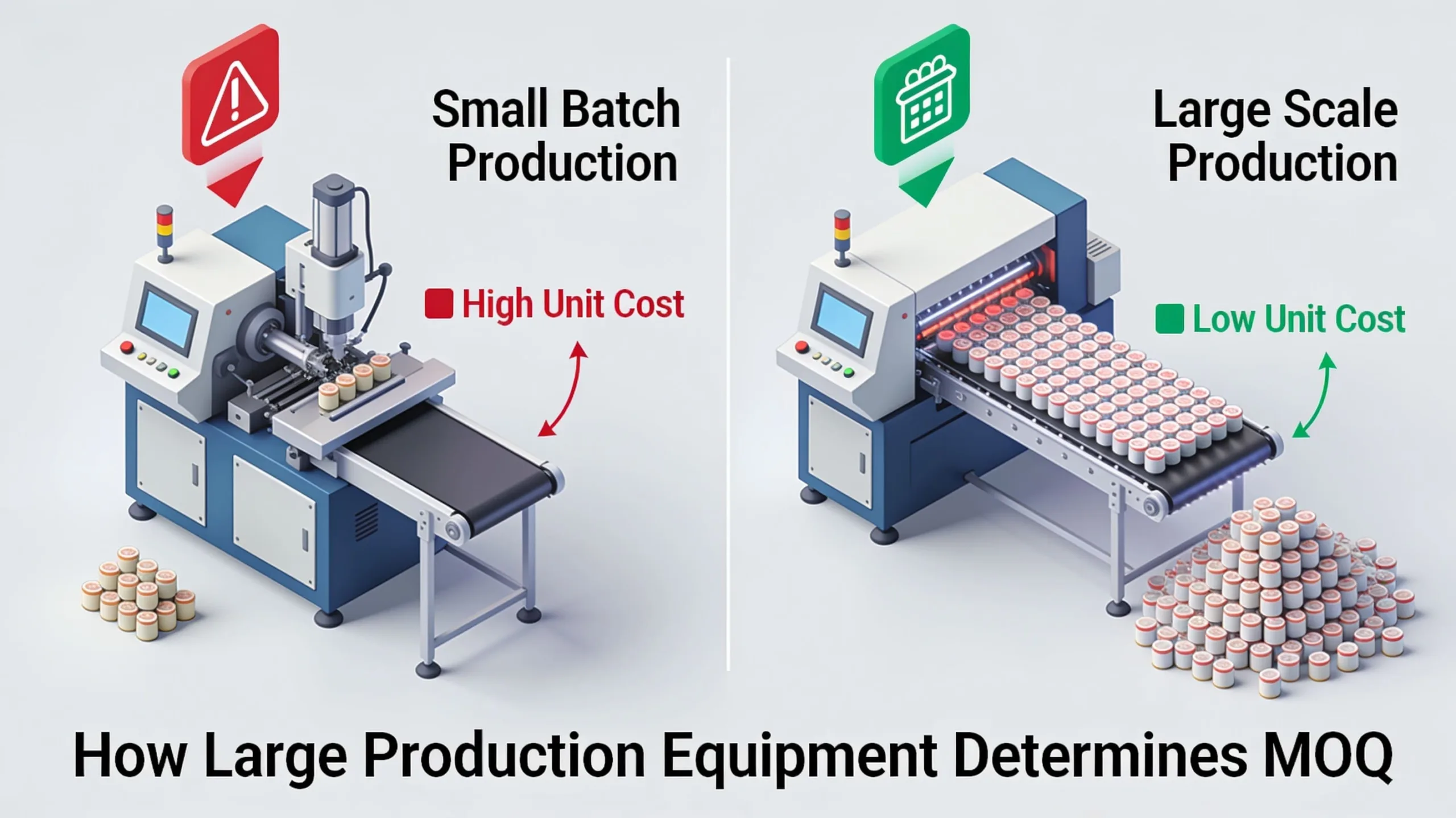
I’ll never forget a passionate startup founder who came to me with a brilliant design for a magnetic closure gift box. She needed just 100 pieces for a promotional event. My heart sank a little when I had to explain why my factory, Ometpack, couldn’t produce just 100 units at a viable price.
It’s a conversation I’ve had many times over the last decade. It’s not that we don’t want to help small businesses—we were one, too. The reality is rooted in the economics of the factory floor.
An MOQ isn’t a barrier designed to keep smaller businesses out; it is an efficiency threshold. My goal with this guide is to take you onto my factory floor, metaphorically, and show you exactly why custom packaging manufacturers have MOQs, what factors determine them, and how you can work with a manufacturer to get the packaging you need at a practical order quantity.
Why Do Manufacturers Have MOQs in the First Place?
You may feel that the MOQ is simply an arbitrary rule forcing you to buy more packaging than you need. It can seem as though the manufacturer simply doesn’t want to deal with a smaller order.
MOQs exist because custom production involves fixed setup costs, material commitments, machine preparation, and production waste. A minimum order helps spread those costs over enough units to make the project economically viable for both the manufacturer and the buyer.
Think of it like a commercial bakery firing up a massive oven. The oven uses roughly the same amount of energy to bake one loaf as it does to bake 100 loaves. The baker’s time to mix the dough and prepare the oven is also a fixed cost.
It’s a similar principle in packaging manufacturing.
Before we can produce even one custom paper bag, a series of setup activities may be required. We may need to order the appropriate paper, prepare printing plates for an offset printing job, create a custom die-cut mold, and calibrate the production equipment. Depending on the product and specifications, setup costs can run into hundreds or even thousands of dollars.
If we spread a $500 setup cost over 5,000 bags, it adds only $0.10 to each bag. If we spread that same cost over just 100 bags, the setup cost alone adds $5.00 per bag.
That is why a manufacturer may set an MOQ: the quantity needs to be large enough for the fixed production costs to be distributed across a commercially reasonable number of units.
Breakdown of Fixed Setup Costs
| Cost Component | Description | Why It’s a Fixed Cost |
|---|---|---|
| Printing Plates | Custom plates may be required for each color in an offset printing design, including CMYK and Pantone colors. | The preparation cost is largely independent of whether the final order contains 1,000 or 100,000 pieces. |
| Die-Cut Mold | A custom cutting and creasing die is created to shape the paper bag, box, or other packaging format. | The tooling cost is generally fixed for a particular size and shape. |
| Machine Calibration | Technicians spend time setting up printing, color registration, cutting, folding, and other production parameters. Some material is used during testing. | Labor and setup waste occur before mass production begins, regardless of the final order quantity. |
| Material Sourcing | Paper and other materials may need to be purchased in larger quantities from mills or suppliers. | A manufacturer may have to commit to a minimum material quantity even when the customer’s order is relatively small. |
What Actually Determines Your Custom Packaging MOQ?
There is no single MOQ that applies to every custom packaging project. The actual minimum order quantity depends on the manufacturing process and specifications of the product.
The most important factors include:
| Factor | Potential Impact on MOQ | Why It Matters |
|---|---|---|
| Packaging Type | High | Bags, folding cartons, rigid boxes, cards, and wrapping paper use different production processes. |
| Printing Method | High | Offset, flexographic, rotogravure, and digital printing have different setup costs and efficient production volumes. |
| Material | High | Special papers, unusual GSM specifications, and custom materials may require larger supplier commitments. |
| Size & Shape | Medium–High | Non-standard dimensions may require custom tooling and different production setups. |
| Finishing | Medium–High | Foil stamping, embossing, spot UV, lamination, and other finishes can add setup and processing requirements. |
| Custom Tooling | High | A completely new die-cut mold can increase the cost of a small production run. |
| Existing Factory Tooling | High | Using an existing die size can sometimes reduce tooling costs and make smaller orders more practical. |
| Repeat Orders | Medium–High | Existing plates and tooling can reduce some setup costs compared with a first-time production run. |
Understanding these factors is more useful than looking at MOQ as a single fixed number. When requesting a quote, buyers should provide the product type, dimensions, material, printing requirements, finishing, and quantity so the manufacturer can determine the most realistic MOQ.
What Are Typical MOQs for Different Paper Products?
You need to budget for your packaging, but you may not know what a realistic order quantity is for paper bags versus boxes, rigid packaging, or wrapping paper. This makes inventory planning and cash-flow forecasting difficult.
Typical custom packaging MOQs can range from around 500 to 2,000 units for many paper packaging products, while wrapping paper may require a higher quantity depending on its printing process and format.
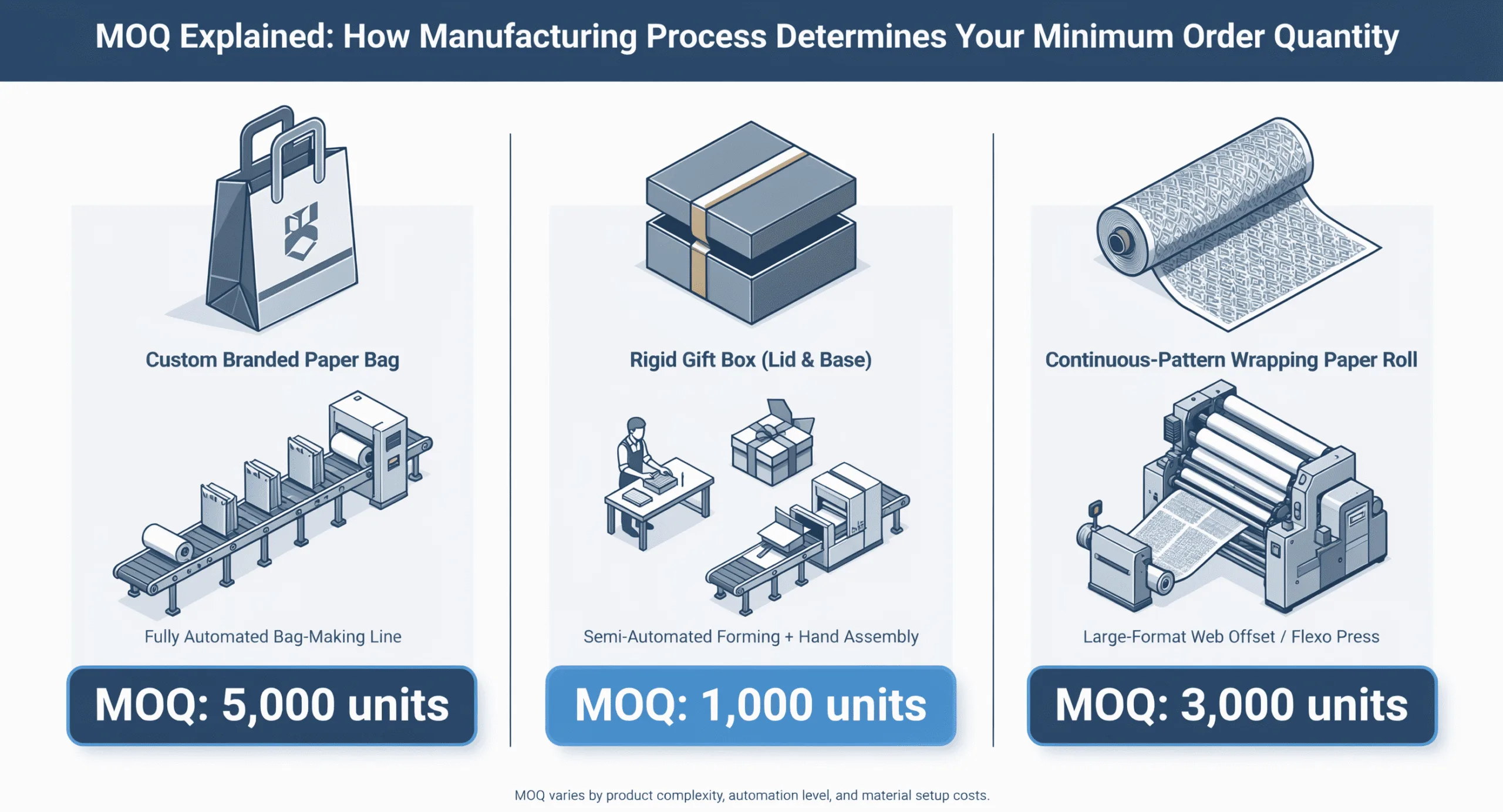
Not all paper packaging is created equal. The machinery, labor, materials, and setup requirements involved in producing a simple paper bag can be very different from those required for a luxury rigid box.
As a manufacturer, we have different production processes and production lines for these items, each with its own efficiency threshold. Understanding these general ranges is the first step in building a realistic packaging strategy.
This allows you to forecast your investment and determine whether your current order volume is suitable for fully custom manufacturing or whether a more standardized solution may make more sense for an initial run.
Standard MOQs by Packaging Type
| Product Category | Typical MOQ | Manufacturing Reason |
|---|---|---|
| Custom Paper Bags | 1,000–2,000 units | Automated production lines can produce large quantities efficiently, but setup and material costs still need to be distributed across the order. |
| Folding Paper Boxes | Around 1,000 units | Printing, die-cutting, folding, and gluing can be streamlined for larger production runs. |
| Luxury Rigid Boxes | 500–1,000 units | These boxes often involve more manual assembly, including wrapping greyboard and installing magnets or other components. Smaller runs may be possible at a higher unit cost. |
| Custom Wrapping Paper | 3,000+ sheets or equivalent roll quantity | Large-volume printing can involve significant setup, paper waste, and material commitments. The actual MOQ varies considerably by printing method and format. |
| Greeting Cards & Tags | Around 1,000 units | Multiple designs can sometimes be efficiently arranged on larger press sheets, helping distribute setup costs. |
Important: These figures are general starting points rather than universal industry standards. Your actual MOQ may be lower or higher depending on the manufacturer, product specifications, printing technology, material availability, and production requirements.
Can You Order Custom Packaging in Small Quantities?
Yes, but smaller quantities usually require a trade-off between MOQ, customization, production method, and unit price.
For example, an order of 500 custom paper bags may be possible with one manufacturer but not another. A factory may also recommend changing the printing method, using an existing die, simplifying the finishing, or accepting a higher unit price.
For very small quantities, digital printing is often more suitable than traditional offset printing because it eliminates the need for printing plates. However, digital printing can have a higher unit cost and may offer fewer finishing options depending on the supplier and equipment.
The key question is therefore not simply:
“Can you produce 500 pieces?”
A better B2B purchasing question is:
“What specifications would allow you to produce 500 pieces at a reasonable cost?”
That question gives the manufacturer an opportunity to suggest practical alternatives.
Can You Negotiate a Lower MOQ with a Manufacturer?
You’re a startup or small business, and the standard MOQ is just beyond your reach. You’re worried you’ll have to settle for generic, unbranded packaging, which could hurt your launch.
Yes, you can often discuss a lower MOQ by making strategic trade-offs in your specifications or by accepting a higher per-unit price to compensate for the manufacturer’s fixed costs.
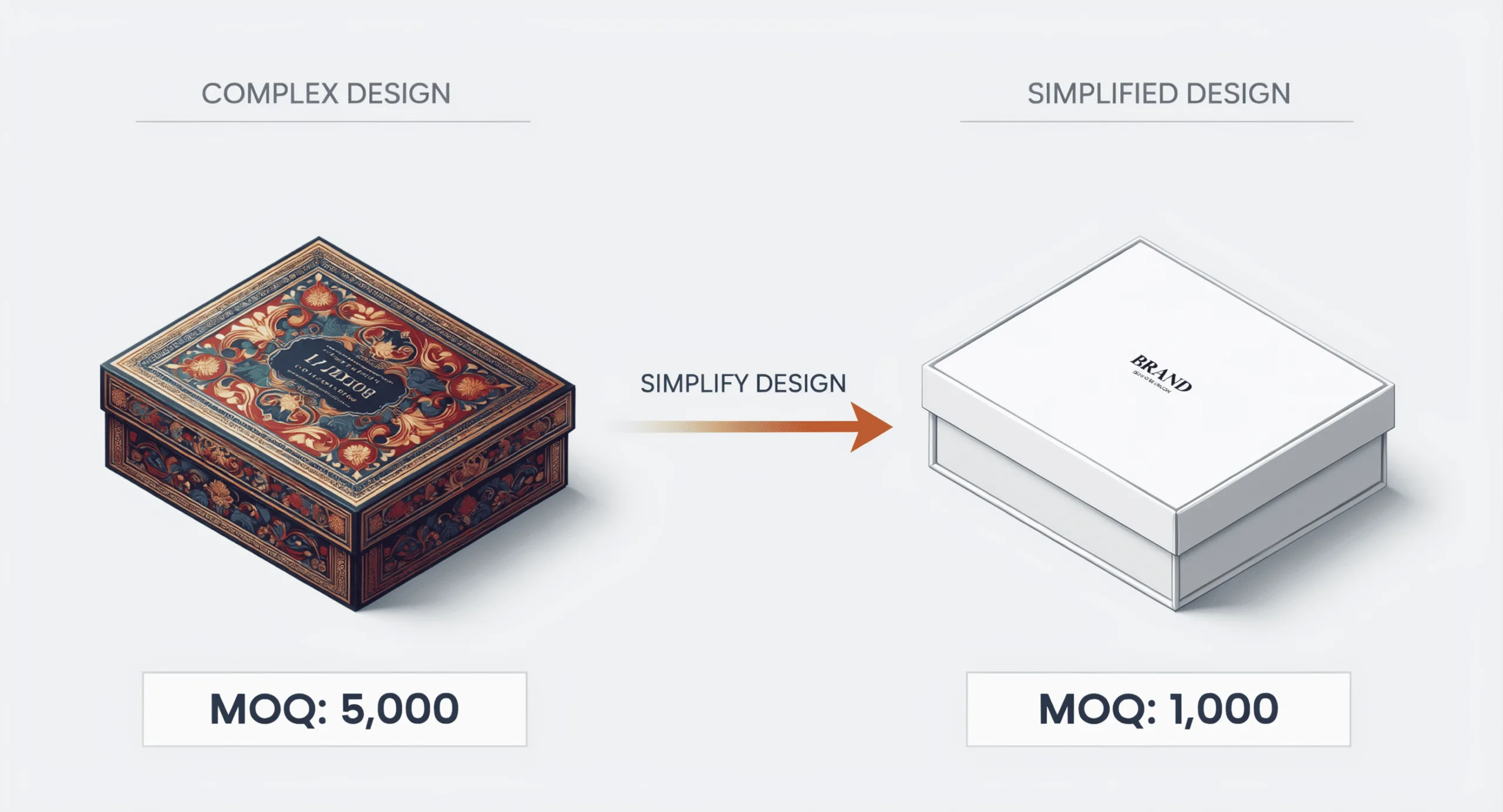
This is where a strong relationship with your manufacturer becomes valuable. A good supplier may not simply say “no” to a lower quantity request; they can often review the specifications and identify ways to make a smaller production run more practical.
When a client tells me they need fewer than our standard MOQ, my first question is, “Let’s look at your design and see where we can be clever.”
The goal is to reduce or better distribute the fixed setup costs. If you can use an existing die-cut mold, simplify the printing, or choose a production method that is more suitable for small quantities, the manufacturer may have more flexibility on MOQ.
Practical Strategies to Reduce Your Custom Packaging MOQ
Here are several strategies you can discuss with your packaging manufacturer:
- Simplify Your Design: Reduce your print from four colors to one or two where appropriate. Removing complex finishes such as Spot UV or embossing can also make a small initial run more practical.
- Accept a Setup Fee or Higher Unit Price: Ask, “What would the per-unit price be for 500 units instead of 1,000?” A higher unit price may allow the manufacturer to cover the fixed costs of a smaller production run.
- Use a Standard Factory Size: Ask your supplier whether they have existing die-cut molds that match your required dimensions. Using existing tooling can eliminate or reduce one of the major fixed costs.
- Ask About Digital Printing: For very small quantities, digital printing can be an alternative to offset printing because it does not require traditional printing plates. The trade-off is usually a higher unit cost.
- Consider a Simplified First Run: If you are launching a new product, consider starting with a simpler packaging specification and upgrading the design once your sales volume increases.
- Ask About Repeat-Order Pricing: If you expect to reorder the same design, tell the manufacturer in advance. Existing tooling and printing files can reduce some setup requirements for future orders.
MOQ vs. Unit Price: Why Quantity Matters
MOQ and unit price are closely connected.
When you place a small custom packaging order, fixed costs such as tooling, setup, calibration, and material preparation are distributed across fewer pieces. This increases the effective cost per unit.
As the quantity increases, those fixed costs are spread across more units.
For example:
| Order Quantity | Fixed Setup Cost | Setup Cost Per Unit |
|---|---|---|
| 500 units | $500 | $1.00 |
| 1,000 units | $500 | $0.50 |
| 5,000 units | $500 | $0.10 |
| 10,000 units | $500 | $0.05 |
This is a simplified example rather than a quotation. Actual pricing also depends on paper, printing, size, finishing, labor, packaging, shipping, and other production factors.
The important principle is simple:
Higher quantities generally make it easier to achieve a lower unit cost because fixed production costs are distributed across more pieces.
How Should B2B Buyers Ask About MOQ?
Instead of asking only:
“What is your MOQ?”
A professional packaging inquiry should provide enough information for the manufacturer to calculate a realistic production solution.
Consider including:
- Product type – paper bag, folding box, rigid box, wrapping paper, greeting card, etc.
- Dimensions – provide all relevant dimensions, especially for bags and boxes.
- Material and GSM – specify the paper type and weight if known.
- Printing – CMYK, Pantone, one-color, or other requirements.
- Finishing – foil stamping, embossing, lamination, spot UV, glitter, etc.
- Handle or accessory requirements – for bags and gift packaging.
- Target quantity – such as 500, 1,000, 3,000, or 10,000 units.
- Delivery destination – especially if you need DDP or another delivered pricing option.
Providing these details allows the manufacturer to recommend not only an MOQ but also the most cost-effective production method for your project.
Conclusion
The MOQ is not simply a wall between your brand and custom packaging. It is a reflection of the economics and production requirements behind manufacturing.
Understanding why an MOQ exists and which factors influence it transforms you from a simple buyer into a more strategic packaging purchaser. It allows you to have a more productive conversation with manufacturers and find practical solutions that balance quantity, customization, quality, and unit cost.
There is no universal MOQ for custom packaging. The right quantity depends on your product, specifications, production method, and budget.
Ready to start that conversation? My team at Ometpack specializes in working with brands of different sizes to navigate these challenges. Contact us with your design, and we’ll help you find a solution that balances your vision, budget, and quantity needs.
Once you’ve understood MOQ, the next step is understanding packaging costs. Dive deeper with our Complete B2B Pricing Guide to Custom Paper Packaging.
FAQs
1. What is the difference between MOQ and MOV?
MOQ (Minimum Order Quantity) refers to the minimum number of units a manufacturer is willing or able to produce for a particular order, such as 1,000 paper bags.
MOV (Minimum Order Value) refers to the minimum monetary value of an order, such as a $2,000 minimum purchase.
Some suppliers use MOV instead of, or in addition to, MOQ because it allows buyers to combine different products or designs to reach the required order value.
2. What is a typical MOQ for custom packaging?
A typical MOQ for many custom paper packaging products is around 500–2,000 units, but there is no universal standard.
Paper bags and folding boxes commonly start around 1,000 units, while some luxury rigid boxes may be available from 500 units. Wrapping paper can require higher quantities depending on the printing method, paper format, and production process.
3. Can I order 500 custom paper bags?
Sometimes, yes. Whether 500 custom paper bags are possible depends on the manufacturer’s production process, specifications, printing method, and material requirements.
If 500 units are below the standard MOQ, ask whether the manufacturer can offer a smaller run using a standard size, simpler printing, existing tooling, digital printing, or a higher per-unit price.
4. Is there such a thing as no-MOQ custom packaging?
True “no MOQ” custom manufacturing is uncommon for fully customized packaging.
When a supplier advertises no MOQ, it may refer to digitally printed packaging, stock packaging with post-production logo customization, or products produced through a different low-volume manufacturing process.
These options can be useful for prototypes and small test orders, but the unit cost may be significantly higher.
5. Does the MOQ change if I reorder the exact same design?
It can. For repeat orders, the printing plates, die-cut molds, artwork files, and production specifications may already be available.
This can eliminate some initial setup costs. However, material purchasing requirements and production efficiency still matter, so the MOQ may not automatically decrease.
It is always worth asking your manufacturer whether a repeat order qualifies for a lower MOQ or better unit pricing.
6. Why is the MOQ for wrapping paper often higher?
Wrapping paper can require larger production quantities because some custom designs are printed using high-speed flexographic or rotogravure equipment. These processes may involve significant setup time, material waste, and large paper-roll requirements.
However, MOQ varies by printing method, paper width, roll or sheet format, GSM, number of colors, and supplier. Digital printing may support smaller quantities at a higher unit cost.
7. Does a lower MOQ always mean a better deal?
No. A lower MOQ can reduce your initial inventory investment, but the unit price is usually higher because fixed production costs are distributed across fewer pieces.
For a product you expect to sell consistently, ordering a larger quantity may provide a significantly lower unit cost. The best MOQ is therefore the quantity that balances your cash flow, storage capacity, sales forecast, and packaging cost per unit.
8. What information should I provide when asking for a packaging MOQ?
For an accurate MOQ and quotation, provide the manufacturer with the packaging type, dimensions, material/GSM, printing method or colors, finishing requirements, accessories, target quantity, and delivery destination.