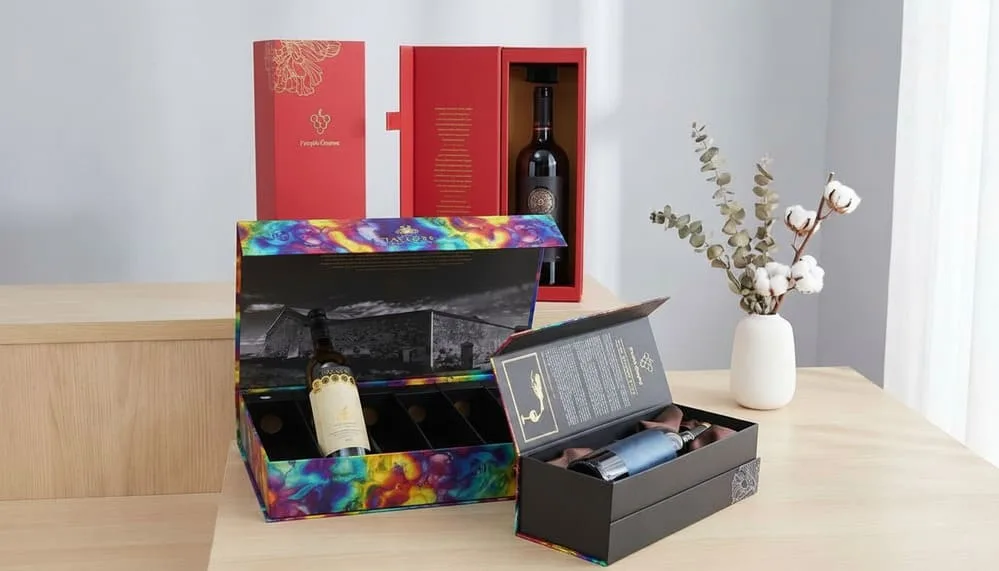
A wine bottle can represent years of craftsmanship, but poor packaging can turn a premium product into a costly return. I use custom wine boxes to balance protection, brand value, sustainability, and landed cost from the start.
Custom wine boxes work best when the bottle, insert, box structure, materials, printing, and shipping conditions are designed as one packaging system.
Key Takeaways / TL;DR
- Custom wine boxes should be designed around the actual bottle shape, sales channel, protection requirement, and target cost.
- Folding paperboard suits retail packaging, rigid paperboard suits premium gifting, and corrugated board suits many shipping applications.
- Bottle-specific inserts reduce internal movement and can help lower breakage, returns, and replacement costs.
- Premium finishes such as foil stamping, embossing, textured paper, and selective UV can strengthen wine-brand positioning without requiring every available finish.
- FSC-certified materials, right-sized structures, recyclable components, and efficient logistics can support more credible sustainable wine packaging decisions.
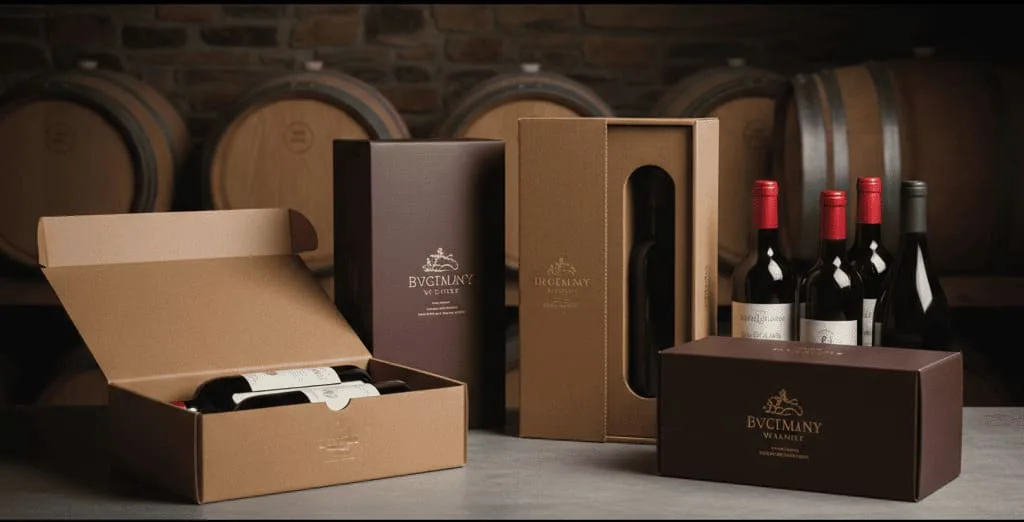
When I speak with wine brands and packaging buyers, I often find that the first question is, “How much does the box cost?” I understand why. Packaging budgets matter. However, the unit price is only one part of the decision.
A wine box also affects bottle protection, storage, shipping volume, customer perception, repeat purchasing, and brand positioning. After more than ten years working across packaging sales, factory production, sampling, quality control, and export orders, I have learned that the best packaging decisions usually begin with the product and distribution model rather than with a box price.
For buyers building a new wine packaging program, I recommend using the Custom Wine Packaging Resources Hub as the broader starting point for materials, printing, finishing, and packaging decisions.
What Are Custom Wine Boxes and Why Do Wineries Need Them?
A generic wine carton can protect a bottle, but it rarely addresses the complete commercial requirement. A custom wine box can be developed around bottle dimensions, brand identity, retail presentation, gifting, fulfillment, and shipping conditions.
Custom wine boxes give wineries and wine brands control over structure, capacity, printing, inserts, finishes, and presentation. That control becomes valuable when the wine sells at a premium or travels through multiple distribution stages.
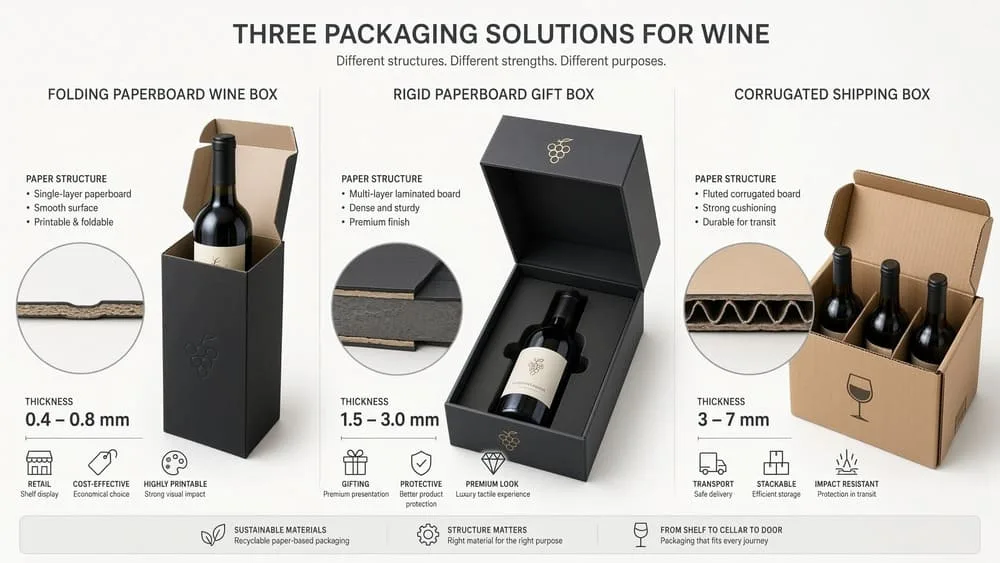
Custom Wine Boxes Do More Than Hold a Bottle
I normally evaluate wine packaging through four practical questions:
- Does the box protect the bottle?
- Does the box communicate the intended brand position?
- Does the structure make sense for storage and transportation?
- Does the total packaging cost fit the product economics?
A premium wine gift box may prioritize tactile quality and unboxing. A direct-to-consumer wine shipping box may prioritize impact resistance and efficient packing. A retail carton may need a strong printed surface and efficient shelf presentation.
These applications can require very different structures even when the same bottle is inside.
Why Wine Packaging Has Become a Business Decision
Wine packaging sits between manufacturing and customer experience. A box that looks excellent but allows excessive bottle movement can create avoidable damage. A highly protective structure that uses excessive material can increase freight volume and material consumption.
Recent research on wine logistics also shows why packaging and transportation should be considered together. A 2026 study of wine logistics found that transport distance, maritime emissions, and packaging choices can materially affect downstream carbon performance. (Source: ScienceDirect, The carbon footprint of downstream wine logistics)
For that reason, I prefer to discuss custom wine boxes as a system rather than as a printed carton.
What Is the Best Material for Custom Wine Boxes?
There is no single best material for every wine application. The correct material depends on bottle weight, box structure, distribution channel, presentation requirements, and target cost.
| Wine Packaging Application | Recommended Material | Main Advantage | Typical Priority |
|---|---|---|---|
| Retail wine packaging | Folding paperboard | Printable and cost-efficient | Branding |
| Premium wine gifts | Rigid paperboard | Strong structure and luxury feel | Presentation |
| E-commerce shipping | Corrugated board | Protection and stacking performance | Shipping |
| Multi-bottle packaging | Corrugated board with inserts | Separation and protection | Logistics |
| Sustainability-focused packaging | FSC-certified or recycled paper-based materials | Responsible sourcing and recyclability potential | Sustainability |
Folding Paperboard for Retail Wine Packaging
Folding paperboard works well when brands need strong graphics, efficient production, and reasonable unit economics. The structure can include tuck flaps, locking mechanisms, windows, dividers, and bottle-specific internal features.
For retail programs, I often recommend spending more attention on structural accuracy and print quality than on adding unnecessary luxury finishes.
Rigid Paperboard for Premium Wine Gifts
Rigid paperboard is a strong option for luxury custom wine boxes and gift packaging. The thicker construction creates a more substantial hand feel.
Rigid structures can also accommodate magnetic closures, ribbon details, foam or paper inserts, and layered presentation.
For a limited-edition wine release, corporate wine gift, anniversary collection, or premium wine club, rigid packaging can justify a higher packaging budget because the box becomes part of the perceived product experience.
Corrugated Board for Wine Shipping
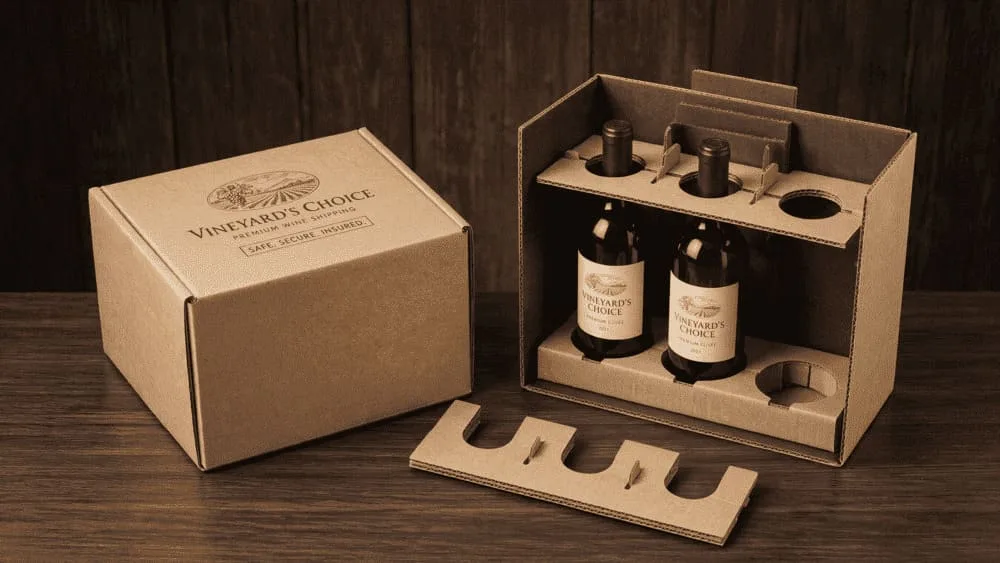
Corrugated board is often the more practical choice when the primary requirement is transportation protection. The structure can be combined with partitions or custom inserts to reduce bottle movement.
I would not recommend selecting a corrugated grade simply because it sounds stronger. The actual bottle weight, stacking conditions, shipping route, box dimensions, and internal support should determine the specification.
FSC-Certified Paper and Sustainable Material Choices
Sustainable wine packaging requires more than adding an “eco” label to a product description. Buyers should ask where the paper comes from, whether the material is certified, how much material the structure uses, and what happens after use.
The FSC Chain of Custody standard establishes requirements for organizations that source, process, label, and sell forest-based products as FSC-certified. (Source: FSC Chain of Custody Certification)
If certification is required for a project, I recommend verifying the actual certification scope and documentation rather than relying on a supplier’s general sustainability statement. Omet’s certifications page provides the appropriate place to review available certification information.
How Do You Design Custom Wine Boxes That Actually Protect the Bottle?
The most common packaging mistake I see is designing the outside of the box before understanding the bottle and internal support.
The correct sequence is:
Bottle → Insert → Internal Dimensions → Box Structure → Printing → Finishing
Start With the Bottle, Not the Box
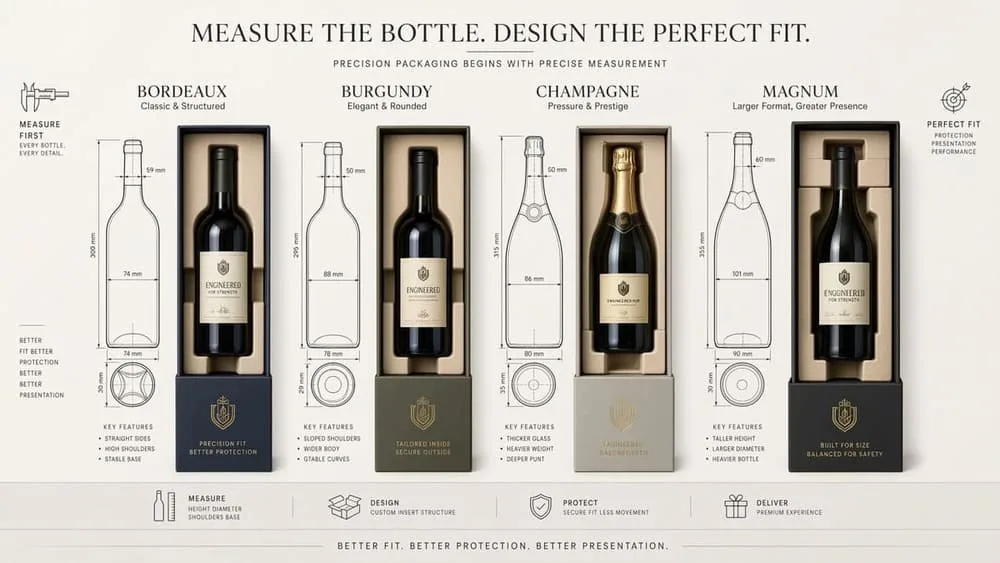
Bordeaux, Burgundy, Champagne, and Magnum bottles can have different heights, diameters, shoulders, bases, and neck proportions.
A box that fits one bottle type may create excessive movement around another bottle. That movement can become a serious problem during transportation.
For a new project, I recommend providing the manufacturer with the actual bottle dimensions. A physical sample is even better when the packaging structure is complex.
Choose the Insert as Part of the Structure
The insert should not be treated as an afterthought. The insert controls how the bottle sits inside the box and how forces are distributed during handling.
Common insert options include:
- Die-cut paperboard inserts
- Corrugated dividers
- Molded-pulp inserts
- EVA or foam inserts
- Folded paper supports
- Multi-bottle partitions
The best option depends on whether the packaging is designed mainly for retail presentation, gifting, or shipping.
Design for Movement, Stacking, and Handling
A shipping box can experience vibration, compression, impact, and repeated handling. The design therefore needs to control movement while maintaining reasonable material use.
A specialized sustainable Winepack structure studied in academic research reportedly reduced bottle breakage by 95% under the tested conditions. That result should not be treated as a universal breakage rate for all wine boxes, but it demonstrates the value of structural packaging engineering. (Source: ScienceDirect, Sustainability in e-commerce packaging)
The practical lesson is simple: adding more board is not always the best solution. Better internal geometry can sometimes produce more useful protection without simply making the package heavier.
Prototype Before Mass Production
I strongly recommend a physical sample before mass production, especially for fragile wine bottles.
At Omet, sampling gives the buyer an opportunity to check bottle fit, insert positioning, closure performance, color, printing, finishing, and overall presentation before committing to a large production run.
For buyers interested in manufacturing capability, the Omet Factory Tour provides additional information about production operations.
How Much Do Custom Wine Boxes Cost?
Custom wine box pricing depends on several variables. A buyer who asks only for a unit price before defining the specifications may receive a number that changes significantly later.
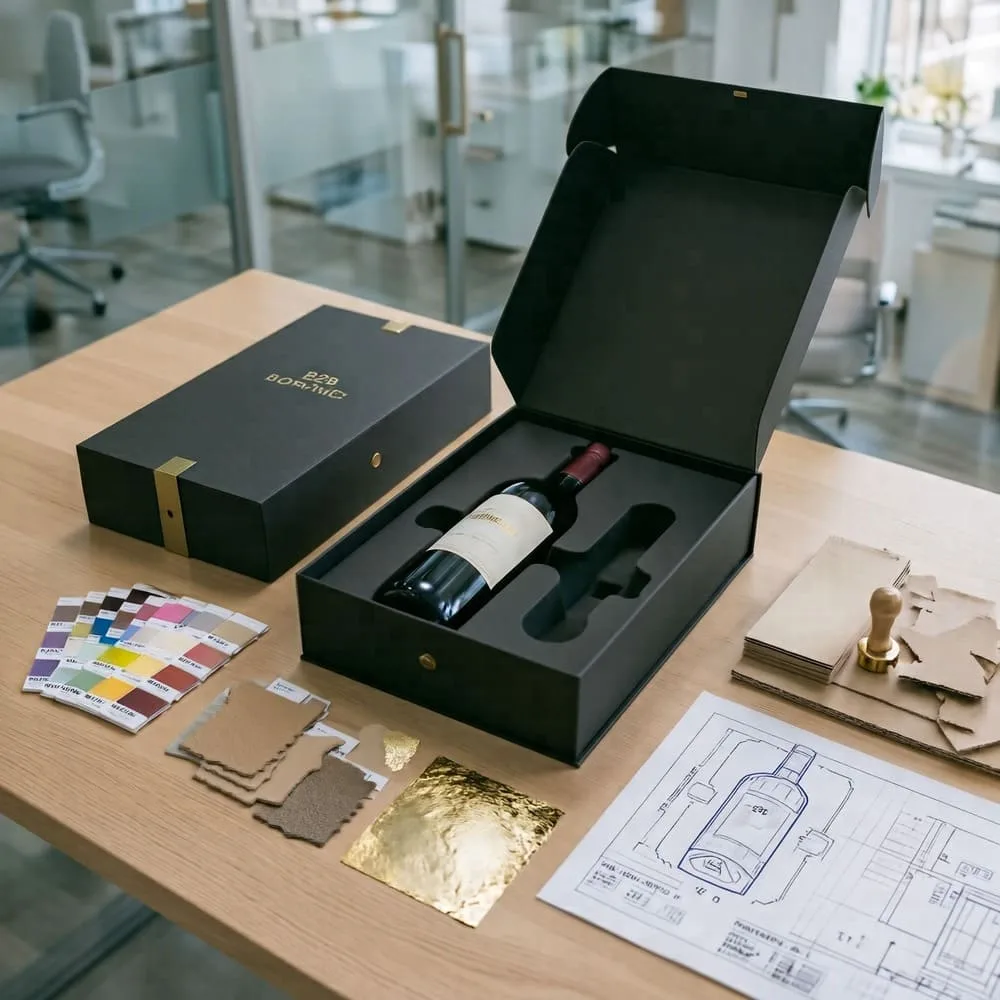
| Cost Factor | Lower-Cost Choice | Higher-Cost Choice | Cost Impact |
|---|---|---|---|
| Structure | Folding carton | Rigid magnetic box | High |
| Material | Standard paperboard | Specialty or thick board | Medium–High |
| Printing | CMYK | Special colors and multiple processes | Medium |
| Finish | No special finish | Foil, embossing, UV, texture | Medium–High |
| Insert | Simple divider | Custom molded or premium insert | Medium–High |
| Quantity | Small batch | Large production run | Strong unit-cost effect |
| Shipping | Optimized flat-pack structure | Large assembled volume | Strong landed-cost effect |
The Six Major Cost Drivers
I usually look at:
- Box dimensions
- Material specification
- Production quantity
- Printing method
- Finishing requirements
- Insert and closure design
Tooling, sampling, packaging for export, and transportation can also affect the final landed cost.
Why Quantity Matters
Large production runs can distribute setup and tooling costs across more units. However, ordering more boxes simply to reduce the unit price is not always financially sensible.
A buyer should compare inventory carrying costs, warehouse space, expected sales velocity, and packaging shelf life.
Unit Price Is Not the Same as Landed Cost
A lower factory quotation can become more expensive if the box is oversized, difficult to pack, inefficient to palletize, or costly to transport.
I have seen buyers focus heavily on the factory unit price while overlooking freight volume. For export packaging, I prefer to review the complete cost from production through delivery.
The real target is not the lowest unit price. The target is the lowest practical total cost while maintaining the required protection and brand experience.
Which Custom Wine Box Finishes Create a Luxury Brand Experience?
Luxury wine packaging does not require every finishing technique available. Strong design usually comes from choosing a few finishes that support the brand.
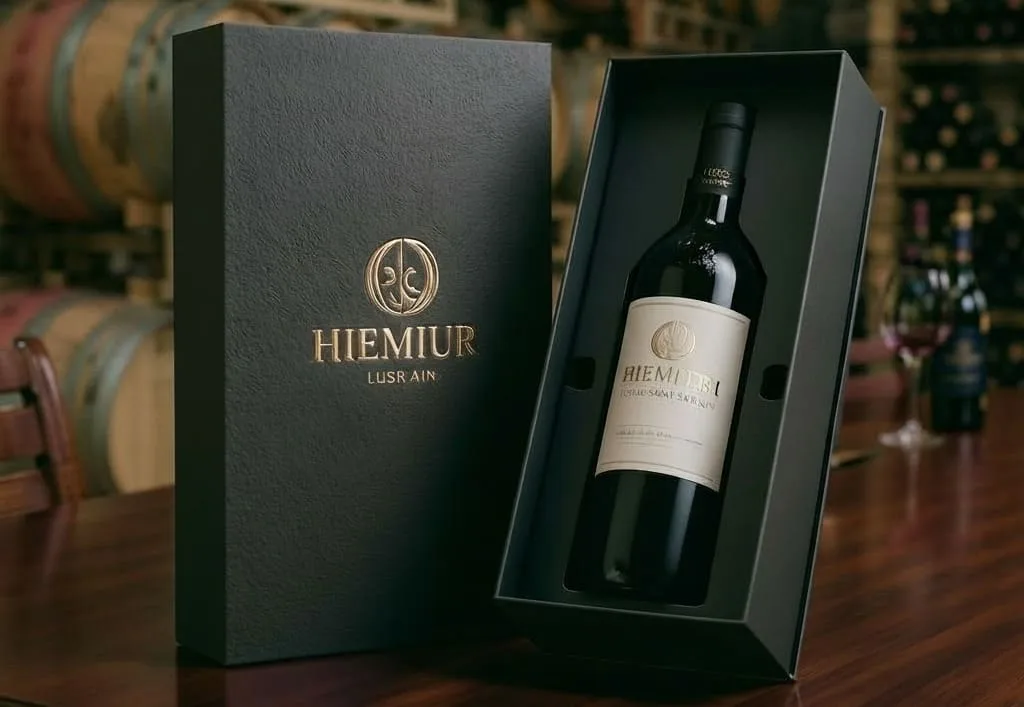
Foil Stamping
Hot foil stamping works well for logos, vintage years, winery names, and restrained decorative details.
Gold, silver, copper, and other metallic effects can create strong contrast against dark or textured papers.
Embossing and Debossing
Embossing creates raised details, while debossing presses details into the paper surface.
Both techniques can make a logo recognizable through touch rather than color alone.
Premium Papers and Textures
Textured paper can create a strong tactile impression without adding multiple printing processes.
For wine brands that want a natural or artisanal identity, textured uncoated papers can work particularly well.
Magnetic Closures
Magnetic closures suit premium wine gift boxes where opening the package is part of the customer experience.
However, I would not recommend magnetic closures simply because they look expensive. The closure needs to match the product price, gifting context, shipping requirements, and target packaging budget.
Omet’s paper box product range can be used as a starting point when evaluating custom paper box structures, inserts, closures, and finishing options.
Selective Premiumization Works Better Than Adding Everything
A common mistake is combining foil, embossing, spot UV, metallic paper, ribbon, magnetic closure, and multiple coatings in one package.
The result can become visually crowded and expensive.
A simpler combination such as textured paper, one foil color, and an embossed logo can communicate premium quality with better design discipline.
How Can Wine Brands Make Custom Wine Boxes More Sustainable?
Sustainable wine packaging should be measured across the entire packaging system.
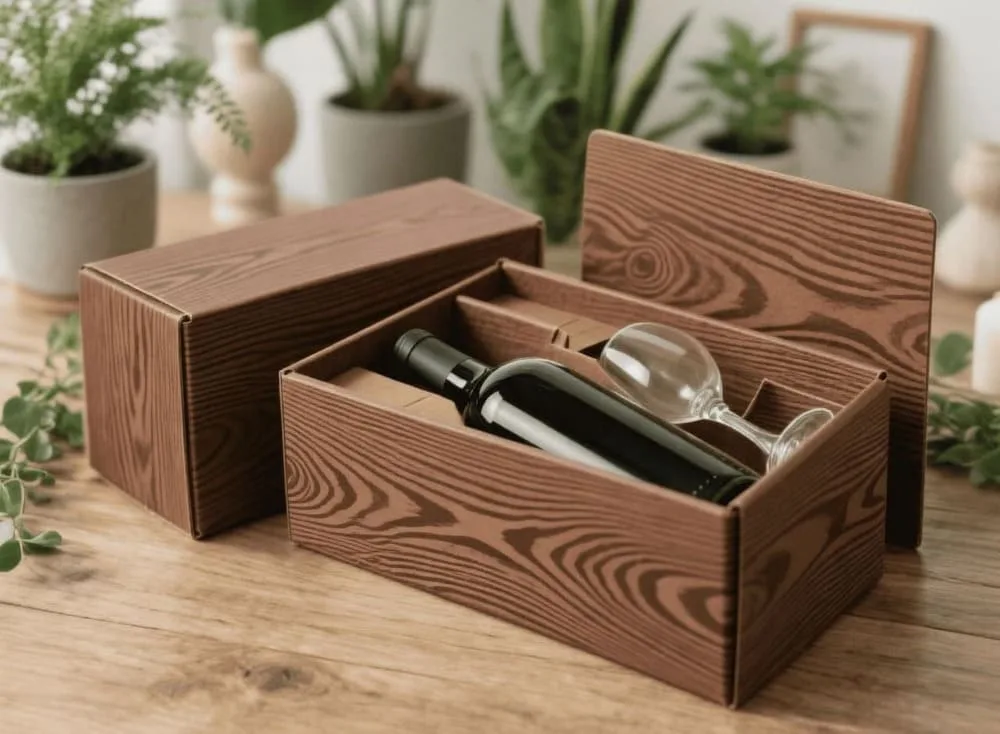
Start With Material Sourcing
FSC certification can provide a documented framework for responsible forest-based material sourcing and chain of custody.
Brands that require FSC-certified packaging should confirm the supplier’s current certification status and the relevant product scope.
Omet’s certification information should be reviewed alongside project-specific certification requirements.
Reduce Material Without Reducing Protection
Using more material does not automatically make packaging more sustainable.
An oversized box may consume more paper, occupy more warehouse space, and increase transport volume.
Right-sizing can reduce unnecessary material while keeping the bottle secure.
Consider the Full Distribution Route
Wine packaging may travel from a winery to a warehouse, distributor, retailer, or consumer.
Packaging design should therefore consider:
- Box dimensions
- Pallet utilization
- Shipping volume
- Protection requirements
- Material weight
- End-of-life handling
A packaging decision that looks sustainable at the factory may perform differently once transportation is included.
Avoid Unsupported Sustainability Claims
I recommend using specific claims that can be supported by documentation.
For example, “FSC-certified paper” is more useful than a vague statement such as “green paper.”
For international B2B buyers, documentation can be just as important as the physical packaging.
What Should You Look for in a Custom Wine Box Manufacturer?
A wine box manufacturer should be evaluated as a development and production partner rather than only as a quotation source.
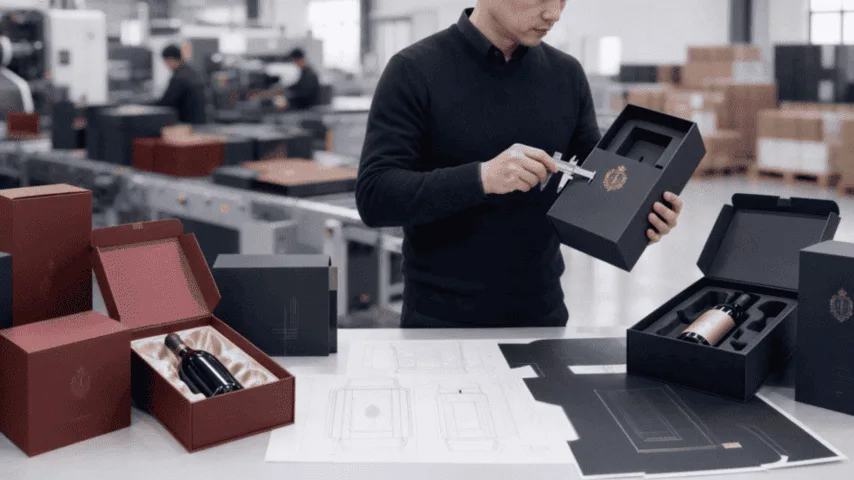
1. Structural Development
Ask whether the manufacturer can design around the actual bottle.
A capable supplier should be able to discuss dimensions, inserts, closures, board grades, tolerances, and production limitations.
2. Sampling
A physical prototype reduces the risk of discovering structural problems after mass production.
I recommend testing bottle fit and presentation before approving the final production sample.
3. Quality Control
Quality control should cover more than printing color.
For custom wine boxes, I would check:
- Dimensions
- Board thickness
- Die-cut accuracy
- Folding accuracy
- Glue strength
- Printing consistency
- Foil registration
- Embossing position
- Insert fit
- Closure performance
4. Certifications and Compliance
International buyers may need documentation related to FSC, social responsibility, or regional packaging requirements.
A supplier should be able to provide appropriate documentation rather than relying on verbal claims.
5. Production Capacity
A supplier that can produce a beautiful sample may still struggle with a large repeat order.
Buyers should evaluate machinery, production lines, quality-control procedures, labor capacity, and peak-season planning.
6. Global Export Capability
For overseas procurement, packaging production is only one part of the process.
Export documentation, carton packing, palletization, shipping method, destination requirements, and delivery coordination can affect the final result.
Custom Wine Boxes vs. Standard Wine Boxes: Which Is Better?
The right choice depends on the business model.
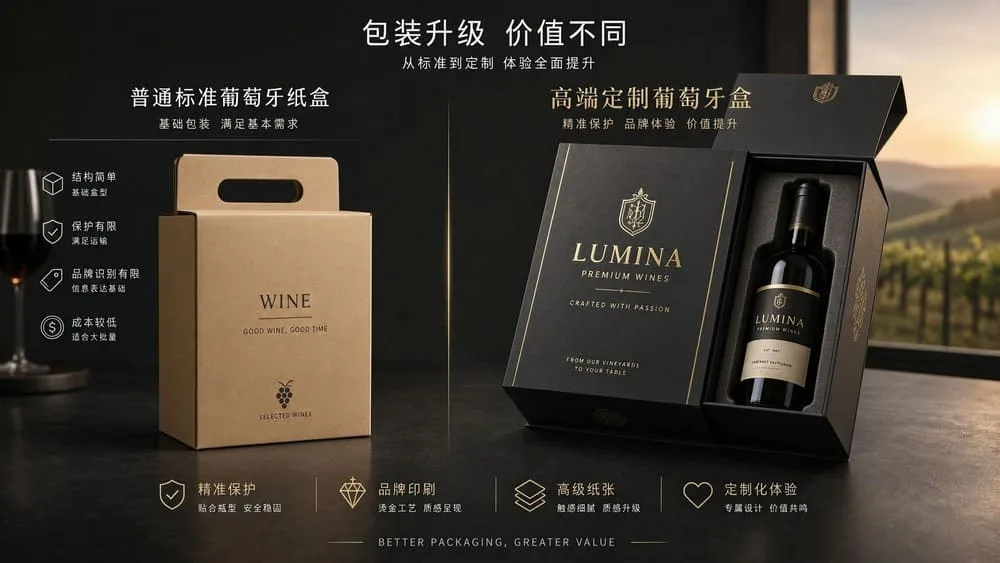
| Decision Factor | Standard Wine Box | Custom Wine Box |
|---|---|---|
| Initial development cost | Lower | Higher |
| Bottle fit | Generic | Bottle-specific |
| Brand differentiation | Limited | High |
| Premium presentation | Basic | Highly customizable |
| Shipping optimization | Moderate | High potential |
| Insert customization | Limited | Flexible |
| Sustainability optimization | Limited | Designable |
| Gift experience | Basic | Premium |
| Repeat-order consistency | Depends on supplier | Can be specified and controlled |
When Standard Packaging Makes Sense
Standard packaging can make sense when the product has a tight margin, the bottle format is common, and brand differentiation is not a major purchasing factor.
It can also work for temporary packaging programs or early-stage product testing.
When Custom Packaging Makes More Sense
Custom wine boxes become more attractive when the wine is:
- Premium-priced
- Gift-oriented
- Sold through direct-to-consumer channels
- Part of a wine club
- Used for corporate gifting
- Released as a limited edition
- Competing for attention in premium retail
The commercial decision should be based on product economics and customer experience rather than packaging cost alone.
What Should B2B Buyers Include in a Custom Wine Box RFQ?
A clear RFQ helps a manufacturer produce a more accurate quotation and reduces repeated clarification.
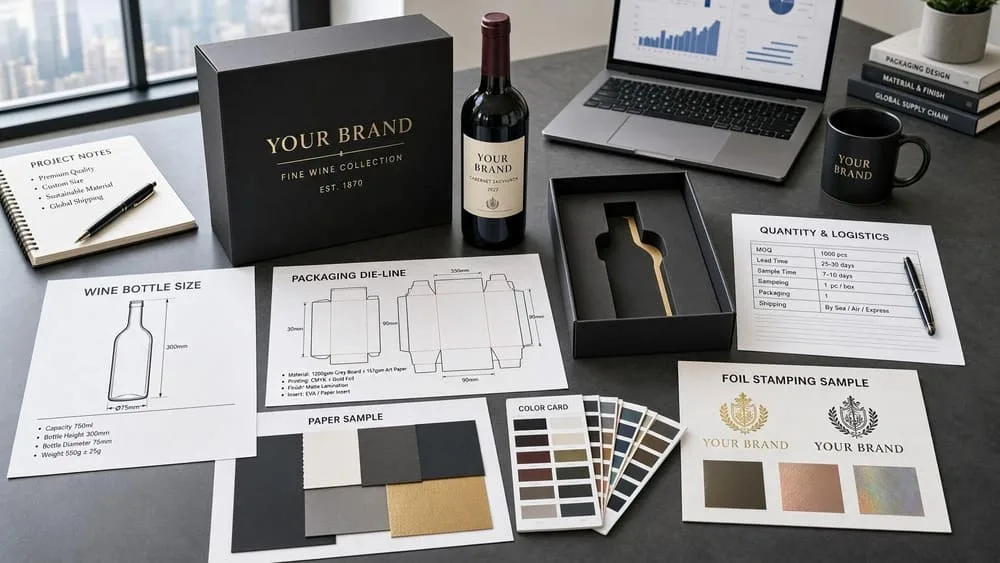
Product Specifications
Provide:
- Bottle height
- Bottle diameter
- Bottle weight
- Bottle quantity per box
- Bottle type
- Box capacity
- Target box dimensions, if available
Printing and Finishing Specifications
Specify:
- Artwork format
- Printing colors
- Pantone requirements
- Foil requirements
- Embossing or debossing
- Lamination
- Surface texture
- Window requirements
- Closure requirements
Quantity and Logistics
Include:
- Sample quantity
- Initial order quantity
- Annual forecast
- Destination country
- Delivery address or port
- Preferred shipping method
- Required delivery date
Certification and Compliance
If the project requires FSC-certified materials or other documentation, state the requirement before quotation.
Early disclosure helps the manufacturer source the correct materials and prepare the appropriate production process.
What Is the Best Custom Wine Box for Different Wine Business Models?
The best structure changes with the sales channel.
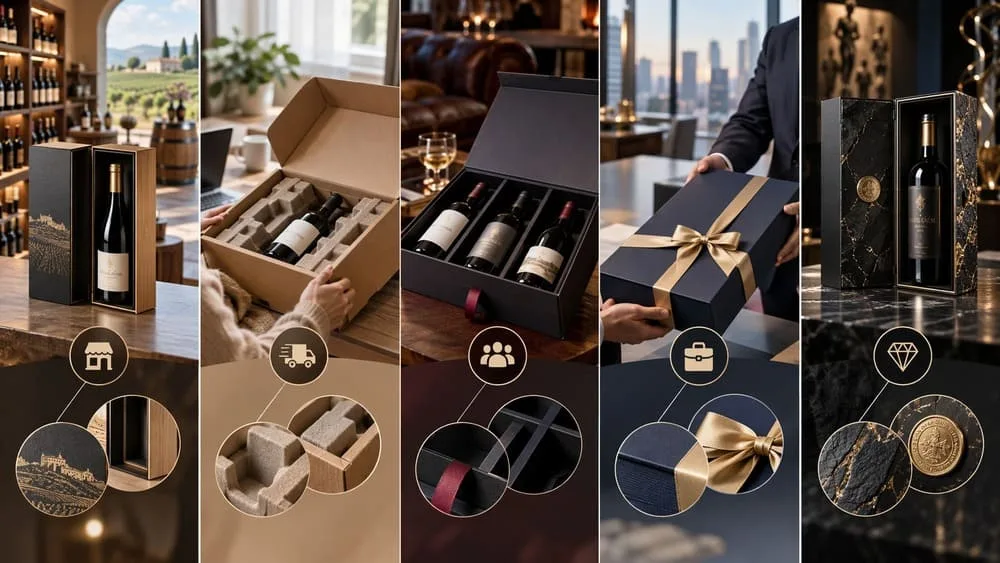
| Wine Business Model | Recommended Packaging Direction | Main Objective |
|---|---|---|
| Winery retail | Printed folding paperboard | Shelf presentation |
| Premium winery | Rigid custom wine box | Brand positioning |
| DTC wine brand | Corrugated shipping box with inserts | Protection |
| Wine club | Custom multi-bottle box | Unboxing and logistics |
| Corporate gifting | Rigid gift box | Premium presentation |
| Limited edition | Specialty rigid or folding structure | Collectability |
| Distributor | Efficient corrugated structure | Storage and transportation |
I recommend starting with the commercial objective and working backward to the packaging structure.
That approach usually prevents unnecessary specifications.
How Can Custom Wine Boxes Improve Total Packaging ROI?
Packaging ROI should not be measured only through unit price.
A better calculation considers:
Packaging Cost + Freight + Damage + Returns + Labor + Storage + Brand Impact
A premium box may cost more but generate value through improved presentation and reduced damage.
A lower-cost box may appear attractive but create higher expenses through oversized shipping dimensions or inadequate bottle protection.
For a B2B buyer, the most useful question is:
How much business value does each packaging dollar create?
That question leads to better decisions than simply asking for the cheapest custom wine box.
Conclusion
Custom wine boxes should protect the bottle, strengthen the brand, support sustainability goals, and remain commercially practical across production and logistics.
If you are sourcing custom wine boxes for a winery, retailer, distributor, wine club, or gifting program, send Omet your bottle dimensions, quantity, destination, and design requirements for a packaging recommendation and quotation.
You can also review the custom paper boxes product range or explore the Wrapping Paper Resources Hub for related packaging knowledge.
For related reading, I recommend building the next internal cluster around materials, printing, finishing, sampling, and supplier selection so buyers can move naturally from packaging research to quotation.
FAQs
What are the best materials for custom wine boxes?
Folding paperboard suits retail packaging, rigid paperboard suits premium gifting, and corrugated board suits shipping. The final material should match bottle weight, distribution conditions, presentation requirements, and target cost.
How much do custom wine boxes cost?
Custom wine box pricing depends on material, dimensions, order quantity, printing, finishing, inserts, closures, sampling, and logistics. Larger production runs can reduce unit cost by distributing setup expenses across more units.
What is the best packaging for shipping wine bottles?
A properly engineered corrugated box with bottle-specific inserts or dividers is generally suitable for shipping. The internal structure should control bottle movement and support the bottle during handling and transportation.
Can custom wine boxes be environmentally friendly?
Yes. Brands can use FSC-certified or recycled paper-based materials, right-sized structures, recyclable components, and efficient inserts. Sustainability should be evaluated across sourcing, production, transportation, use, and end-of-life.
How do I order custom wine boxes from a manufacturer?
Provide bottle dimensions, bottle quantity, box capacity, order volume, artwork, material preference, finishing requirements, insert specifications, destination, and certification needs. A manufacturer can then develop a sample and quotation.