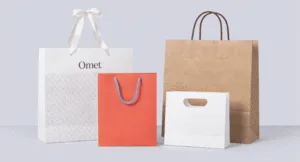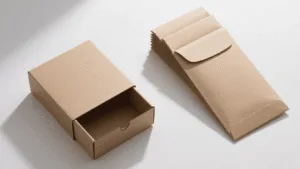
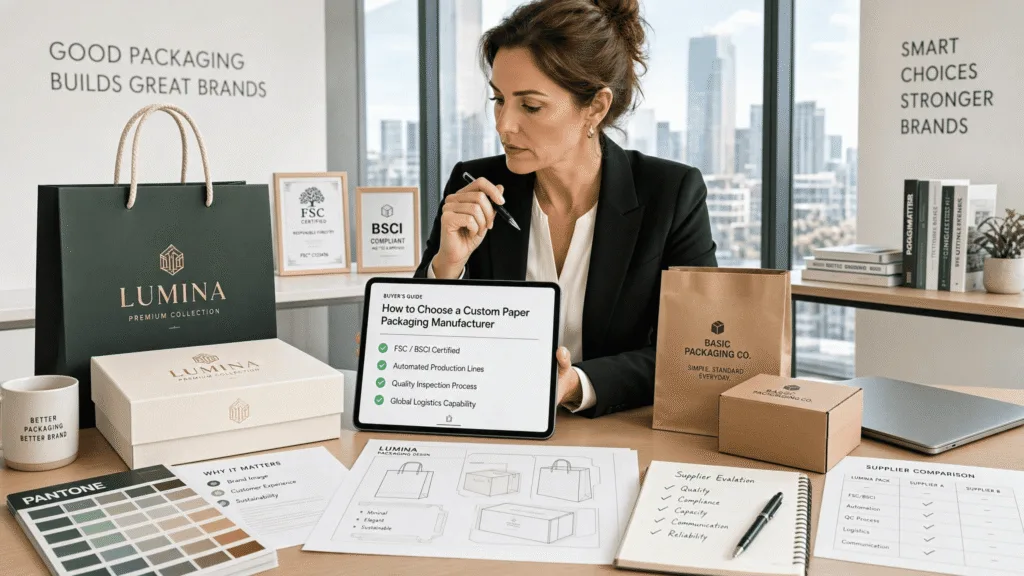
Choosing a custom paper packaging manufacturer should not start with price. B2B buyers should first verify manufacturing capability, sample quality, quality control, production capacity, MOQ, lead time, and total landed cost.
The best way to choose a custom paper packaging manufacturer is to evaluate manufacturing capability, quality control, samples, communication, and total cost together. Compare suppliers using identical specifications rather than choosing based only on unit price.
This guide explains how brands, retailers, wholesalers, and purchasing teams can evaluate a manufacturer before ordering custom paper bags, paper boxes, wrapping paper, or other paper packaging.
Key Takeaways
- Verify manufacturing capability: Ask for factory information, production equipment, certifications, samples, and evidence of similar projects.
- Inspect physical samples: Check paper GSM, printing, dimensions, construction, handles, finishing, and structural strength.
- Compare quotations like-for-like: Make sure paper, GSM, printing, finishing, handles, packaging, quantity, and shipping terms are the same.
- Investigate unusually low prices: A lower quote may reflect thinner paper, fewer finishing processes, weaker construction, or different shipping terms.
- Prepare a detailed RFQ: Include dimensions, material, GSM, printing, finishing, components, quantity, packaging, destination, and Incoterm.
- Check the complete production schedule: Sampling, approval, mass production, inspection, packing, and shipping all affect the actual delivery date.
- Evaluate communication: A supplier that identifies missing specifications and explains production risks clearly is easier to work with.
What Makes a Good Custom Paper Packaging Manufacturer?
A professional website alone does not prove that a company operates its own manufacturing facilities.
A reliable packaging manufacturer should be able to demonstrate that its capabilities match your product requirements. Look for evidence in five areas:
- Manufacturing capability
- Quality control
- Physical samples
- Production capacity and lead time
- Clear communication and accountability
Before I founded Yiwu Omet Packaging, I spent years working in factory sales and communicating with B2B buyers. One recurring problem was that buyers compared packaging suppliers by unit price before confirming whether the quotations were based on the same specifications.
That creates a misleading comparison.
For example, two paper shopping bags may have very different prices because of differences in paper GSM, lamination, construction, and handles:
| Specification | Supplier A | Supplier B |
|---|---|---|
| Paper | 180 GSM | 250 GSM |
| Lamination | None | Matte |
| Construction | Standard | Reinforced |
| Handles | Twisted paper | Ribbon |
| Price | Lower | Higher |
The lower quotation does not necessarily represent better value. The first step is to understand exactly what each supplier is quoting.
How to Verify a Packaging Manufacturer
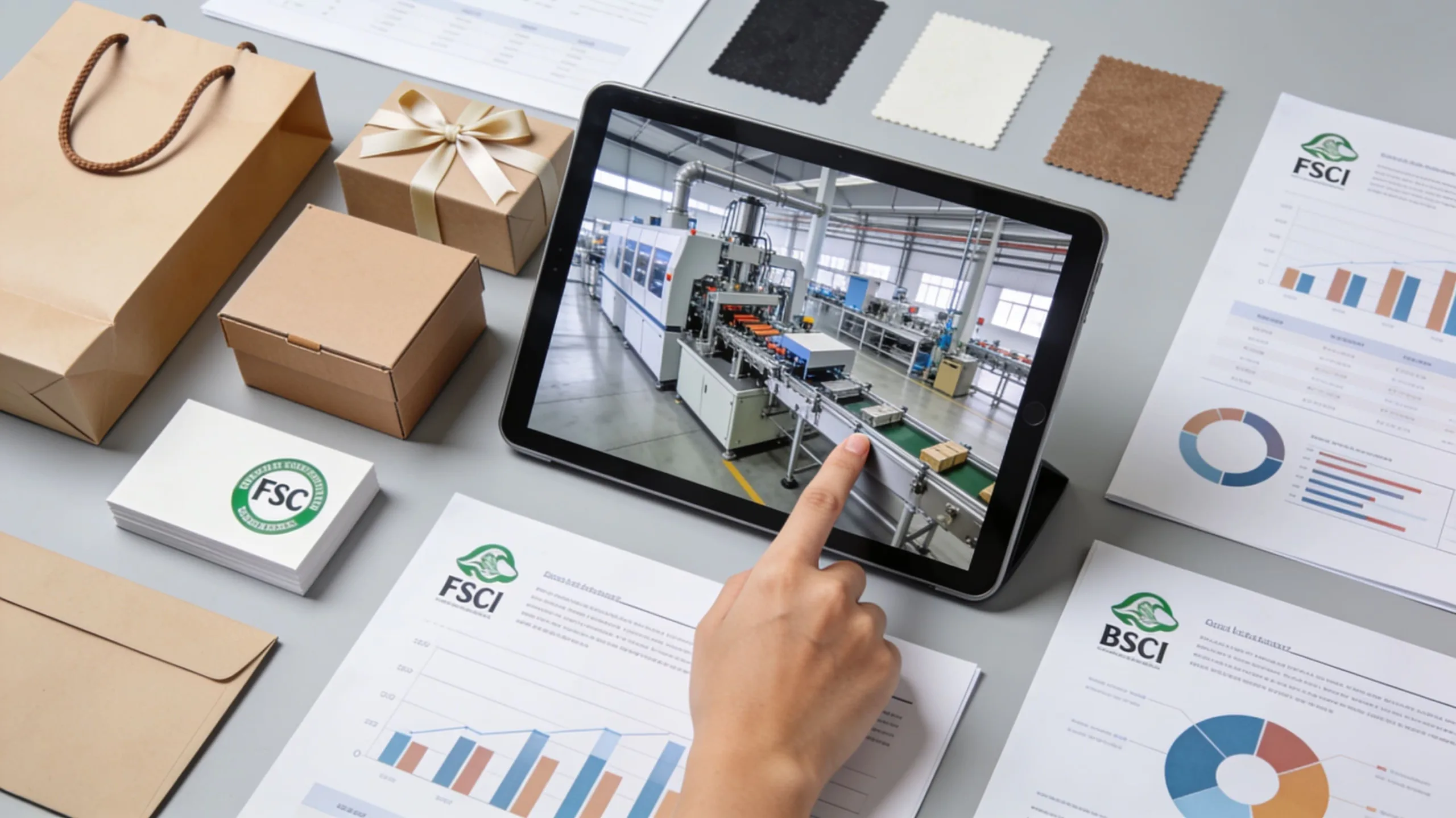
Verify a packaging manufacturer’s capabilities using factory information, production equipment, physical samples, certifications, production records, and a clear explanation of its quality-control process.
What Should You Ask a Packaging Manufacturer to Provide?
Ask for:
- Recent factory photographs or production videos
- A live virtual factory tour when practical
- Details of relevant production equipment
- Examples of similar packaging products
- Available paper types and GSM ranges
- Printing capabilities
- Finishing capabilities such as lamination, hot stamping, embossing, and UV
- Sample-production procedures
- Quality inspection procedures
- Typical production capacity and lead times
- Relevant certifications or audit documentation
At Omet Pack, buyers can discuss packaging requirements directly with the team and review production capabilities, samples, and relevant certifications.
The important question is not whether a supplier has the most impressive website. It is whether the supplier can provide evidence that its manufacturing capabilities match your project.
Manufacturer vs. Trading Company: What Should Buyers Check?
A direct manufacturer and a trading company are not automatically good or bad choices. The important issue is whether the supplier can provide the quality, communication, production capacity, accountability, and service required for your project.
If you are unsure which business model you are dealing with, ask:
- Where is the actual production facility?
- Which manufacturing processes are performed in-house?
- Which processes are outsourced?
- Who is responsible for quality inspection?
- Can the supplier show examples of products made in its production facility?
- Who will manage your order after sample approval?
These questions are more useful than simply asking whether a supplier calls itself a "factory."
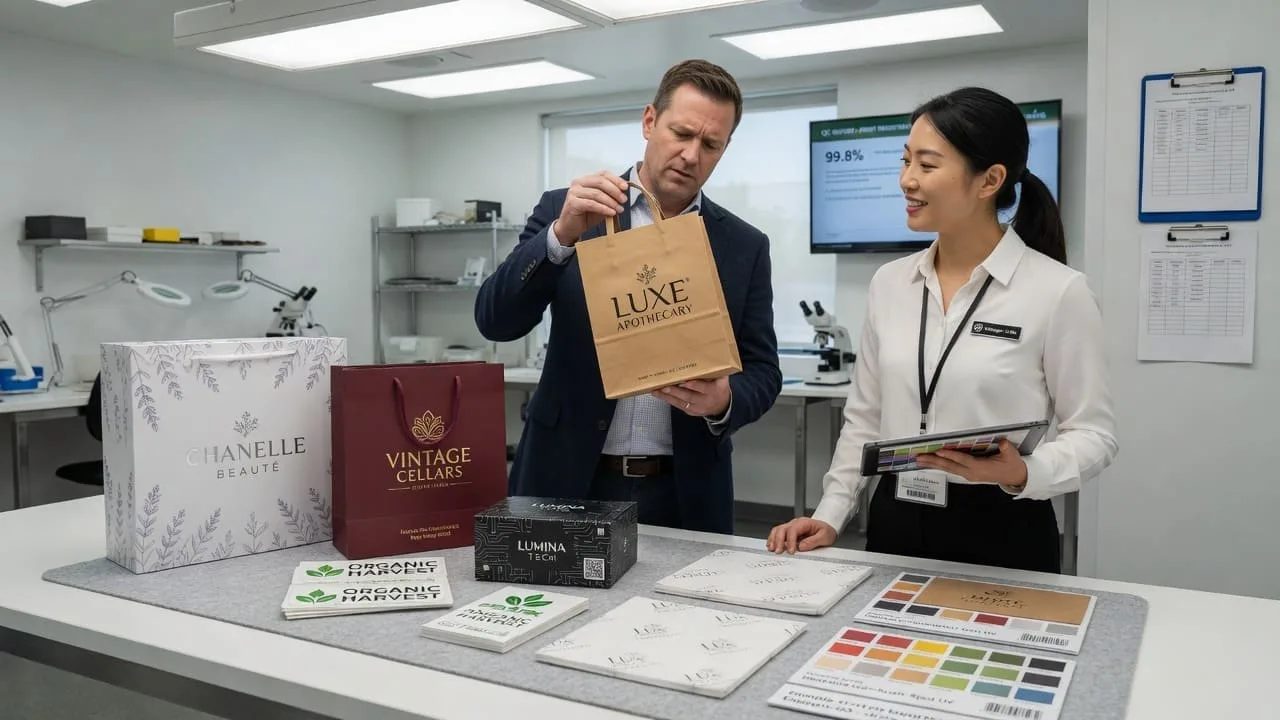
How to Evaluate a Custom Packaging Sample
A physical sample is one of the most useful tools in packaging procurement.
A sample should answer:
Can this manufacturer consistently produce the packaging according to my specifications?
For custom paper bags and boxes, inspect these five areas:
| Inspection Area | What to Check |
|---|---|
| Paper & Material | Paper type, GSM, thickness, stiffness, texture, coating, and appearance |
| Printing | Color accuracy, Pantone matching, registration, image sharpness, text clarity, and ink coverage |
| Construction | Folding accuracy, glue lines, structural strength, reinforcement, and overall shape |
| Handles & Components | Material, attachment points, strength, symmetry, and finishing |
| Finishing | Foil adhesion, embossing depth, lamination consistency, UV coating, and surface protection |
Don’t Just Inspect Appearance
For a paper shopping bag, also check:
- Whether dimensions match the approved specification
- Whether the bottom construction can support the intended product
- Whether handle attachment is secure
- Whether the paper is appropriate for the product positioning
- Whether printed colors match the approved artwork
- Whether foil stamping is clean and correctly positioned
- Whether lamination is consistent
- Whether folding and gluing are accurate
A visually attractive sample is not enough if the construction cannot withstand real use.
Packaging Manufacturer Verification Checklist
| Verification Method | What to Look For | Why It Matters |
|---|---|---|
| Certifications | Relevant FSC, BSCI, ISO, or other documentation where applicable | Supports sustainability, social-compliance, or quality-management requirements |
| Factory Tour | Live video or recent production footage | Helps confirm the production environment |
| Production Equipment | Printing, die-cutting, folding, laminating, hot stamping, bag-making, or other relevant equipment | Shows whether the supplier has suitable production capabilities |
| Sample Kit | Materials, printing, finishing, handles, and completed products | Allows you to evaluate actual workmanship |
| Quality Control | Incoming-material checks, in-process inspection, and final inspection | Shows how quality is managed |
| Similar Projects | Examples of comparable packaging | Helps confirm relevant manufacturing experience |
| Project Management | Clear contact person and approval process | Reduces communication problems |
Certifications Are Useful, But Verify Them
Certifications should support supplier evaluation rather than replace it.
For example:
- FSC may be relevant when sourcing requirements include responsibly sourced forest products.
- BSCI may be relevant to social-compliance requirements.
- ISO 9001 may be relevant when evaluating quality-management systems.
However, buyers should check:
- Whether the certification is current
- Which company or facility it applies to
- What its scope covers
- Whether the documentation can be verified
- Whether it is relevant to the procurement requirements
FSC does not prove manufacturing capability, BSCI does not prove product quality, and ISO 9001 does not mean a supplier will have zero defects.
What Red Flags Should You Watch For?
Common packaging supplier red flags include unexplained low prices, vague technical answers, unverifiable documentation, inconsistent communication, unclear production timelines, and resistance to physical sampling.
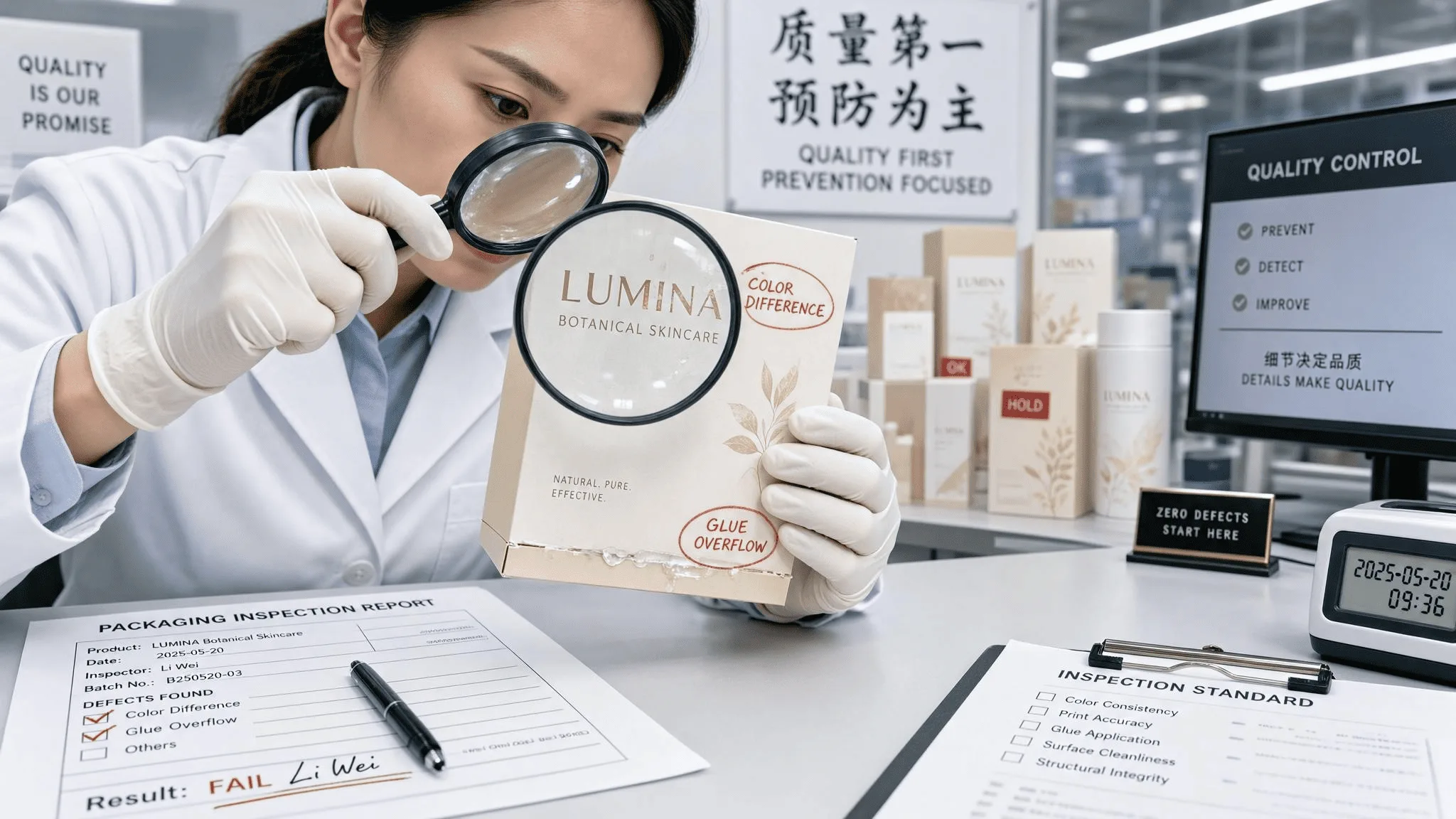
Quality problems often begin before production starts because the buyer and supplier have different assumptions about:
- Paper GSM
- Material type
- Printing
- Finishing
- Handle material
- Reinforcement
- Packaging
- Shipping terms
Before accepting a surprisingly cheap quotation, ask:
- Is the paper GSM identical?
- Is the paper type identical?
- Is the printing method identical?
- Is the finishing identical?
- Are the handles made from the same material?
- Is reinforcement included?
- Are tooling and sampling costs included?
- Is export packaging included?
- Is the Incoterm the same?
- Are freight, duties, or other costs included?
There is no universal percentage that makes a quotation "too cheap." The better approach is to identify why the quotation is cheaper.
Red Flags vs. Green Flags
| Red Flag | Green Flag |
|---|---|
| Price is dramatically lower without a clear specification difference | Price is competitive and clearly itemized |
| Supplier gives vague technical answers | Supplier explains materials and production clearly |
| Certifications cannot be verified | Relevant documentation can be provided |
| Supplier resists physical samples | Supplier supports sample approval before production |
| Different employees provide conflicting information | A dedicated contact coordinates the project |
| Production lead time is unclear | Supplier provides a realistic production schedule |
| Supplier cannot explain quality inspection | Supplier has defined quality-control procedures |
| Supplier avoids confirming specifications | Supplier clearly confirms GSM, dimensions, printing, finishing, and construction |
How to Evaluate a Packaging Manufacturer’s Communication
Communication quality is especially important for international B2B packaging projects.
Pay attention to whether the supplier:
- Identifies missing specifications
- Confirms dimensions and tolerances
- Explains material options
- Confirms printing requirements
- Explains finishing limitations
- Provides a clear sampling process
- Gives realistic production timelines
- Identifies potential production risks
- Records approved specifications clearly
A useful test is the quotation process itself.
If a supplier immediately gives you a price without asking about dimensions, paper, GSM, printing, finishing, quantity, or packaging requirements, the quotation may be based on assumptions.
A professional packaging manufacturer should ask enough questions to understand what you actually need.
What Does a Good Packaging Production Process Look Like?
A reliable custom packaging project normally contains several approval stages.
At Omet Pack, the process typically follows this structure:
- Specification confirmation — Confirm dimensions, paper, printing, finishing, handles, quantity, and packaging.
- Quotation — Calculate pricing based on the confirmed specifications and quantity.
- Digital proofing — Review artwork, mockups, dielines, and technical information where required.
- Sample production — Produce a physical sample when the project requires one.
- Sample approval — Confirm materials, colors, construction, and finishing before mass production.
- Mass production — Manufacture according to the approved specifications.
- Quality inspection — Perform appropriate quality checks before shipment.
- Export packing and delivery — Pack and ship according to the agreed terms.
Each major production decision should be confirmed before the next stage begins.
How Should You Evaluate Packaging Manufacturer Lead Time?
Do not evaluate lead time using one number alone.
A statement such as "Production takes 15 days" does not tell you when the order will actually arrive.
| Project Stage | What Buyers Should Ask |
|---|---|
| Artwork Preparation | How long will artwork review and technical confirmation take? |
| Sampling | How many working days are needed for the physical sample? |
| Sample Approval | How much time is needed for shipping and buyer approval? |
| Mass Production | How many working days after sample approval? |
| Quality Inspection | When is final inspection performed? |
| Export Packing | How long does packing and loading take? |
| Shipping | What is the estimated transit time under the selected Incoterm? |
Also ask what happens if the buyer changes paper, dimensions, artwork, printing, finishing, or quantity after the sample has been produced.
A realistic production schedule should include approval time and potential revisions, not just factory production days.
What Should You Include in a Packaging RFQ?
A detailed RFQ makes supplier quotations easier to compare.
A request such as:
"Please quote 5,000 paper bags."
is usually not enough because suppliers may make different assumptions about materials, dimensions, printing, finishing, handles, packaging, and shipping.
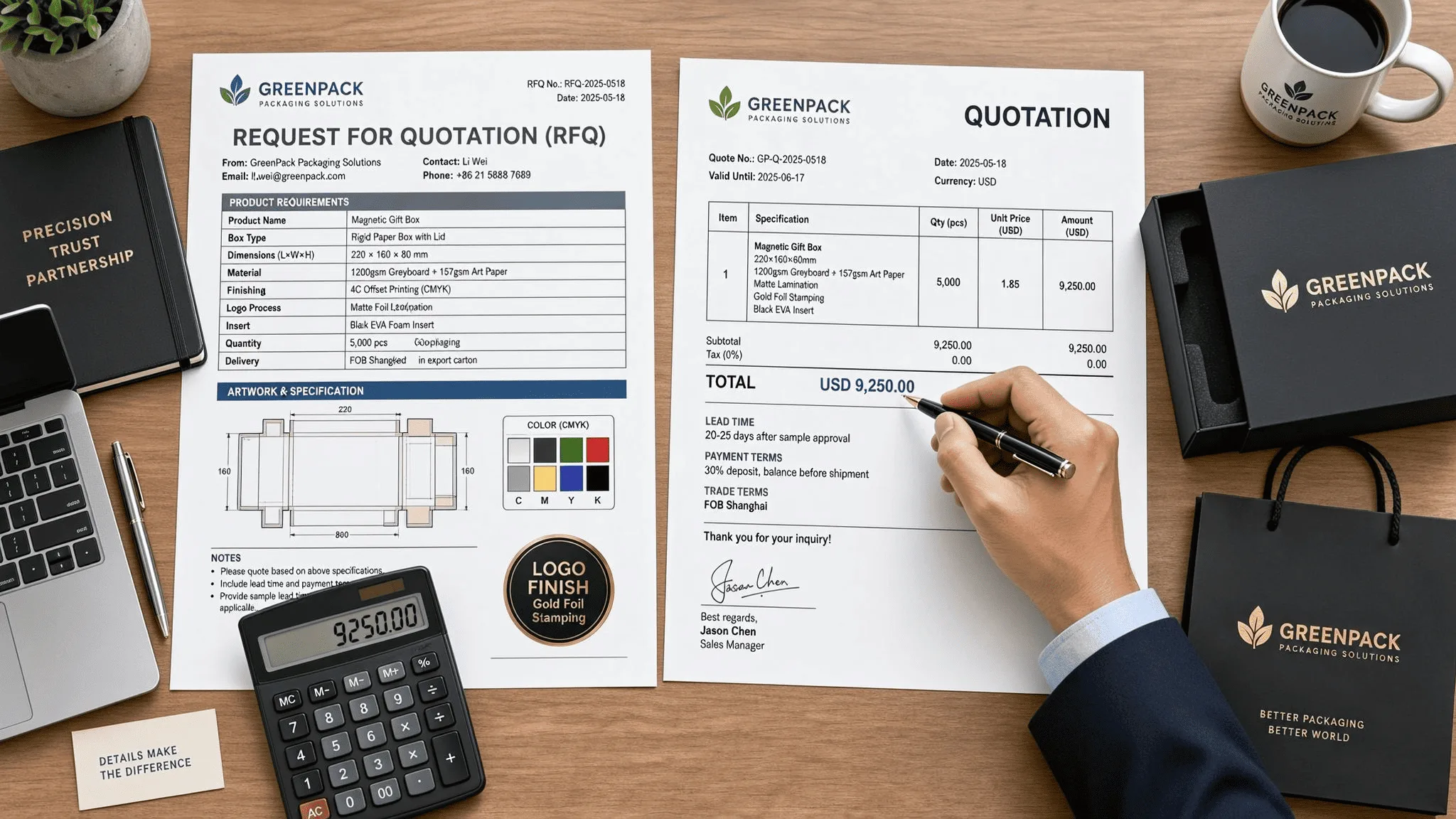
Essential Packaging RFQ Checklist
| Specification | What to Provide | Example |
|---|---|---|
| Product Type | Paper bag, folding box, mailer box, etc. | Custom Paper Shopping Bag |
| Dimensions | Width × Height × Depth or appropriate product dimensions | 30 × 40 × 12 cm |
| Material | Paper type and GSM | 210 GSM Art Paper |
| Printing | CMYK, Pantone, coverage, or printing method | CMYK + 1 Pantone |
| Finishing | Lamination, foil stamping, embossing, UV, etc. | Matte Lamination + Gold Foil |
| Handles | Material, type, width, and color | 2 cm Grosgrain Ribbon |
| Construction | Reinforcement, bottom structure, closure, etc. | Reinforced Bottom |
| Quantity | Total quantity and number of designs | 5,000 pcs, 1 design |
| Packaging | Carton and packing requirements | Export Cartons |
| Shipping | Destination and preferred Incoterm | DDP Los Angeles |
If you do not know the correct paper GSM or construction, tell the manufacturer what the packaging needs to carry and how it will be used.
A good manufacturer should be able to recommend suitable specifications rather than simply asking you to choose technical parameters you may not understand.
How to Compare Quotes From Different Packaging Manufacturers
Never compare packaging suppliers by unit price alone.
First standardize the specifications, then compare total cost and commercial terms.
| Cost or Specification | Supplier A | Supplier B | Supplier C |
|---|---|---|---|
| Paper type | |||
| Paper GSM | |||
| Dimensions | |||
| Printing | |||
| Finishing | |||
| Handle type | |||
| Reinforcement | |||
| MOQ | |||
| Sample cost | |||
| Tooling cost | |||
| Production lead time | |||
| Packaging | |||
| Incoterm | |||
| Shipping cost | |||
| Estimated landed cost |
A supplier may offer a lower unit price because it uses:
- Lower GSM paper
- Fewer finishing processes
- Different handles
- Less reinforcement
- Different packaging
- Different shipping terms
How to Calculate Landed Cost
For international B2B purchasing, a simplified landed-cost calculation is:
Landed Cost = Product Cost + Tooling/Sampling Costs + Packaging + Freight + Duties/Taxes + Other Applicable Import Costs
The exact calculation depends on the destination and agreed Incoterm.
Compare total value and landed cost, not just factory unit price.
What Is a Realistic MOQ for Custom Paper Packaging?
There is no universal MOQ for custom paper packaging.
For many custom paper bags and boxes, suppliers may quote MOQs around 1,000–3,000 pieces, but the actual MOQ depends on:
- Product structure
- Paper material
- Printing
- Finishing
- Machine setup
- Quantity
- Number of designs
- Production method
More importantly, ask how the MOQ is calculated.
A supplier may apply MOQ:
- Per order
- Per design
- Per size
- Per color
- Per material
- Per production run
For example, 3,000 bags in one design is very different from 3,000 bags divided across six designs.
Always clarify this before comparing quotations.
Packaging Manufacturer Evaluation Scorecard
When comparing several suppliers, a simple scoring system can make the decision more objective.
| Evaluation Category | Suggested Weight |
|---|---|
| Manufacturing Capability | 20% |
| Sample Quality | 20% |
| Quality Control | 15% |
| Communication | 15% |
| Price | 10% |
| Lead Time | 10% |
| Certifications | 5% |
| MOQ Flexibility | 5% |
| Total | 100% |
A supplier with the lowest price may not receive the highest overall score.
The goal is to identify the manufacturer that offers the best combination of quality, capability, reliability, communication, and total value for your specific project.
Does the Best Manufacturer Depend on the Packaging Product?
Different paper packaging products require different manufacturing capabilities.
Paper Bags
Pay particular attention to:
- Bag-making capability
- Paper GSM
- Handle attachment
- Bottom reinforcement
- Printing quality
- Structural strength
Paper Boxes
Pay particular attention to:
- Die-cutting accuracy
- Folding and gluing
- Structural construction
- Insert fitting
- Finishing consistency
Wrapping Paper
Pay particular attention to:
- Paper GSM
- Roll width and length
- Printing consistency
- Rewinding
- Roll packaging
The best supplier for one packaging product is not necessarily the best supplier for another. Match the manufacturer’s equipment and experience to the product you are purchasing.
A Practical 7-Step Process for Choosing a Packaging Manufacturer
If you are evaluating several suppliers, use this process:
Step 1: Standardize Your Specifications
Prepare the same RFQ for every manufacturer.
Step 2: Check Manufacturing Capability
Verify that the supplier can actually produce your required packaging.
Step 3: Review Samples
Inspect paper, printing, construction, handles, finishing, and structural strength.
Step 4: Verify Documentation
Check relevant certifications, audits, and company information.
Step 5: Compare Quotes Like-for-Like
Make sure suppliers are quoting identical specifications.
Step 6: Evaluate Communication
Look at how clearly and consistently the supplier handles technical questions.
Step 7: Confirm the Complete Production Schedule
Understand sampling, approval, production, inspection, packing, and shipping.
Final Checklist Before You Place a Packaging Order
Before approving a manufacturer, make sure you can answer "yes" to most of these questions:
- Can the supplier demonstrate relevant manufacturing capabilities?
- Have you reviewed a physical sample?
- Does the sample match the required specifications?
- Have you confirmed paper type and GSM?
- Have you confirmed dimensions?
- Have you confirmed printing and color requirements?
- Have you confirmed finishing?
- Have you checked handle and structural strength?
- Have you confirmed the MOQ?
- Have you confirmed sample and tooling costs?
- Have you received a realistic production schedule?
- Have you confirmed the inspection process?
- Have you compared quotations using identical specifications?
- Have you calculated the expected landed cost?
- Do you have a clear point of contact?
If several answers are "no," complete the supplier evaluation before placing the order.
Conclusion: Choose the Manufacturer That Reduces Your Total Risk
Choosing a custom paper packaging manufacturer should be treated as a procurement decision, not simply a price comparison.
The most reliable approach is to:
- Verify the supplier’s manufacturing capabilities.
- Check relevant certifications and documentation.
- Request and inspect physical samples.
- Standardize specifications before comparing quotations.
- Evaluate quality-control and production processes.
- Confirm MOQ, sampling, production, and shipping timelines.
- Evaluate communication and project management.
- Compare total landed cost rather than unit price alone.
The cheapest quotation is not necessarily the lowest-cost option.
A packaging manufacturer that consistently meets specifications, communicates clearly, manages quality, and delivers according to an agreed schedule can help reduce delays, reorders, quality claims, and unnecessary operational costs.
At Omet Pack, we work with B2B buyers on custom paper bags, paper boxes, wrapping paper, labels, and other paper packaging requirements. If you already have your dimensions, materials, quantity, artwork, or target specifications, our team can review them and provide a quotation based on your actual requirements.
Contact Omet Pack for a custom packaging quotation
Frequently Asked Questions
How can I tell if a packaging supplier is a real manufacturer?
Ask where the production facility is located, which processes are performed in-house, what equipment is available, and whether the supplier can provide recent factory footage, product samples, and relevant documentation.
A professional website alone is not sufficient evidence of manufacturing capability.
Should I order a sample before choosing a packaging manufacturer?
For custom packaging projects where quality and appearance are important, a physical sample is strongly recommended.
Use the sample to check paper GSM, dimensions, printing, construction, handles, finishing, and structural strength before approving mass production.
What should I include in a packaging RFQ?
Include the product type, dimensions, paper type and GSM, printing requirements, finishing, handles or other components, construction requirements, quantity, number of designs, packaging method, and destination or Incoterm.
The more consistent your RFQ is across suppliers, the easier it is to compare quotations accurately.
How do I compare two paper packaging quotes?
First confirm that both suppliers are quoting the same specifications.
Then compare paper, GSM, dimensions, printing, finishing, handles, reinforcement, MOQ, sampling and tooling costs, production lead time, packaging, shipping terms, and other applicable costs.
A lower unit price does not necessarily mean a lower total purchasing cost.
What should I check when I receive a packaging sample?
Check:
- Paper type and GSM
- Dimensions
- Print quality and color accuracy
- Folding and construction
- Glue lines
- Handle attachment
- Reinforcement
- Finishing quality
- Structural strength
The sample should be evaluated against the approved technical specifications, not only by appearance.
What questions should I ask a packaging manufacturer before placing an order?
Ask about manufacturing capabilities, material options, MOQ, sample lead time, mass-production lead time, quality-control procedures, packaging, shipping terms, certifications, and the project approval process.
Also ask who will be responsible for managing your order after the quotation stage.
What is a realistic MOQ for custom paper packaging?
There is no universal MOQ.
For many custom paper bags and boxes, MOQs may fall around 1,000–3,000 pieces, but the actual requirement depends on the product, materials, printing, finishing, production method, and number of designs.
Always confirm whether the MOQ applies per order, design, size, color, or production run.
What certifications should a paper packaging manufacturer have?
The appropriate certification depends on your product, target market, customer requirements, and procurement standards.
Common certifications or assessments buyers may encounter include:
- FSC — responsible forest-product sourcing and chain-of-custody requirements
- BSCI — social-compliance assessment
- ISO 9001 — quality-management systems
Buyers should verify the scope, validity, issuing organization, and relevance of any certification instead of relying only on a certification logo.
Last updated: September 2026