Premium greeting cards often look great on screen but feel cheap in hand, crack on the fold, or resist handwriting. Those failures lead to returns, reprints, and missed seasonal launches. I will show you a spec-first method that avoids these costly sampling loops.
The best cardstock for premium greeting cards is usually a 300–350gsm premium white board (often using C1S logic), paired with the correct grain direction, scoring, and a finish that matches your scuff- and writability-needs.
Key Takeaways / TL;DR:
- Premium greeting cards typically perform best at 300–350gsm, but caliper and stiffness must be specified to guarantee a rigid "hand-feel."
- C1S (Coated One Side) cardstock is a common choice because one side prints sharply while the other remains more writable for personal messages.
- Prevent fold cracking by ensuring the paper grain is parallel to the fold and by using proper scoring. This is especially critical for thick, coated stocks.
- Matte and soft-touch finishes require rub/scuff testing on dark designs. For durability and simpler recyclability, consider an aqueous coating.
- Supplier consistency is built on a Golden Sample system, AQL-based inspections, and proper documentation, including EUDR and PPWR readiness for relevant markets.
As the CEO of a paper packaging factory in Yiwu, I’ve learned that "premium" is not a single choice; it’s a system. It’s the combination of board family, GSM, coating, grain direction, scoring, and finishing. The good news is that the perfect spec is predictable. By testing in the right order and writing a purchase order that a factory can execute repeatedly, you can ensure your vision is realized in the final product. Let’s walk through how to build that spec.
Choosing a paper can feel overwhelming with terms like GSM, C1S, and SBS. This confusion leads to flimsy cards, poor print quality, or shades that don’t match your brand.
The foundation for a premium card is a 300–350gsm board. For luxury, Solid Bleached Sulfate (SBS) is ideal. For functionality, C1S (Coated One Side) offers a printable exterior and a writable interior, providing the best of both worlds.
Your card’s foundation is defined by its weight, base material, and coating. Getting this right is 80% of the battle.
The 300–350gsm "No-Regrets" Rule
In my factory, when a client asks for "premium," we start sampling at 300gsm and 350gsm. This range provides a satisfying rigidity that feels valuable. However, GSM alone isn’t enough. You should also specify caliper (thickness in pt or mm), as two boards with the same GSM can have different stiffness. A purchase order line like "350gsm SBS C1S, 16pt caliper" is what a professional supplier wants to see.
C1S: The Smart Choice for Most Greeting Cards
C1S (Coated One Side) cardstock is a factory favorite because it solves the classic "look vs. function" dilemma. The coated side provides a smooth, sealed surface for crisp, vibrant printing and finishing. The uncoated or less-coated side remains absorbent, making it perfect for customers to write a personal message without smudging.
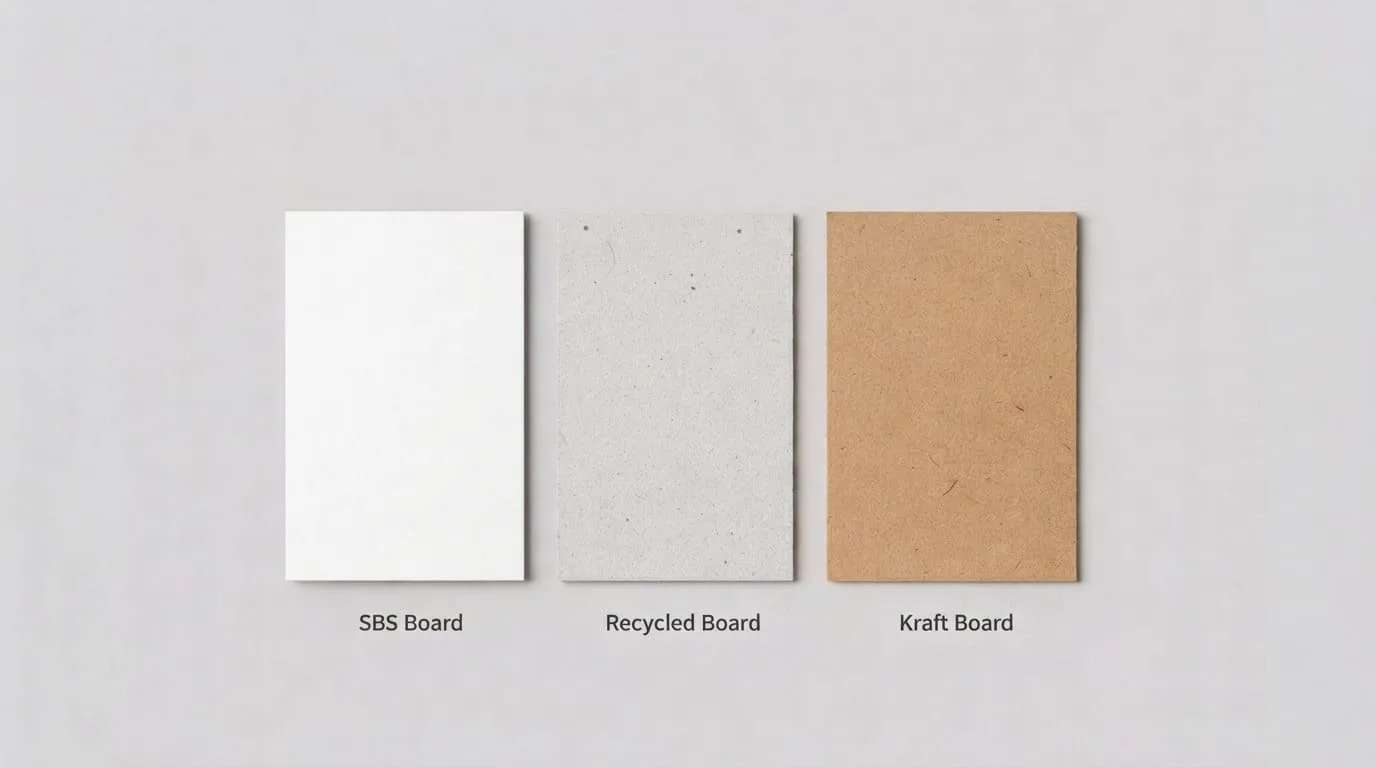
Board Family: SBS vs. Recycled vs. Kraft
The base paper itself sets the tone. Your choice should align with your brand identity and design intent.
| Board Type | Best For | Print Performance | Sustainability Note | Cost Tier |
|---|---|---|---|---|
| SBS / C1S | True luxury, vibrant colors | Excellent color accuracy and detail | Available with FSC certification | $$$ |
| Recycled Board | Strong eco-messaging | Good, but expect slight specks & shade variation | Highest recycled content | $$ |
| Kraft Board | Rustic, natural aesthetic | Mutes colors; best with dark, high-contrast inks | Often unbleached and has recycled content | $ |
For high-end luxury, SBS is the clear winner. For eco-conscious brands, recycled paper is great, but you must define an acceptable tolerance for shade variation with your supplier.
How do you prevent fold cracking and choose the right finish?
You’ve invested in thick, beautiful paper, but the final cards show ugly white cracks along the fold, and the dark matte surface is covered in scuffs.
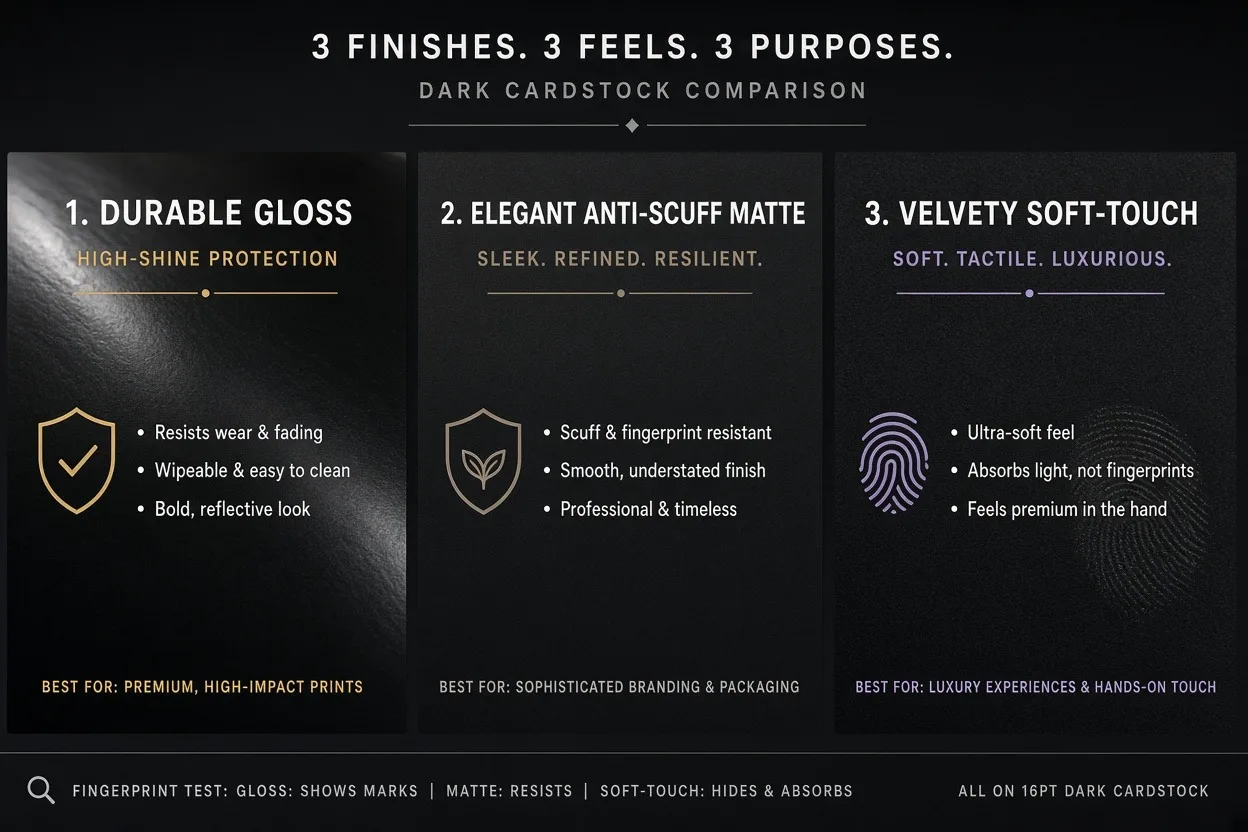
Prevent cracking by scoring the paper with the grain direction parallel to the fold. For finishes, specify an "anti-scuff" matte or soft-touch laminate for dark designs to avoid damage during shipping and handling. A PPS (Pre-Production Sample) is essential for approval.
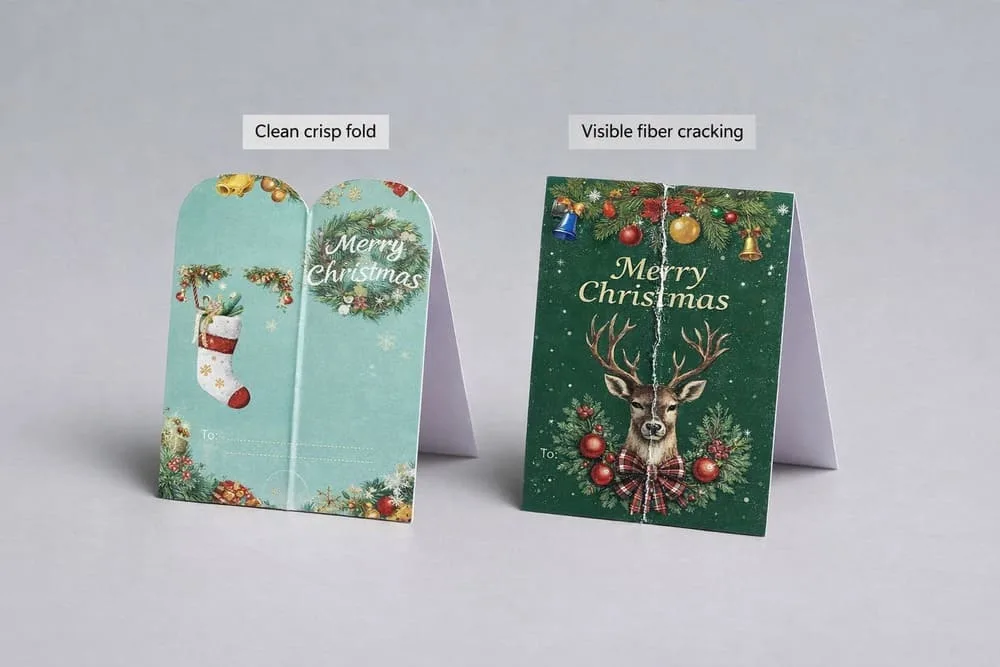
A card’s finish and fold quality are where premium execution truly shows. A single error here can undermine the entire project.
The Unbreakable Rule for Folding
The most common and preventable defect I see is fiber cracking. The solution is simple and has two parts:
- Grain Direction: Paper fibers have a grain. Always fold parallel to the grain. Folding against it breaks the fibers, causing visible cracks.
- Scoring: For any board over 250gsm, scoring (creating a mechanical crease) is not optional. It creates a clean hinge for the paper to fold along. A hand-folded sample does not replicate a production scorer, so always test this on a machine-made PPS.
Finishes: Balancing "Wow" Factor with Durability
The finish gives your card its final look and feel, but it also has to perform.
- Matte & Soft-Touch: These feel luxurious and modern but can be a nightmare for scuffing on dark colors. I always recommend specifying an anti-scuff matte or anti-fingerprint soft-touch laminate. We run a mandatory "rub test" on such designs before mass production.
- Gloss: This finish offers excellent durability and makes colors pop, but can sometimes look less sophisticated for minimalist brands.
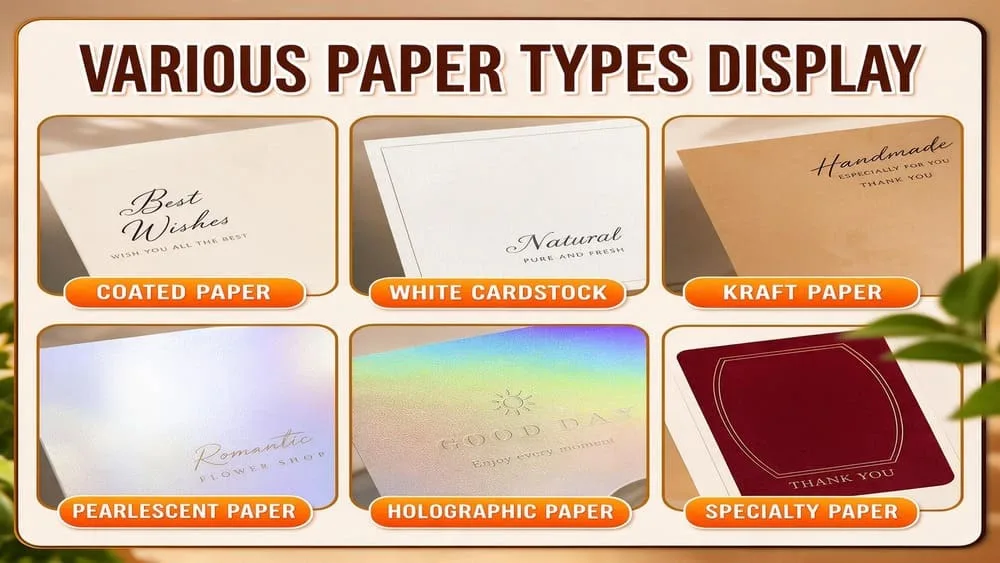
- Premium Effects: Hot foil stamping and embossing add incredible value, but the key is restraint. Use them to highlight a logo or key text, not to cover the card. This keeps costs down and ensures a clean, high-end look.
You’re getting wildly different quotes, facing long lead times, and worried that your reorders won’t match the first batch. Sourcing shouldn’t be a gamble.
To source efficiently, standardize your paper platform to lower costs and MOQs. Ensure quality by qualifying suppliers with a documented QC plan (IQC, IPQC, FQC) and a Golden Sample system for consistency on reorders.

As a factory CEO, I can tell you that the most successful clients are expert planners. They design for manufacturability and hold their partners accountable with clear, documented standards.
Smart Sourcing: Cost & Timelines
The main cost drivers you can control are paper grade, number of finishing steps, and number of unique designs (SKUs). An order for 10,000 cards of one design is far cheaper per unit than 10 designs of 1,000 cards each, due to setup costs.
My advice: create a "brand card platform." Standardize on one paper and finish, then vary the artwork. This allows you to place larger paper orders and streamline production. For timelines, plan for 7–14 days for PPS sampling and 25–45 days for production, adding a buffer for peak seasons. Our Factory Tour page shows the scale of production that makes this planning so important.
The Non-Negotiable QC Plan
A reliable supplier can prove their quality with more than just pretty pictures. Here is a simple checklist you can use.
| Stage | What to Check | Why It Matters |
|---|---|---|
| IQC (Incoming) | Paper GSM, caliper, shade | Catches material variations before production starts. |
| IPQC (In-Process) | Print-to-finish registration, color consistency | Prevents large-scale defects like misaligned foil. |
| FQC (Final) | AQL sampling for defects, count, packing | Ensures the shipped batch meets your quality standard. |
| System | Golden Sample | Your approved PPS becomes the non-negotiable standard for all reorders. |
A supplier who embraces this level of documentation is a partner you can trust to protect your brand. For a deeper look at our approach, visit our guide to Quality Control & Testing.
Conclusion
Creating a premium greeting card is a predictable process when you treat it as a system. Begin with a solid 300–350gsm foundation, specify the right board and finish, control the fold, and partner with a supplier who values documented quality control. This factory-tested approach turns your design vision into a tangible product that delights customers.
Ready to specify your next premium card collection with confidence?
- Request our free Material Swatch Kit to feel the difference between our premium boards.
- Send us your artwork for a complimentary spec recommendation from my team.
- Explore our full range of custom paper card solutions.
FAQs (Frequently Asked Questions)
What GSM is best for premium greeting cards?
The ideal weight for premium greeting cards is between 300gsm and 350gsm. This range offers a substantial, rigid feel that communicates quality without being too thick to fold cleanly or mail easily, when properly scored.
What cardstock is best for writing on inside a greeting card?
C1S (Coated One Side) cardstock is often the best choice. The coated exterior allows for vibrant printing, while the uncoated interior provides an absorbent surface that is perfect for writing personal messages without smudging.
How do you stop cardstock from cracking when folded?
To prevent cracking, the paper’s grain direction must be parallel to the fold line, and the card must be scored (creased) before folding. This is especially critical for cardstock over 250gsm.
Note: Please ensure FAQPage Schema markup is applied to the FAQs section above. If the article contains step-by-step instructions, consider adding HowTo Schema.