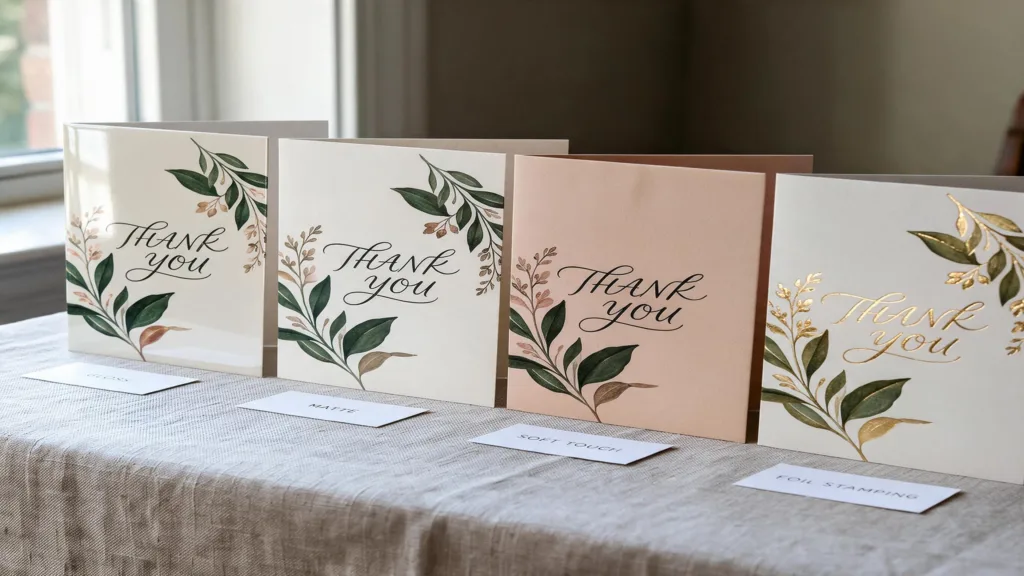
Mood-board greeting card finishes often fail on the factory press. Laminated interiors smudge pen ink, uncalibrated folds crack dark cardstock, and stacked effects blow seasonal budgets. This manufacturing guide explains how to choose the right finish for custom greeting cards.
Buyers choose the right finish for custom greeting cards by pairing 300 to 400 gsm paperboard with one exterior base coating—matte, gloss, or soft-touch lamination—and one hero accent such as hot foil stamping, spot UV, or embossing, while leaving interiors uncoated for smooth handwriting.
Key Takeaways / TL;DR:
- Base Surface Plus One Hero Accent: Packaging developers maximize return on investment by combining one base surface (matte, gloss, or soft-touch lamination) with a single focal treatment (hot foil stamping, spot UV, or blind embossing) rather than stacking competing effects.
- Cardstock Weight and Scoring Rules: Professional greeting cards require 300 to 400 gsm coated, silk, or uncoated art board with calibrated steel-rule crease scoring prior to folding to eliminate spine cracking.
- Exterior-Only Lamination for Writability: Procurement specs must mandate one-sided (C1S) exterior film lamination and an uncoated or light aqueous-coated interior so ballpoint and gel pens write without smearing.
- Amortized Tooling Economics: Hot foil stamping and embossing require custom brass or magnesium dies ($80 to $200 one-time setup), which dilute to under $0.08 per card once order volumes reach 2,000 pieces.
- EU Recyclability and FSC Compliance: Brands selling into European Union and North American retail channels require supplier FSC Chain of Custody certification, EU PPWR recyclability documentation, and verifiable environmental claims under Directive (EU) 2024/825.
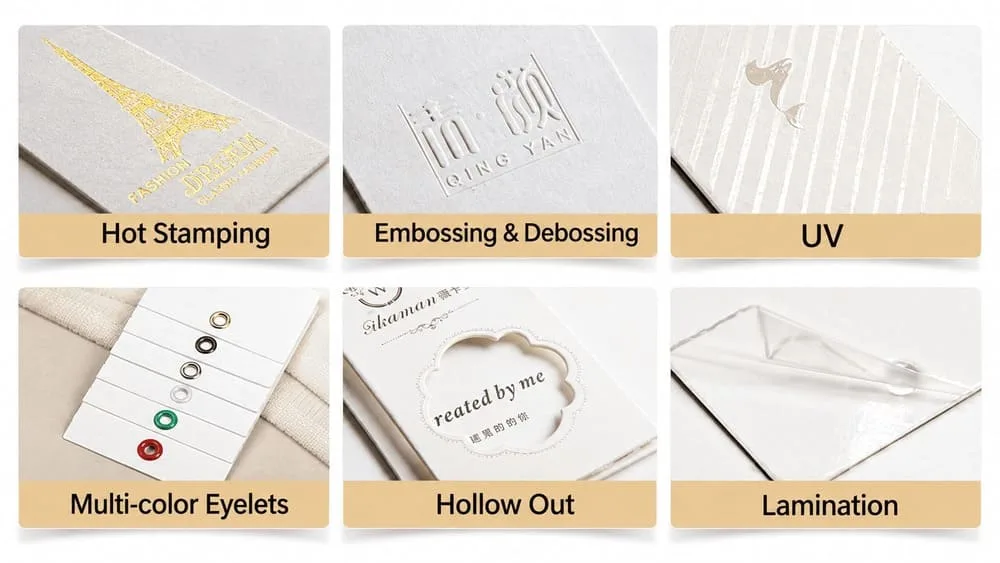
Early in my career on the factory floor in Yiwu, a European stationery publisher sent us artwork for a holiday card line featuring soft-touch lamination on both sides, heavy gold foil, raised spot UV, and deep embossing. The showroom samples looked striking, yet two weeks after delivery, retail buyers complained that customers could not write inside the laminated cards without ink smearing across the page. Worse, tight carton strapping scuffed the velvet coating during ocean transit. Since founding Ometpack in 2013, I have helped global greeting card publishers, corporate gift buyers, and retail brands engineer surface finishes that survive high-speed press runs and international shipping. Below is the exact factory decision framework my team uses to turn creative concepts into production-ready cards.
What Makes a Custom Greeting Card Finish Feel Premium While Staying Manufacturable?
Overcrowded card effects ruin print registration and inflate reject rates. Buyers waste money stacking conflicting surface treatments. Following a two-layer finishing hierarchy delivers retail luxury and press stability.
A custom greeting card finish feels premium when buyers combine tactile paper weight between 300 and 400 gsm, a controlled base surface, and one high-contrast hero accent. Selecting one base lamination plus a single focal technique prevents registration drift and keeps factory rejection rates low.
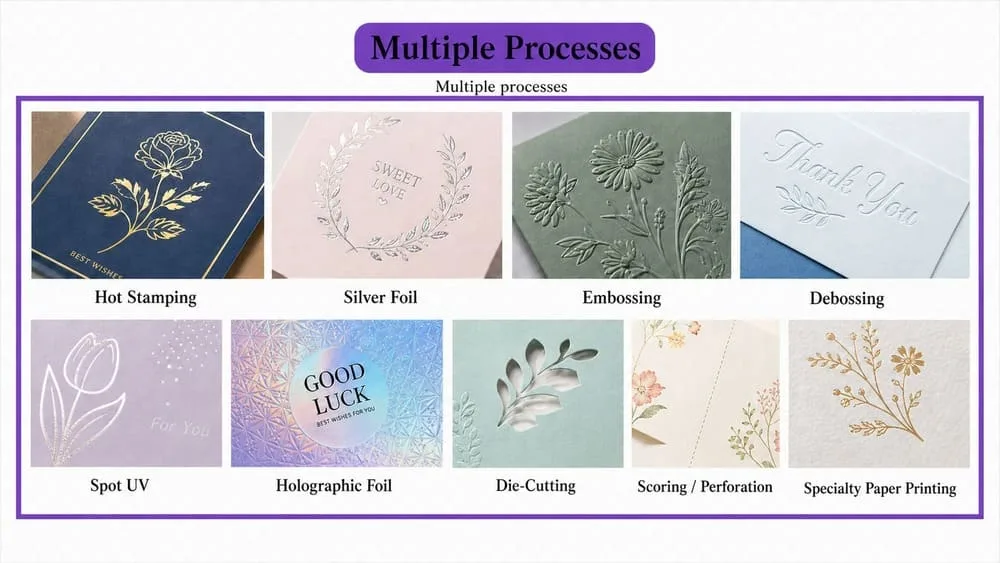
The Two-Layer Finishing Architecture: Base Surface + Hero Accent
When brand managers browse our paper cards resource hub, I always advise them to treat greeting card finishing as a two-step engineering decision rather than an open-ended art project. Every reliable card program separates surface treatments into two distinct functional layers:
- The Base Surface Layer: This layer covers the entire exterior face of the sheet. Options include gloss lamination, matte lamination, soft-touch velvet film, protective aqueous varnish, or raw textured uncoated stock. The base surface controls light reflection, hand-feel, fingerprint resistance, and spine fold durability.
- The Hero Accent Layer: This layer targets 5% to 20% of the front cover—typically the brand mark, seasonal typography, or border illustration. Options include metallic hot foil stamping, high-build spot UV, or blind embossing/debossing.
Stacking three or four hero accents on the same card rarely increases retail shelf value. Instead, every additional press pass introduces mechanical registration tolerances of ±0.2 mm to ±0.5 mm and multiplies setup waste.
Four Production-Safe Finish Stacks by Commercial Use Case
In our Yiwu facility, my team groups custom greeting card orders into four repeatable finish stacks so procurement managers can match unit budgets and retail price tiers without redesigning from scratch every season.
| Commercial Program Stack | Recommended Base Surface | Recommended Hero Accent | Target Retail / B2B Use Case | Relative Cost & QC Risk |
|---|---|---|---|---|
| Brand Hero Stack | 350 gsm silk board + exterior soft-touch film | Metallic gold or silver hot foil stamping | Luxury gift box inserts, VIP corporate holiday cards, boutique retail | Moderate-High cost; requires anti-scuff pack-out |
| Volume Retail Stack | 300–350 gsm C1S art board + matte lamination | High-gloss spot UV over typography or patterns | Supermarket seasonal racks, everyday birthday cards, museum gift shops | Low-Moderate cost; zero metal die fee; fast press speed |
| Quiet Luxury Stack | 350–400 gsm uncoated cotton or textured linen | Multi-level blind debossing or embossing | Wedding suites, architectural stationery, high-end artisanal brands | Moderate cost; requires one-time brass sculpting die |
| Eco-Forward Stack | 300–350 gsm 100% FSC recycled uncoated board | Soy-ink printing + water-based aqueous varnish | Plastic-free European retail programs, sustainable D2C thank-you cards | Lowest unit cost; 100% repulpable in standard paper streams |
Which Base Coating Should Buyers Choose: Matte, Gloss, Soft-Touch Lamination, or Uncoated Paperboard?
Ordering thin paperboard or the wrong surface film cheapens brand perception. Glare hides typography while unsealed dark ink rubs off. Matching cardstock GSM to the right base coating locks in durability.
Buyers choose between matte, gloss, soft-touch lamination, and uncoated paperboard based on visual contrast, tactile hand-feel, and environmental goals. Greeting cards require 300 to 400 gsm paperboard, where gloss boosts photographic vibrancy, matte reduces retail glare, soft-touch adds velvet warmth, and uncoated stock offers natural texture.
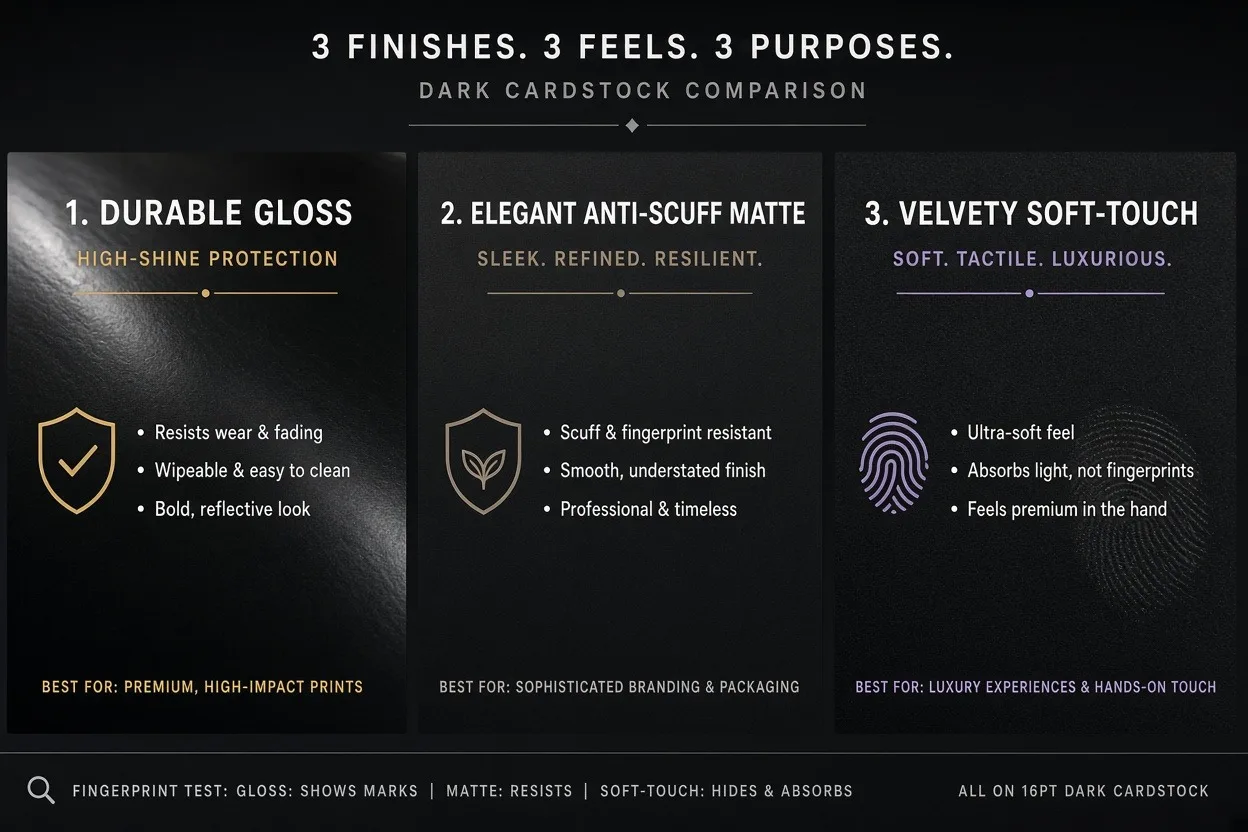
Pairing 300–400 GSM Substrates with Surface Films
Before choosing a coating, buyers must lock in the underlying paperboard basis weight (measured in grams per square meter, or GSM) and caliper thickness. One of the most common specification errors I see from first-time importers is ordering 250 gsm coated paper and expecting the card to stand upright on a customer’s mantelpiece. At 250 gsm, a folded card flexes visibly in the hand and reads as a budget promotional flyer.
For commercial greeting cards, 300 gsm coated one side (C1S) or silk art board serves as the entry-level professional baseline. For luxury retail, corporate gifting, and keepsake cards, my team defaults to 350 gsm to 400 gsm solid bleached sulfate (SBS) board or heavy uncoated art paper. Once the substrate weight is fixed, the base surface determines how light and fingers interact with the printed CMYK or Pantone inks:
- Gloss Lamination (BOPP Film): Amplifies color saturation and deepens black ink density. Ideal for vibrant photographic holiday cards, though high overhead retail lighting can create glare across fine text.
- Matte Lamination: Diffuses harsh retail lighting and gives illustrations a smooth, contemporary satin finish. Matte film serves as the highest-contrast foundation for shiny spot UV or metallic foil overlays.
- Soft-Touch Lamination: Uses a specialized polyurethane or copolymer matte film that feels like peach skin or suede. In our showroom tests, buyers select soft-touch more than any other surface for luxury e-commerce thank-you cards, though dark solid backgrounds require anti-scratch film grades to prevent rub marks.
- Aqueous Coating & Uncoated Stock: Water-based dispersion varnish protects ink against finger smudging without adding a plastic film layer, keeping the card fully repulpable.
| Base Surface Option | Ideal Cardstock Weight | Visual & Tactile Signal | Foil & Spot UV Compatibility | Fingerprint & Scuff Resistance | Municipal Paper Recyclability |
|---|---|---|---|---|---|
| Matte Film Lamination | 300 – 400 gsm Coated/Silk | Low-glare, modern, diffused satin | Excellent high-contrast base for both | High (especially anti-scratch matte) | Film layer limits repulping in strict EU mills |
| Soft-Touch Lamination | 350 – 400 gsm Coated/Silk | Velvet suede hand-feel; mutes dark ink slightly | Outstanding tactile contrast with foil/UV | Resists fingerprints; sensitive to carton friction | Plastic film layer; check local EPR guidelines |
| Gloss Film Lamination | 300 – 350 gsm Coated SBS | High shine, punchy photographic contrast | Poor contrast for Spot UV; accepts foil well | Shows fingerprints on dark solid colors | Film layer limits standard paper mill repulping |
| Aqueous Varnish (Water-Based) | 300 – 350 gsm Coated/Uncoated | Clean natural paper feel; light satin or matte | Accepts foil; moderate contrast for Spot UV | Good rub protection; non-plastic barrier | Widely recyclable in standard EU/US streams |
| Raw Uncoated / Textured Linen | 320 – 400 gsm Art/Cotton | Organic fibrous warmth; artisanal character | Ideal for blind emboss; deep纹理 limits fine foil | Absorbs skin oils if heavily handled | 100% mono-material paper recyclable |
How Do Hot Foil Stamping, Spot UV, and Embossing Compare for Greeting Card ROI?
Adding every special effect inflates tooling fees and slows delivery. Thin foil lines bridge together while flat varnish looks invisible on gloss stock. Comparing accent tooling and contrast maximizes perceived value.
Hot foil stamping delivers the highest metallic luxury signal, spot UV provides selective gloss contrast without metal die fees, and embossing creates dimensional relief. Combining one base matte or soft-touch surface with a single foil or spot UV focal element generates the strongest return on investment for B2B buyers.
Evaluating Tooling Costs, Minimum Line Weights, and Substrate Match
When procurement teams review our materials, printing, and finishes guide, they often ask whether hot foil, spot UV, or embossing delivers better shelf appeal per dollar spent. Each process operates on different mechanical principles on our factory floor:
- Hot Foil Stamping: A heated metal die presses pigmented or metallic polyester foil onto the board under several tons of pressure. For short runs with simple edges, etched magnesium or copper dies work well; for long runs, fine serifs, or repeat seasonal SKUs, CNC-engraved brass dies ($80 to $200 one-time cost) maintain razor-sharp edges across tens of thousands of impressions. Avoid specifying positive foil lines thinner than 0.25 mm (0.7 pt) or reverse knockouts narrower than 0.4 mm to prevent foil bridging.
- Spot UV and 3D Raised UV: Screen-printed or digitally jetted photopolymer varnish is cured instantly under ultraviolet lamps. Because digital and screen spot UV do not require engraved metal dies, buyers eliminate upfront tooling fees on small 250 to 500-piece runs. Spot UV must be applied over a matte or soft-touch base; applying gloss spot UV over gloss lamination produces almost zero visual contrast.
- Blind Embossing and Debossing: A mated pair of male and female metal dies presses the paper fibers into a raised (emboss) or recessed (deboss) three-dimensional sculpture. Embossing performs best on long-fiber 350 to 400 gsm uncoated or cotton stocks that stretch without tearing; keep in mind that embossing leaves a mirror-image indentation on the inside cover unless the card uses a duplex laminated construction.
Why Foil Tooling Pays Back Rapidly After 1,000 Units
In our Yiwu facility, the most frequently reordered specification across our custom greeting card clients is 350 gsm silk board with exterior soft-touch lamination and a gold hot-foil logo. A one-time $120 brass foil die adds $0.24 per card on a 500-piece test order, but drops to just $0.06 per card at 2,000 pieces—and $0.00 on every reorder because we archive client dies in our tool room.
| Hero Accent Process | Primary Sensory Cue | One-Time Tooling Setup | Unit Run Cost Premium | Minimum Artwork Line Width | Best Base Surface Pairing |
|---|---|---|---|---|---|
| Hot Foil Stamping | True mirror-metallic or holographic reflection | $80 – $200 (Brass/Copper die) | +$0.03 – $0.10 / pc | 0.25 mm positive / 0.4 mm reverse | Soft-touch film, matte film, smooth uncoated |
| Flat or 3D Spot UV | High-contrast gloss shine (and raised texture for 3D) | $0 – $60 (Digital or screen frame) | +$0.02 – $0.07 / pc | 0.30 mm positive line | Matte lamination or soft-touch lamination only |
| Blind Emboss / Deboss | Pure sculptural tactile depth without ink | $90 – $220 (Male/female metal die set) | +$0.03 – $0.08 / pc | 0.50 mm relief stroke width | 350–400 gsm uncoated, cotton, or textured linen |
| Foil + Emboss Combo | Raised metallic relief in a single press strike | $150 – $300 (Precision sculpted brass die) | +$0.05 – $0.12 / pc | 0.40 mm positive stroke | Smooth 350+ gsm silk or uncoated art board |
| Laser Cut / Filigree | Intricate cut-out windows and lace patterns | $0 (Digital laser path file) | +$0.15 – $0.60+ / pc (speed dependent) | 0.80 mm minimum paper bridge | 300–350 gsm rigid uncoated or pearl board |
How Do Surface Finishes Affect Interior Writability, Spine Scoring, and Card Formats?
Double-sided film lamination blocks pen ink and ruins handwritten notes. Heavy coated cardstock also cracks ugly white lines along the fold. Engineering interior coatings and crease depth protects user experience.
Film lamination and heavy UV coatings seal paper pores and cause ballpoint or gel pen ink to smear across greeting card interiors. Buyers preserve writability by specifying one-sided (C1S) exterior lamination with an uncoated interior, while calibrating steel-rule scoring depth to prevent spine cracking on 300+ gsm folds.
The Exterior-Only (C1S) Rule for Handwritten Personalization
A greeting card fails its primary job if the sender cannot write a personal message inside without smudging ink onto the opposite page. BOPP matte, gloss, and soft-touch films create a non-porous plastic barrier that rejects water-based gel pens, rollerballs, and fountain pens.
Corporate and retail buyers frequently approve a striking double-sided soft-touch sample in the boardroom, only to discover during packing that staff signatures smear right off the inside panel. At Ometpack, when we engineer custom greeting cards and gift packaging solutions, my prepress team enforces an Exterior-Only Finishing Rule unless the card carries pre-printed messages only:
- Specify C1S (Coated One Side) Paperboard or apply film lamination strictly to the outer cover sheet before die-cutting.
- Leave the interior spread completely uncoated, or apply a specialized writable matte primer if inside background ink coverage exceeds 30%.
- Leave a clean white or lightly tinted quiet zone on the inside right panel, and test the preproduction sample with standard ballpoint, gel, and felt-tip pens for a 10-second dry time.
Preventing Spine Cracking Across Standard Card Sizes (A7, A6, A5, DL, Square)
The single most common revision request we handle during physical sampling is spine cracking along the center fold on heavy dark-colored cards. When 350 gsm coated board laminated with film is folded directly without proper preparation, surface fibers stretch beyond their elastic limit and expose a jagged white paper core along the spine.
In our factory, every greeting card above 250 gsm goes through a dedicated steel-rule creasing matrix before folding. We calibrate the scoring channel width and blade depth to the exact caliper of the laminated board, and align the paper grain direction parallel to the fold spine so fibers bend smoothly rather than snapping across the grain.
| Standard Card Format | Folded Dimensions (mm / inches) | Open Flat Dimensions (mm) | Primary Commercial Application | Scoring, Grain & Envelope Engineering Rule |
|---|---|---|---|---|
| A7 Mini / Enclosure | 74 × 105 mm (approx. 3 × 4 in) | 148 × 105 mm (or flat) | Florist bouquet cards, luxury gift box inserts | Often produced flat on 350 gsm C1S; no fold required |
| A6 Standard Retail | 105 × 148 mm (4.1 × 5.8 in) | 210 × 148 mm | Everyday retail greeting cards, thank-you notes | Mandatory 1-line steel score; pair with C6 (114 × 162 mm) envelope |
| 5 × 7 Inch (US Standard) | 127 × 178 mm (5.0 × 7.0 in) | 254 × 178 mm | North American holiday, birthday & wedding mainstream | Grain must run parallel to 178 mm spine; fits A7 US envelope |
| A5 Statement / Corporate | 148 × 210 mm (5.8 × 8.3 in) | 296 × 210 mm | VIP corporate milestones, large photo holiday cards | Requires 350–400 gsm board to prevent large panel bowing; C5 envelope |
| Square Boutique | 148 × 148 mm (5.8 × 5.8 in) | 296 × 148 mm | Modern fashion brand lookbooks, boutique stationery | Check postal surcharge rules in destination market for square envelopes |
| DL Tall Executive | 99 × 210 mm (3.9 × 8.3 in) | 198 × 210 mm | Formal corporate invitations, gift voucher holders | Long 210 mm spine requires deep precision crease to sit flat in carton |
How Can Brands Combine Multiple Finishes Without Wrecking Print Registration or Adhesion?
Overlapping foil and UV varnish causes flaking and misaligned halos. Flattened PDF files confuse press operators and delay sampling. Sequencing finishes properly guarantees razor-sharp multi-process alignment.
Brands combine multiple greeting card finishes safely by following strict press sequencing: offset printing first, base film lamination second, hot foil or spot UV third on separated zones, and embossing last. Designers must supply layered vector artwork with dedicated spot-color channels and allow 0.3 mm registration tolerance between processes.
The Mandatory Factory Press Sequence and Adhesion Rules
When a card design includes CMYK printing, lamination, foil stamping, and embossing, the order in which sheets travel across our automated printing, foil stamping, and die-cutting production lines in Yiwu determines whether the finishes bond permanently or peel off in the customer’s hand.
My production engineers follow four strict physical compatibility rules:
- Print → Laminate → Accent → Cut/Score: Offset CMYK or Pantone inks always go down first and cure for 24 hours before thermal or wet film lamination. Lamination protects the ink and provides a smooth foundation for secondary finishes.
- Never Overlap Spot UV and Hot Foil on the Same Element: UV varnish cures into a cross-linked plastic shell that blocks hot-foil adhesives from bonding, while stamping foil first and coating UV over top causes the UV varnish to bead up and flake off the slick metallic surface. Keep at least a 1.0 mm gap between foil and spot UV elements.
- Use Dyed Film Grades for Multi-Step Adhesion: Standard low-cost BOPP lamination uses slip additives that can cause foil edges to lift. Specify dyne-tested corona-treated matte or soft-touch film (minimum 38 to 40 dynes/cm surface tension) whenever foil or spot UV goes over lamination.
- Combine Foil and Embossing into One Combination Brass Die: If a brand wants a raised metallic gold emblem, running foil on one machine and embossing on a second machine guarantees slight registration halos. Instead, our toolmakers engrave a single sculpted brass combination die that stamps the foil and embosses the relief in one simultaneous press strike.
Prepress File Engineering That Eliminates Sampling Delays
Most "impossible" multi-finish cards that arrive at our quoting desk are actually file-preparation issues. Designers frequently send flattened marketing PDFs where the foil logo is baked into the CMYK artwork. To prevent ink edge bleeding out from underneath metallic foil if the press shifts by 0.2 mm, our prepress team separates every finish onto a dedicated 100% K (black) vector spot layer and knocks out (or slightly traps) underlying heavy dark inks beneath large foil blocks.
| Finish Combination Pair | Technical Feasibility | Primary Production Risk | Mandatory Prepress & Factory Rule |
|---|---|---|---|
| Soft-Touch Lamination + Hot Foil | Excellent (Industry Gold Standard) | Foil edge flaking if film surface tension is too low | Use corona-treated soft-touch film (≥38 dynes); select film-grade foil adhesive |
| Matte Lamination + Spot UV | Excellent (High Visual Contrast) | UV orange-peel texture over uncured dark CMYK ink | Cure offset ink 24h before laminating; keep UV 2 mm away from fold score lines |
| Hot Foil + Blind Embossing | High (Requires Precision Setup) | Misregistration halo between metallic edge and raised bevel | Use a single CNC-sculpted brass combination die for simultaneous strike |
| Hot Foil + Spot UV (Adjacent) | Good (Separated Zones Only) | Varnish flaking or foil blistering if layers overlap | Maintain ≥1.0 mm clear separation between FOIL_LAYER and UV_LAYER vectors |
| Soft-Touch Film + Deep Emboss | Moderate (Process Sensitive) | Excess heat and sharp bevels can stretch or whiten matte film | Use rounded bevel dies; press-test temperature and dwell pressure on final lot |
| Gloss Lamination + Spot UV | Not Recommended | Zero visual contrast (gloss varnish on gloss film disappears) | Switch base layer to matte or soft-touch film to make Spot UV pop |
What Drives Custom Greeting Card Finishing Costs, MOQs, and Peak-Season Lead Times?
Comparing unit prices while ignoring metal die fees skews procurement budgets. Small bespoke runs suffer high setup overhead and holiday bottlenecks. Itemizing tooling, pass counts, and MOQ tiers protects margins.
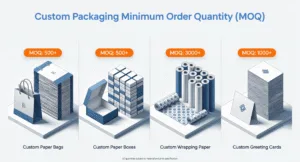
Custom greeting card finishing costs, minimum order quantities, and lead times depend on paperboard GSM, base film selection, number of special finishing passes, metal die tooling, and pack-out complexity. Standard factory MOQs start between 500 and 1,000 pieces per design, with mass production taking 10 to 20 working days after sample sign-off.
Itemizing Setup Tooling vs. Variable Per-Pass Run Costs
No single global price index governs custom greeting card finishes because factory pricing splits into fixed setup fees (plates, metal dies, machine make-ready) and variable run costs (paper weight, film square footage, foil consumption, press speed). When buyers request quotes for our custom paper cards, tags, and stickers, I break down the exact cost levers so procurement teams can see how volume dilutes fixed tooling:
- Paperboard & CMYK Printing: Upgrading from 300 gsm to 350 gsm FSC silk board adds modest material weight cost, while printing 40 cards up on a large-format offset sheet keeps base printing pennies per unit above 1,000 pieces.
- Lamination Pass: Matte and gloss BOPP films add minimal unit cost; specialized anti-scratch soft-touch film costs roughly 2 to 3 times more per square meter in raw film material than standard matte BOPP.
- Each Special Finishing Pass: Every time pallets move from the offset press to the hot-foil stamper, screen UV line, or die-cutter, operators spend 45 to 90 minutes locking in registration and wasting 50 to 100 setup sheets. Removing one redundant pass saves far more money than downgrading cardstock weight.
- Ganging Multi-SKU Assortments: If a publisher sells a box of 8 seasonal designs that share the exact same 350 gsm stock, A6 dieline, and matte lamination, we gang all 8 designs onto a single offset press sheet—allowing buyers to hit bulk paper economies while keeping per-design quantities low.
Realistic Factory MOQs and Seasonal Production Calendars
Negotiating fractions of a cent on paper rarely saves as much as locking in seasonal production schedules early. For Q4 Christmas and Valentine’s Day programs, European and North American buyers should approve physical preproduction samples 90 to 120 days ahead of retail launch to accommodate ocean transit.
| Cost / Schedule Component | Basic CMYK + Matte/Gloss Card | Mid-Tier Soft-Touch + Spot UV Card | Luxury Soft-Touch + Foil + Emboss Card | Buyer Optimization Lever |
|---|---|---|---|---|
| Typical Factory MOQ | 500 – 1,000 pcs per SKU | 500 – 1,000 pcs per SKU | 1,000 – 2,000 pcs (to amortize brass dies) | Gang 4–8 artwork designs on one master sheet with shared dieline |
| Fixed Tooling Setup | $0 (Standard rectangle dieline) | $0 – $50 (Digital/screen UV setup) | $120 – $280 (Foil + Emboss brass dies) | Reuse archived brass logo dies across seasonal reorder runs |
| Indicative Ex-Factory Unit Tier | Baseline (1.0x reference index) | ~1.25x – 1.45x baseline unit cost | ~1.60x – 2.20x baseline unit cost | Keep foil area compact (<15% cover) to reduce foil roll waste |
| Physical Sampling Lead Time | 5 – 7 working days | 6 – 8 working days | 7 – 10 working days (includes die engraving) | Submit layered 300 dpi CMYK + vector spot files at first brief |
| Mass Production Lead Time | 7 – 12 working days | 10 – 14 working days | 12 – 18 working days (multi-pass + curing) | Lock holiday purchase orders before October pre-CNY peak rush |
Do Custom Greeting Cards Require FSC Certification, EU PPWR Recyclability, or Green Claims Compliance?
Plastic film lamination and vague eco-labels trigger European regulatory penalties. Unverified forest claims stall supermarket vendor onboarding. Auditing FSC Chain of Custody and EU packaging rules secures market access.
Custom greeting cards sold in European Union and North American retail channels require verifiable FSC Chain of Custody fiber certification, compliance with the EU Packaging and Packaging Waste Regulation (EU) 2025/40 for card wraps and envelopes, and substantiated environmental claims under Directive (EU) 2024/825 banning generic eco-friendly labels.

FSC Chain of Custody vs. Finished Card Recyclability
Compliance teams at major European and US retailers now demand documentation packs before approving creative finishes. Buyers must distinguish between responsible fiber sourcing and end-of-life recyclability:
- FSC Chain of Custody (CoC): A greeting card publisher cannot legally print the FSC logo on a card or claim "FSC-certified board" on retail packaging unless the printing and converting factory holds an active FSC Chain of Custody certificate (Source: Forest Stewardship Council Chain of Custody Standards). Always verify the manufacturer’s exact FSC license code on the public FSC database rather than accepting verbal claims.
- EU Packaging and Packaging Waste Regulation (PPWR): Regulation (EU) 2025/40 entered into force in February 2025 and generally applies from 12 August 2026 (Source: EU Packaging and Packaging Waste Regulation (EU) 2025/40). While a greeting card itself is often classified as a stationery product depending on use case, the outer cello sleeve, mailing envelope, gift box, or retail belly band is regulated packaging subject to Extended Producer Responsibility (EPR) registration and 2030 recyclability performance grades. Furthermore, if a card functions as a luxury e-commerce packaging insert, heavy BOPP plastic film lamination can complicate mono-material paper recyclability audits.
Under the EU Empowering Consumers for the Green Transition Directive—Directive (EU) 2024/825, applying from 27 September 2026—brands are prohibited from printing generic environmental claims such as "eco-friendly," "green," or "sustainable" on cards or packaging without verifiable proof, and self-created sustainability badges are banned (Source: EU Empowering Consumers for the Green Transition Directive (EU) 2024/825).
At the same time, European greeting card retailers have largely phased out single-use OPP plastic polybags in favor of naked cards held together with removable paper card clasps ("nested envelopes") or glassine paper bands. Because Ometpack maintains audited Ometpack’s FSC, BSCI, and EUDR/EPR compliance certifications, my team supplies full pulp traceability files under EU Deforestation Regulation (EUDR) due-diligence guidelines alongside BSCI social audit reports so buyers clear retail vendor onboarding smoothly.
| Regulatory / Retail Standard | Jurisdiction & Timeline | Impact on Greeting Card Finish & Packaging | Factory Documentation Required |
|---|---|---|---|
| FSC Chain of Custody (CoC) | Global Retail Baseline (Active) | Mandatory if printing FSC trademark on card back or envelope | Active factory FSC CoC certificate number + FSC claim on commercial invoice |
| EU PPWR (Reg (EU) 2025/40) | European Union (Applies Aug 12, 2026) | Envelopes, retail sleeves, and packaging inserts must meet recyclability & EPR rules | Material composition breakdown (paper weight vs coating/film weight %) |
| EmpCo Green Claims (Dir 2024/825) | European Union (Applies Sep 27, 2026) | Bans vague "eco-friendly" text on card backs; requires specific verified claims | Certified recycled content % or valid FSC license claim verification |
| EUDR Wood Pulp Due Diligence | European Union (Reg (EU) 2023/1115) | Standalone imported paper goods under covered CN codes require deforestation-free proof | Botanical wood species, harvest country, and mill geolocation declarations |
| BSCI / Ethical Labor Audit | EU & North American Chain Retailers | Mandatory social compliance gate for supermarket and department store tenders | Current valid amfori BSCI audit report from the converting factory |
How Should Procurement Teams Brief a Factory and Prevent Scuffing During Mass Pack-Out?
Showroom-perfect soft-touch cards often arrive scuffed from ocean freight vibration. Approving digital mock-ups without physical proofs causes costly color disputes. Enforcing prepress briefs and anti-scuff pack-out protects bulk quality.
Procurement teams prevent mass-production defects by submitting a 5-part technical brief, signing off on a physical preproduction sample on final cardstock, and specifying engineered pack-out with tissue interleaving and controlled bundle pressure. Treating carton packing as a quality control step stops soft-touch scuffing and corner crushing during transit.
Why Pack-Out Engineering Determines Soft-Touch Survival
On our production lines, the finish that still looks intentional after 35 days of ocean freight vibration is the only finish that counts. Soft-touch lamination and heavy dark matte coatings have high surface friction. If a warehouse crew stacks 100 soft-touch cards tightly together, straps them with hard polypropylene bands, and leaves 2 cm of empty void space inside the shipping carton, constant micro-vibration on a container ship rubs the cards against each other—creating shiny scuff patches right across the front cover.
In our Yiwu factory, packing discipline prevents more soft-touch complaints than any coating chemistry change. For dark matte, soft-touch, and deep-embossed greeting cards, my QC engineers build pack-out rules directly into the manufacturing specification:
- Acid-Free Tissue Interleaving: Insert a sheet of smooth 17 gsm acid-free tissue paper between every dark soft-touch or heavily embossed card face to eliminate card-to-card friction.
- Low-Tension Paper Belly Bands or Shrink Film: Bundle cards in small stacks of 10 to 25 units with matched envelopes using wide paper bands or controlled-tension poly bags with chipboard top-and-bottom stiffeners so edges never bite into the card spine.
- Zero-Void Seaworthy Master Cartons: Pack inner boxes tightly inside 5-ply double-wall corrugated export cartons lined with a sealed PE moisture barrier bag, silica gel desiccant, and rigid pallet corner boards.
The 10-Point Pre-Order Finish & QC Specification Checklist
Before authorizing bulk production—whether ordering standalone cards or matching them with rigid boxes and carrier bags from our complete luxury gift packaging solutions and gift packaging catalog—buyers should lock in the 10-point specification table below and retain a physically signed golden sample.
| Specification Parameter | Required Buyer Input in RFQ Brief | Factory QC Inspection Method | Acceptance Tolerance / Standard |
|---|---|---|---|
| 1. Base Paperboard Stock | Exact GSM (e.g., 350 gsm), caliper (mm/pt), grade (C1S/Silk/Uncoated), FSC status | Electronic GSM scale & micrometer caliper gauge | Within ±3%–5% GSM; verified FSC CoC batch code |
| 2. Print Color Reference | CMYK profile + Pantone (PMS) spot codes for brand marks | X-Rite spectrophotometer & D50 light booth check | Color deviation ΔE ≤ 2.0–3.0 against signed proof |
| 3. Base Surface & Sides | Film/coating type (Matte/Gloss/Soft-Touch/Aqueous) + C1S Exterior Only | Visual check + interior ballpoint/gel pen write test | Zero ink smearing on interior after 10-second dry time |
| 4. Hero Accent Layer File | Separate 100% K vector spot layers (FOIL, SPOT_UV, EMBOSS, DIELINE) |
Prepress overlay check + steel ruler registration gauge | Accent-to-print registration drift ≤ ±0.25 mm |
| 5. Foil / UV Adhesion | Metallic foil shade code or UV build height (flat vs 3D raised) | 3M 600 tape cross-hatch pull test & fingernail scratch check | Zero foil flaking, bridging, or UV edge peeling |
| 6. Score & Fold Integrity | Folded size (e.g., A6 105×148 mm), grain parallel to spine, score channel depth | 180-degree full crease fold check on 20 random sheets | Zero white fiber cracking along dark folded spine |
| 7. Envelope Pairing | Envelope size (e.g., C6), paper GSM (120–140 gsm), seal type (gummed/peel-and-seal) | Physical insertion test with folded card + clasp check | Card slides smoothly with 3–5 mm clearance per side |
| 8. Preproduction Sign-Off | Mandatory physical Preproduction Sample (PPS) on final stock + film + die | Counter-signed Golden Sample kept on press & QC table | Bulk run must match signed physical PPS (never screen RGB) |
| 9. Anti-Scuff Pack-Out | Interleaving tissue spec, bundle count (10–25 pcs), retail clasp vs OPP bag | Carton drop test & 60-stroke carton vibration rub simulation | Zero surface rub marks, corner dents, or strap indentation |
| 10. Final AQL Audit | AQL inspection standard (typically General Inspection Level II: Critical 0, Major 1.5, Minor 4.0) | Pre-shipment random sampling report with high-res photos/video | Batch passes AQL thresholds prior to balance payment & dispatch |
Conclusion
Choosing the right finish for custom greeting cards requires balancing tactile shelf appeal with press-floor physics. By pairing 300 to 400 gsm FSC paperboard with an exterior-only base surface, one high-ROI focal accent, calibrated spine scoring, and anti-scuff pack-out, brands deliver retail-ready cards that survive transit and delight recipients.
Ready to test how different finishes look and feel on your own artwork? Contact Ometpack today to request a Free Custom Greeting Card Finish Sample Kit—including 350 gsm soft-touch, matte, hot gold foil, 3D spot UV, and blind embossed swatches—or send us your dieline and specifications for a detailed 24-hour factory quote. You can also explore our full line of custom paper cards, tags, and stickers to coordinate matching envelopes, gift tags, and retail packaging under one roof.
To further streamline your next production run, check out our related technical guides on preparing print-ready packaging artwork and dielines and packaging quality control and pre-shipment testing protocols.
FAQs
What paper weight (GSM) is best for custom greeting cards?
Professional custom greeting cards require a minimum paper weight of 300 gsm so the folded card stands upright without flexing. Luxury retail publishers, wedding stationery brands, and corporate gift buyers typically specify 350 gsm to 400 gsm silk art board, C1S paperboard, or uncoated cotton stock for superior rigidity and embossing depth.
Can you write with a pen on matte or soft-touch laminated greeting cards?
Standard ballpoint, gel, and rollerball pens smear and fail to dry on matte, gloss, or soft-touch BOPP film lamination because plastic film seals the paper pores. Buyers must specify one-sided (C1S) exterior film lamination and leave the interior spread uncoated so recipients can write personalized messages cleanly.
What is the difference between hot foil stamping and spot UV on greeting cards?
Hot foil stamping uses a heated brass or copper die ($80 to $200 setup fee) to bond opaque metallic or pigmented polyester foil onto cardstock for true mirror reflection. Spot UV applies a clear high-gloss polymer varnish cured under ultraviolet light to create shiny contrast over matte lamination without metal die fees.
Do custom greeting cards need FSC certification for European and US retail?
Major European Union and North American retail chains require FSC-certified paperboard for custom greeting cards and envelopes to prove deforestation-free fiber sourcing. To print the official FSC trademark on finished cards legally, the manufacturing factory itself must hold an active FSC Chain of Custody (CoC) certification.
What is the minimum order quantity (MOQ) and lead time for custom greeting cards from China?
Specialized Chinese packaging factories typically accept minimum order quantities of 500 to 1,000 pieces per design for custom finished greeting cards, or 1,000 to 2,000 pieces to amortize custom brass foil and embossing dies economically. Physical preproduction sampling takes 5 to 10 working days, followed by 10 to 18 working days for mass production.